Showing posts with label Good Friday. Show all posts

Friday, April 22, 2011

Being There

Johnny Cash and Russ Taff have trembling, earth-shaking voices. So when they sing "Were You There?" - the Good Friday-through-Easter spiritual - you can't help but tremble and shout alongside them.


But my daughter has been singing it recently. She doesn't have the gravitas of voice, of course. She's only three, so her little high, girlish falsetto hasn't begun to develop, much less into something that she could know how to control.

But it's the fact that it's her, my little mortal princess, my darling, the little girl who comes to sleep with us in the middle of every night. This little girl who we sometimes struggle with to get her to take her three-times daily life-saving treatments. This little one who, today, I figured wears full-body pajamas that have as much cotton as my t-shirts. It's the fact that it's her whom I touch and hold and gives me besos and huggies that sings these lines that makes this song immediate and tangible and transcendent for me.

It's her that embodies something very close and personal and wonderful and scary about the rhythms of life and death and life again in ways that are new and earth-shattering for me.

Somehow, though she doesn't quite understand the gravitas of the two thousand year old mystery of the death and resurrection of a Jewish prophet/homeless teacher, man/God, she conveys it to me in simply profound, understated, and relational ways.

Thank you, Jesus.

Friday, April 06, 2007

Gooood Friday, World!*

From The Gospel According to Matthew, Chapter 27, beginning in verse 27:

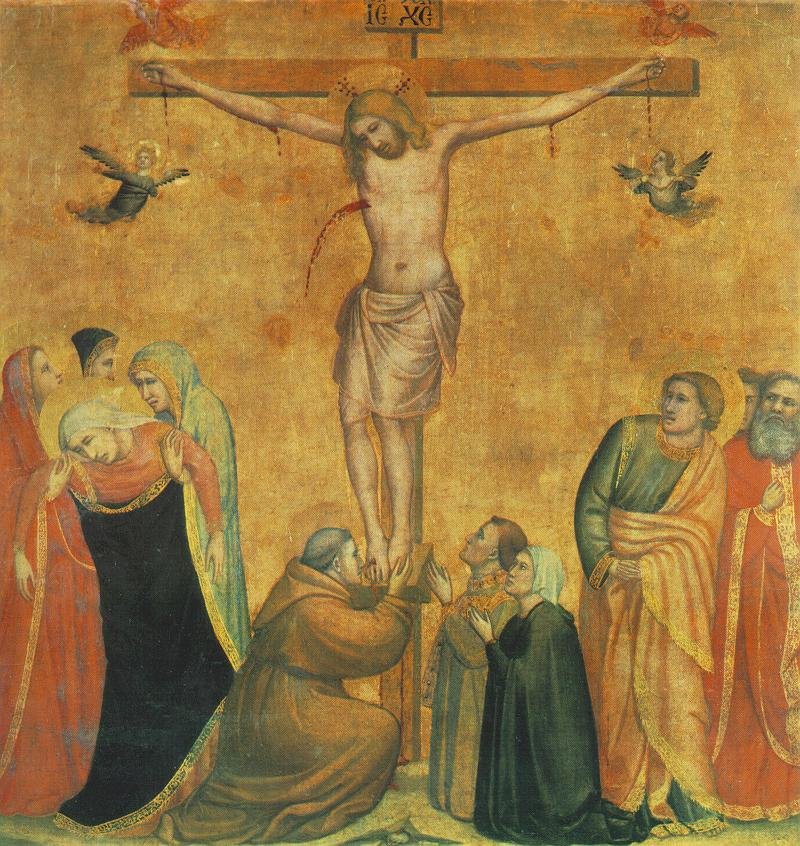
Some of the governor's soldiers took Jesus into their headquaters and called out the entire regiment. They stripped him and put a scarlet robe on him. They wove thorn branches into a crown and put it on his head, and they placed a reed stick in his right hand as a scepter. Then they knelt before him in mockery and taunted, "Hail! King of the Jews!" And they spit on him and grabbed the stick and struck him on the head with it. When they were finally tired of mocking him, they took off the robe and put his own clothes on him again. Then they led him away to be crucified.**

The type of new covenant that Jesus was sharing in stories and proclamations with his people - first century Jews - was expressed as the coming of a kingdom. The Kingdom of Heaven/God. It's upon you, he would say; it's like a returning, like a coming back from exile, like a homecoming for a wayward son; it starts out small and will grow like a huge tree where all the birds can nest; it's a party for the poor, diseased, crippled, vagrants, prostitutes and anyone else that wants in; it will be like the end of this world, and the beginning of a new one; it'll be cosmic, on the scale 0f stars falling from the sky and the sun turning red; every knee will bow to the King - including, by inference, Caesars, governors and provincial rulers like Herod and Pontius Pilate.

Many Jews loved this part of the story, including - maybe especially - the Pharisees. They were anticipating it even, trying to purify themselves and their country of infidelity (sound familiar?) to prepare the way of the Lord. They were looking forward to the fulfillment of Isaiah's prophecy, to the perfection of the Word. What the leaders found so unnerving is that this utterly powerless, homeless, seemingly passive (turn the other cheek, the violent try to take it by force, etc.) was declaring that the Kingdom would happen through him. He referenced himself as the Son of God and the Temple. It was obvious he was taking away from their base of power by his miracles and food and stories and wisdom.

So, the leaders (the usually feuding Pharisees and Sadducees - who weren't so happy about upsetting the Roman power structure as the Pharisees - as well as priests, scribes, etc.) came up with a plan. They captured Jesus and brought him to the Roman government. They then charged him with a half-truth: This man is an insurrectionist by claiming that he is the King of the Jews. According to the account given in the Gospel According to John, when Pilate tried to release the popular man, the leaders countered that Jesus' claims to be the King of the Jews was a threat to the power of Caesar. In this, they were correct.

In fact, though, today as I looked over the passage in Matthew 27, I was struck by how little that threat meant to the occupying forces. They weren't just mocking Jesus by calling him and enacting scenes with him, on the cross and in his torture, the "King of the Jews." They were mocking the Jews and their supposedly backward nation, as well as all that they held dear (to my ears, though, I hear traces of Abu Ghraib). Over the next several generations, the Romans would tear apart the land of the Jews and scatter them. But now those who watched over the land (as occupying forces are wont to do) felt little more than contempt for such a puny, little, insignificant, backwards nation that truly believed they were better than anyone else.

The Jews knew this claim to be a massive threat, however, because they believed the promise given to Abraham at the beginning of the old covenant: I will bless you and make you famous, and you will be a blessing to others... All the families on earth will be blessed through you (Genesis 12:2,3). This promise would be repeated and expounded upon in the prophets.

And the saga continues...

*My caveat is that I do not wish for anti-Semitism (or anti-any other people group) or any other such misunderstanding or misinterpretation. Such things are immoral and against the spirit of the whole of the Bible and of the God I worship. With that being said, I'm not trying to offend anyone or make anyone feel threatened or even exclude anyone, but I believe that more illumination is needed, not just hollow political correctness.

**New Living Translation, thank you very much.

Friday, April 14, 2006

Some more meditations on Good Friday and Easter:

EASTER is not the celebration of a past event. The alleluia is not for what was; Easter proclaims a beginning which has already decided the remotest future. The Resurrection means that the beginning of glory has already started.

Karl Rahner, Everyday Faith
courtesty Christianity Today.

-------

Jesus's death was not only physical, as noted earlier, but also spiritual. I'm not a theologian, I don't have a clue as to whether or not he went to hell for a day. Or how else Jesus would've preached to the souls in prison, as testified in one of the latter epistles (I think Jude's). But I was able to glean a bit into the suffering of Jesus, why he would agonize so much over the cup he was to drink (more on that later), asking that that should pass from him.

A few years ago, my associate pastor decided he wanted to dramatize the Life and Death of Jesus as a one-act wordless play. He and I worked on much of the dramatization together. One thing that struck us, that we tried to dramatize, as silently as possible (with the sole exception being one of the last words of Christ) was his connection and then rejection by God the Father, and how utterly cold and alone he must have felt on that "Dark Night of the Soul."

Jesus was a human being, as we mentioned earlier, but he was intimately connected with his Holy Father, the first person of the Trinity, whom he did everything according to. I'm not sure that Jesus would ever sing a song about "Everyday is sweeter than the day before" about his relationship with the Father, but it's evident, from his miracles, his teachings, his lifestyle, his prayers, that they were intimately connected, that God the Father was his lifeblood. Jesus' act of being led to the slaughter was an act of obedience to the Father, in fact. And, there could be no breaking of the connection between the obedience and love of Jesus. They were intertwined at the hip, in soul and embodiment.

Yet, for all of the relationship, for all of the kinship, for all of the blood between them, why does Jesus feel abandoned in his primo time of need? One of Jesus's famous last words is a desperate cry, "Father, Father, why have you forsaken me?" (Which was the aforementioned spoken part of our dramatization.) As much as we like to point out the obvious, that Jesus died a horrible physical and bloody (though probably not as bloody as suggested by Gibson's The Passion of the Christ) death by means of the crucifixion, a cruel, long-lasting mixture of asphyxiation and (internal and external) blood-letting, what happened spiritually was of equal importance. (As per the worth of the physical death of Jesus, "Without the shedding of blood, there is no forgiveness of sins.")

If, again, death is a separation from life, than Jesus' death was both physical (organs stopped working, as attested to by the Roman soldiers, experts on excruciating and painful dying and death) and spiritual. For God, the epitome of life itself, had separated himself from Jesus. What Jesus suffered was the cup of God's wrath, his anger and punishment against all humanity in all of our sinfulness was upon Jesus (the Suffering Servant of Isaiah) and it was God's good will to have him suffer - on our behalf.