Sunday, December 26, 2010

Lazy Sunday Readings (Christmas Edition): The Word Made Flesh

The following is from a sermon delivered by theologian/pastor/historian NT Wright on Christmas five years ago.
What is this Word?  ‘In the beginning was the Word . . . and the Word was made flesh.’  We are so used to it, to the great cadences, the solemn but glad message of the incarnation; and we risk skipping over the incomprehensibility, the oddness, the almost embarrassing strangeness, of the Word.  The light shines in the darkness, and the darkness didn’t comprehend it; the world was made through him but the world didn’t know him; he came to his own, and his own didn’t receive him.  John is saying two things simultaneously in his Prologue (well, two hundred actually, but let’s concentrate on two): first, that the incarnation of the eternal Word is the event for which the whole creation has been on tiptoe all along; second, that the whole creation, and even the carefully prepared people of God themselves, are quite unready for this event.  Jew and Gentile alike, hearing this strange Word, are casting anxious glances at one another...

That is the puzzle of Christmas.  And, to get to its heart, see how it works out in the rest of John’s gospel.  John’s Prologue is designed to stay in the mind and heart throughout the subsequent story.  Never again is Jesus himself referred to as the Word; but we are meant to look at each scene, from the call of the first disciples and the changing of water into wine right through to the confrontation with Pilate and the crucifixion and resurrection, and think to ourselves, this is what it looks like when the Word becomes flesh.  Or, if you like, look at this man of flesh and learn to see the living God.  But watch what happens as it all plays out.  He comes to his own and his own don’t receive him.  The light shines in the darkness, and though the darkness can’t overcome it it has a jolly good try.  He speaks the truth, the plain and simple words, like the little boy saying what he had for breakfast, and Caiaphas and Pilate, incomprehending, can’t decide whether he’s mad or wicked or both, and send him off to his fate.

But, though Jesus is never again referred to as the Word of God, we find the theme transposed, with endless variations.  The Living Word speaks living words, and the reaction is the same.  ‘This is a hard word,’ say his followers when he tells them that he is the bread come down from heaven (6.60).  ‘What is this word?’, asks the puzzled crowd in Jerusalem (7.36). ‘My word finds no place in you,’ says Jesus, ‘because you can’t hear it’ (8.37, 43).  ‘The word I spoke will be their judge on the last day’, he insists (12.48) as the crowds reject him and he knows his hour has come.  When Pilate hears the word, says John, he is the more afraid, since the word in question is Jesus’ reported claim to be the Son of God (19.8).  Unless we recognise this strange, dark strand running through the gospel we will domesticate John’s masterpiece (just as we’re always in danger of domesticating Christmas), and think it’s only about comfort and joy, not also about incomprehension and rejection and darkness and denial and stopping the ears and judgment.  Christmas is not about the living God coming to tell us everything’s all right.  John’s gospel isn’t about Jesus speaking the truth and everyone saying ‘Of course!  Why didn’t we realise it before?’  It is about God shining his clear, bright torch into the darkness of our world, our lives, our hearts, our imaginations, and the darkness not comprehending it.  It’s about God, God-as-a-little-child, speaking the word of truth, and nobody knowing what he’s talking about.

That is the puzzle of Christmas.  And, to get to its heart, see how it works out in the rest of John’s gospel.  John’s Prologue is designed to stay in the mind and heart throughout the subsequent story.  Never again is Jesus himself referred to as the Word; but we are meant to look at each scene, from the call of the first disciples and the changing of water into wine right through to the confrontation with Pilate and the crucifixion and resurrection, and think to ourselves, this is what it looks like when the Word becomes flesh.  Or, if you like, look at this man of flesh and learn to see the living God.  But watch what happens as it all plays out.  He comes to his own and his own don’t receive him.  The light shines in the darkness, and though the darkness can’t overcome it it has a jolly good try.  He speaks the truth, the plain and simple words, like the little boy saying what he had for breakfast, and Caiaphas and Pilate, incomprehending, can’t decide whether he’s mad or wicked or both, and send him off to his fate.

But, though Jesus is never again referred to as the Word of God, we find the theme transposed, with endless variations.  The Living Word speaks living words, and the reaction is the same.  ‘This is a hard word,’ say his followers when he tells them that he is the bread come down from heaven (6.60).  ‘What is this word?’, asks the puzzled crowd in Jerusalem (7.36). ‘My word finds no place in you,’ says Jesus, ‘because you can’t hear it’ (8.37, 43).  ‘The word I spoke will be their judge on the last day’, he insists (12.48) as the crowds reject him and he knows his hour has come.  When Pilate hears the word, says John, he is the more afraid, since the word in question is Jesus’ reported claim to be the Son of God (19.8).  Unless we recognise this strange, dark strand running through the gospel we will domesticate John’s masterpiece (just as we’re always in danger of domesticating Christmas), and think it’s only about comfort and joy, not also about incomprehension and rejection and darkness and denial and stopping the ears and judgment.  Christmas is not about the living God coming to tell us everything’s all right.  John’s gospel isn’t about Jesus speaking the truth and everyone saying ‘Of course!  Why didn’t we realise it before?’  It is about God shining his clear, bright torch into the darkness of our world, our lives, our hearts, our imaginations, and the darkness not comprehending it.  It’s about God, God-as-a-little-child, speaking the word of truth, and nobody knowing what he’s talking about...

John’s Prologue by its very structure reaffirms the order of creation at the point where it is being challenged today.  John is consciously echoing the first chapter of Genesis: In the beginning God made heaven and earth; in the beginning was the Word.  When the Word becomes flesh, heaven and earth are joined together at last, as God always intended.  But the creation story which begins with the bipolarity of heaven and earth reaches its climax in in the bipolarity of male and female; and when heaven and earth are joined together in Jesus Christ, the glorious intention for the whole creation is unveiled, reaffirming the creation of male and female in God’s image.  There is something about the enfleshment of the Word, the point in John 1 which stands in parallel to Genesis 1.26–8, which speaks of creation fulfilled; and in that other great Johannine writing, the Book of Revelation, we see what’s going on: Jesus Christ has come as the Bridegroom, the one for whom the Bride has been waiting.

Allow that insight to work its way out.  Not for nothing does Jesus’ first ‘sign’ transform a wedding from disaster to triumph.  Not for nothing do we find a man and a woman at the foot of the cross.  The same incipient gnosticism which says that true religion is about ‘discovering who we really are’ is all too ready to say that ‘who we really are’ may have nothing much to do with the way we have been physically created as male or female.  Christian ethics, you see, is not about stating, or for that matter bending, a few somewhat arbitrary rules.  It is about the redemption of God’s good world, his wonderful creation, so that it can be the glorious thing it was made to be.  This word is strange, even incomprehensible, in today’s culture; but if you have ears, then hear it...

Listen, this morning, for the incomprehensible word the Child speaks to you.  Don’t patronize it; don’t reject it; don’t sentimentalize it; learn the language within which it makes sense.  And come to the table to enjoy the breakfast, the breakfast which is himself, the Word made flesh, the life which is our life, our light, our glory.

I really didn't want to steal the whole sermon. I think, even in reading it, there are some gaps that need to be filled in. But if you would like to read more by Wright, a good place to start would be NTWrightpage.com, which has many links to speeches, sermons, interviews, and even chapters that he's written. One of his most recent books, Surprised by Hope, is another great primer and one of my favorites.

Thursday, December 23, 2010

Merry Christmas, from the Great White North

Sarah Palin vs Rudolph the Red Nosed Reindeer, courtesy of the Great Coco!

Is this update fair? Should it have been Bambi's mom instead?

Speaking of Disney classics, I've just been watching (many times, on repeat) Dumbo with my daughter. Most of the Disney films deal with orphaned kids, but in this case, the loving, doting parent is neither murdered nor missing (and we see some tender moments between mother and child. In fact, the whole first fifteen minutes are told through her perspective) but is sent away to solitary confinement, leaving the child to - as all other Disney protagonists do - grow up on his own with the aid of a parental surrogate.

Nothing to do with the previous post (at least not without coffee and a loooot of stretching), but thought I'd share.

Sunday, December 19, 2010

Lazy Sunday Readings: Trading away our rights

From the summary for Trading Away Our Rights: Women working in global supply chains

Kenya: Rights to Women Workers Denied

* (translated into American English from the British variety)
“As a casual worker, I do not get a bonus, or paid holiday or severance pay. I am looking for a place to stay so that I can collect all my children to stay with me. To be a mother with all my chickens under my wings.”
  • Rage, picking fruit in South Africa for export to UK supermarkets


“We have to do overtime until midnight to earn a decent income. I am afraid of having children because I wouldn’t be able to feed them.”
  • Nong, 26, sewing underwear for Victoria’s Secret in Thailand


“We don’t have the right to be sick. One day when I was not well and I took a doctor’s note to my employer, he gave me a written warning.”
  • Zakia, 36, sewing garments for Spain’s El Corte Ingles in Morocco

Globalization has drawn millions of women into paid employment across the developing world. Today, supermarkets and clothing stores source the products that they sell from farms and factories worldwide. At the end of their supply chains, the majority of workers – picking and packing fruit, sewing garments, cutting flowers – are women. Their work is fueling valuable national export growth. And their jobs could be providing the income, security, and support needed to life them and their families out of poverty. Instead, women workers are systematically being denied their fair share of the benefits brought by globalization…

The harsh reality faced by women workers highlights one of the glaring failures of the current model of globalization. Over the past 20 years, the legal rights of powerful corporate entities have been dramatically deepened and extended. Through the World Trade Organization and regional and bilateral trade agreements, corporations now enjoy global protection for many newly introduced rights. As investors, the same companies are legally protected against a wide range of governments’ action. Workers’ rights have moved in the opposite direction. And it is no coincidence that the rise of the ‘flexible’ worker has been accompanied by the rise of the female, often migrant, worker. The result is that corporate rights are becoming ever stronger, while poor people’s rights and protections at work are being weakened, and women are paying the social costs.

Exploiting the circumstances of vulnerable people – whether intentionally or not – is at the heart of many employment strategies in global supply chains. Of course vulnerable social groups desperately need employment as a means of escaping poverty and inequality. But it is no escape at all if the way that they are employed turns their vulnerability into an opportunity for employers to pay them less, work them harder and longer, and avoid paying their rightful benefits. ..

  • In Chile, 75 per cent of women in the agricultural sector are hired on temp contracts picking fruit, and put in more than 60 hours a week during the season. But one in three still earns below the minimum wage.

  • Fewer than half of the women employed in Bangladesh’s textile and garment export sector have a contract, and the vast majority gets no maternity or health coverage – but 80% fear dismissal if they complain.

  • In China’s Guangdong province, one of the world’s fastest growing industrial areas, young women face 150 hours of overtime each month in the garment factories – but 60 % have no written contract and 90% have no access to social insurance.

The impacts of such precarious employment go far beyond the workplace. Most women are still expected to raise children and care for sick and elderly relatives when they become cash-earners. They are doubly-burdened, and, with little support from their governments or employers to cope with it, the stress can destroy their own health, break up their families, and undermine their children’s chances of a better future. The result: the very workers who are the backbone of wealth creation in many developing countries are being robbed of their share of the gains that trade could bring.

I walked into a local hipster coffee shop the other day, saw the cover, had a cursory glance and knew how important this was. I started transcribing it right away, oblivious to the fact that it's already fully on the interwebz in full color. Please read with me here.

Thursday, December 16, 2010

Hey, Man! Leave Those Atheists Alone.

To be honest, I find the New Atheist movement flippin' annoying. It's like dealing with hyper-fundamentalists all over again - very reactionary, very ideological, very little grounding in fact. Much yelling, screaming, flying accusations and dishes... It reminds me too much of home...

But enough about me. What I do understand about the NAM is that -- on the occasions when they are flying off the handle -- they are reacting to something that is very threatening. Take for instance the reaction to the ads going up countrywide, as reported in the New York Times.
A clash of beliefs has rattled this city ever since atheists bought ad space on four city buses to reach out to nonbelievers who might feel isolated during the Christmas season. After all, Fort Worth is a place where residents commonly ask people they have just met where they worship and many encounters end with, “Have a blessed day.”

“We want to tell people they are not alone,” said Terry McDonald, the chairman of Metroplex Atheists, part of the Dallas-Fort Worth Coalition of Reason, which paid for the atheist ads. “People don’t realize there are other atheists. All you hear around here is, ‘Where do you go to church?’ ”

But the reaction from believers has been harsher than anyone in the nonbeliever’s club expected. Some ministers organized a boycott of the buses, with limited success. Other clergy members are pressing the Fort Worth Transportation Authority to ban all religious advertising on public buses. And a group of local businessmen paid for the van with the Christian message to follow the atheist-messaged buses around town.

The Christians' response (not to be confused with the Christian response) would make sense if perhaps the ads were being belligerent (like the ones in New York declaring Christmas to be a myth. Which, in a sense, it can be described of as in a fairly accurate way. But that doesn't seem to be the case here). The pastors who sponsored the bus answer that they're just trying to tell people that God loves them.

But that's the problem with much of contemporary Christianity. We talk a whole lot about love, but we don't seem to know how to practice it with people who are different from us. In fact, our love is pretty shallow, at least collectively. I'm sure some people are genuinely loving toward atheists, gays, and Muslims in person, but if you ask the typical non-Christian how they feel about Christians' response to them, you (if you were a Christian who thought the world loves Christians, that is) may be surprised. Well, it's because we're not very nice people. We're that annoying couple who come first, jabber in everybody's ear about our precious children and show dogs and jobs, and leaves hours after everybody else, and then thinks we were the life of the party. We're the muscle-necked kid in middle school who forces everybody else to be our friend, but then wonders why nobody signs our yearbook pics, or comes to hang out during the weekends or summer.

Those visuals are incorrect, though. They imply that we should be making friends. That's not a Christian's job, according to Jesus.

A Christian's job, according to the Bible and Jesus himself, can be summed up in three, interconnected parts: Love God; Love Others; Make Disciples. By being the majority bullies that we are - by not allowing others to disagree or think differently in peace - we're ignoring that second creed (ironically by saying that we're doing the second creed). Additionally, if we don't love others, we can't truly love God. And if we can't convince people that there is anything lovely about the Gospels (yet there is. We've lost that in much of our practices), what is there to attract them to it? Most of new converts would be just more fake friends, faking their way through their co-dependency, trading in one broken life for another, more dependent one. And that does nobody any good.

Wednesday, December 15, 2010

Chicago Tuesdays: Why Local?

Tonight a few thousand Chicagoans are going to be grilling mayoral candidates about issues of local interest at UIC. While most of the world is interested in Rahm "Hammer" Emanuel, this forum excites me with the possibility of introducing Miguel del Valle to these entrenched citizens. Community activists of the most pure type, they are here to fight for the rights of their families and their neighbors. And I love them for that. (Suck on that, Glenn Beck and Sarah Palin)

Speaking of Beck and Palin (and.... SUCK IT!), I realize that they are the big names. That if I want traffic to my site, all I need to do is talk about them - or some other big national name, but the KKKlowns tend to be the biggest draw - and then post a link on some sort of (usually left-leaning) political-interest/humor site. But the problem is, as much as I can't stand those ignorant racists and the profit-induced lies they spew, they really don't have much to do with the everyday mechanisms of our daily worlds (well, maybe they helped destroy true health care reform. Thanks for letting my extended family members suffer, a**holes!).

Although all politics ain't local, much of it is. The groundwork sure is. It seems obvious that most of the concern for politics in this nation only occurs every four years, at the election of a president. But of course, with the division of power in this country, and with its immense size, the president really only has so much power (though executive orders and the scope of the military industrial complex and 'homeland security' industrial complex, etc., have enlarged it in scary proportions lately). Localized communities, however, have more access to their local pols and policies.

Take, for instance, two issues we've been dealing with at this site for a while: health care access and affordable housing. Both issues could use some national help, for sure (creating laws that recognize health care and housing as a fundamental human right issue could be one such way, for starters), but, if we're honest, the work to accomplish such practicalities is local. Even if nationally we were to establish, say, Single Payer Health Care, we must acknowledge that that only changes the way hospitals and hcp's are paid, and the way that we - as a collective society - pay for our care. It can't, however, make sure that the hospitals, techs, nurses, and doctors provide equitable care to Black and Latino populations. And their neighborhoods.

Housing is also very local. Of course this only makes sense - after all, prices for a place in Manhattan are going to wildly vary from the same space in Aurora, Cleveland, Chicago, LA, Oak Lawn, Boston, or Seattle. In fact, in Chicago, it should become even more localized. The rubric for measuring what housing is "affordable" in this area is based on not just what the median payment is for a rental in the city, but in the surrounding collar counties - which includes the super-affluent North Shore. So, someone paying $600 for a three-bedroom in Garfield Park (ok, I totally made that up) is not going to be considered as weighty because someone is paying four times as much for something like that in Wicker Park, six times as much in Lincoln Park, and eight times as much in Wilmette. The result is that what is deemed as "affordable" in Chicago is not affordable for the typical working class family. People who typically make $20,000 a year between two jobs shouldn't have to pay half or more than that just to keep their families indoors.

Having said all of that, I'm going to try to maintain Chicago Tuesdays and ask my blogging friends to also have periodical local features (if not local blogs). I'm also in the process of adding a blogroll of Chicago interests. If you know of any worthwhile Chicago-area sites, please keep me informed. Thanks!

* Chicago and suburbs neighborhoods map courtesy of http://www.wildonions.org/Neighborhoods-Suburbs.htm

Thursday, December 09, 2010

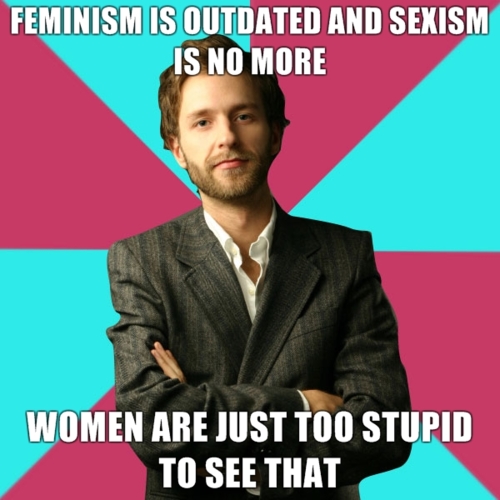
Privilege-Denying Dude Pic Dump

I really, seriously, just want to host a few images. Because I keep running into these guys, especially on Facebook.

Privilege Denying Dude - Minorities can say...Privilege Denying Dude - Offense?


I know What Racial Oppression Feels LikeWhy Should I Take Women's Studies?

Feminism is outdated and sexism is no more
This latest one is courtesy of Chris Brown.

Wednesday, December 08, 2010

On Allies and Accusations of Rape

Update(s) below


This Amanda Marcote post was on pendagon.net. I couldn't find the original link and found this through a cache that Glenn Greenwald put up, but I thought it was too important (and I think she's thoroughly right). I'll get links up and running in a bit.
"C’mon, we can do this acting like grown-ups thing

• Crime

Update: Julian Assange has been arrested.  Again, I must point out that if we treated rape seriously even when the accused aren’t people that are embarrassing the U.S. government, rape would probably be far smaller of a problem.

When I was in junior high school, one of my classmates got pregnant on accident.  The rumor spread quickly... that she was having sex with her boyfriend, the condom broke, she begged him to quit and he wouldn’t.  Even at the tender age of 13 years old, I knew that there was no way on earth that this was morally acceptable, or even close to it, and the proof was in the pregnancy that she (purportedly) begged him not to inflict on her against her will.  Again, this was a rumor...  But what I do know is that my friends and I who were horrified were 100% right.  What is amazing to me is when grown adults can’t wrap their minds around what childish virgins understand, which is that it’s wrong to fuck a woman who has withdrawn her consent, no matter when she does it.  It’s assault.  It’s rape, even if it’s not legally rape.

Interpol is using a rape accusation that resembles this one to put Julian Assange on their most-wanted list.  As Lindsay points out, this is just silly.  Sex crimes are never actually taken this seriously---we feminists wish!---and I’m annoyed to see rape used in this way, considering that rape apologists are already eager to suggest that rape accusations are about some evil bitch with ulterior motives. Indeed, as Lindsay notes, the usual rape apologist tropes are being employed, this time by people who should know better.  Jill has more on why forcibly fucking a woman who has withdrawn her consent because the condom conditions weren’t met is in fact rape, and it should always be legally treated as such.  The key here is “consent”, which was withdrawn.  That means that the woman was non-consenting.  Having sex with a non-consenting person is rape...

I don’t know if Julian Assange is guilty, of course, but I’m deeply disturbed by the people who aren’t content with suggesting that Interpol is politicizing a crime that shouldn’t be politicized, but instead slurring the victims with the usual course of rape apologist tactics, including accusing a victim of the high crime of being a “radical feminist”.  I suppose we should find this evidence against her, instead of evidence that Assange has sex with other people in the community of political radicals to which he belongs. I’m sorry, but why on earth is it so hard to believe that Assange is the kind of guy who power trips on women by promising to use a condom and then slipping it off during sex?  This is one of the most common kinds of sexual assault there is, and a favorite way for guys with power issues to get cheap thrills at the expense of women, who they often feel are contemptible and weak.  Are we to assume that someone who clearly gets a rise out of making the most powerful nation on the planet scramble around in a chickens-with-heads-cut-off manner doesn’t have a tendency to ego trip?  Are we to assume someone who risks life and limb for this isn’t the kind of guy who might get smaller kicks out of smaller, less internationally interesting power trips?...

I’m just annoyed at people’s black-and-white thinking---believing that because they support Assange’s actions in this one case, that means that his motivations must be pure as the driven snow and he must generally be above reproach.  It doesn’t work that way.  If anything, my experience says to me that men on the radical political fringes are quite often big assholes with power issues that they take out on women.  I’ve definitely seen with my own eyes the way that anti-war demonstrators who devote their lives to the cause often have the women in the kitchen making sandwiches while the men sit around on their asses bullshitting. And I’ve heard more than one story about anarchist communes and how the women are, despite all the lip smacking about radical politics, relegated to very unradical gender roles, which are, in turn, justified by some high-falutin’ rhetoric.. [I]t’s completely silly to think that leftists, especially in the fringe, aren’t capable of being massive dicks about women’s right to things such as bodily autonomy.

We can be grown-ups here.  We can entertain the idea that Wikileaks is performing a valuable service while acknowledging the strong possibility that Julian Assange is himself an asshole who treats women like they’re objects he can exert his massive power issues on.  We can criticize Interpol for treating these alleged sex crimes more seriously than they ever treat sex crimes and maintain sympathy for women who reportedly were quite afraid they had been exposed to unintended pregnancy or worse.  Maybe we can even do one better than that, and accept that more than a few men who consider themselves liberals or even leftists---or may even claim to be feminists---still act like women’s concerns should be dismissed and our rights can be transgressed with ease.  I’m not accusing Assange of anything, but I seriously think it’s silly to think the accusations couldn’t be credible.

Bonus:

Of course this whole fiasco is convoluted, filled with explosives and fishies and lurkers all over. I've heard all types of false accusations, many of which have been purportedly spread by the mainstream media or been actually spread by the mainstream media. Here's a few that I'm a bit worried about:

  • The false accusation, often repeated, that Assange was arrested on charges of statutory rape - or sex with minors - is chief among them. No one that I've spoken to in this regard can even produce a link to a story that even suggests that. Somehow, people read "rape" and "sex" and add "with minors" in between the lines.

  • That Wiki dumped ALL of their cables, indiscriminately.

  • That the cables risk hundreds of thousands of lives. (Again, links above)

  • That Assange, et. al are culpable of treason.

  • That Assange, et al are terrorists.

  • That it's all just pranksterism.

  • That we haven't learned anything new from the cables that have been released.


To this last point, I'll point out these revelations that Greenwald assembled for us here:
(1) the U.S. military formally adopted a policy of turning a blind eyeto systematic, pervasive torture and other abuses by Iraqi forces;

(2) the State Department threatened Germany not to criminally investigate the CIA's kidnapping of one of its citizens who turned out to be completely innocent;

(3) the State Department under Bush and Obama applied continuous pressure on the Spanish Government to suppress investigations of the CIA's torture of its citizens and the 2003 killing of a Spanish photojournalist when the U.S. military fired on the Palestine Hotel in Baghdad (see The Philadelphia Inquirer's Will Bunch today about this: "The day Barack Obama Lied to me");

(4) the British Government privately promised to shield Bush officials from embarrassment as part of its Iraq War "investigation";

(5) there were at least 15,000 people killed in Iraq that were previously uncounted;

(6) "American leaders lied, knowingly, to the American public, to American troops, and to the world" about the Iraq war as it was prosecuted, a conclusion the Post's own former Baghdad Bureau Chief wrote was proven by the WikiLeaks documents;

(7) the U.S.'s own Ambassador concluded that the July, 2009 removal of the Honduran President was illegal -- a coup -- but the State Department did not want to conclude that and thus ignored it until it was too late to matter;

(8) U.S. and British officials colluded to allow the U.S. to keep cluster bombs on British soil even though Britain had signed the treaty banning such weapons, and,

(9) Hillary Clinton's State Department ordered diplomats to collect passwords, emails, and biometric data on U.N. and other foreign officials, almost certainly in violation of the Vienna Treaty of 1961.

But then there's other problems. For all the mounting evidence that can be used against the US's imperialistic acts of aggression (and there are many), WikiLeaks also dumped a whole 'nother chicken the other day. In revealing crucial sites to US security the other day, they may have left any number of people open for severe attacks. Some of the information, apparently, is already well-known. Some, not so much and could be used to attack the weak - through biological warfare, etc. I have a feeling that there is another story here, but I'm not sure what that may be.

And then there's the fact that Sweden could very well extradite Assange to the US in the very near future to face criminal charges that could very well end freedom of the press in any regard in the US.

So, that's what we have. There are no more angels. Everybody is tainted, including the whistle blowers. Live happy ;)

Bonus II:

I finally found the original post for Marcotte's blog. Not sure what happened to that. Internets sure is acting strange these days. *wink*

Wednesday, December 01, 2010

Chicago Tuesdays (Late Edition): Bad News, Good News

First, the bad news. Bad, I suppose, if you were hoping for miracles in this city. But I like to be hopeful; it's a nice change of pace.


Last week 13 members of a committee defied Daley and forwarded the ordinance to set aside 20 percent of the city’s annual tax increment financing revenues toward affordable housing to a full city council vote last Wednesday.

With more than half of the aldermen in support, sponsor Ald. Walter Burnett Jr. (27th) was concerned that a few might “double cross” he and others who have worked since last spring to bring the ordinance to vote.

One week later the ordinance was back in the joint committee after intervention by the Mayor’s office. In the end, it was Burnett who decided to avoid the full vote. He decided that the wiser course of action was to negotiate a new substitute ordinance over the original—one that Daley could agree on while satisfying other aldermen now seeking amendments and reelection.

One possible amendment rips the guts out of the affordable housing ordinance by turning the articulated mandate to spend 20 percent of annual TIF dollars—about $100 million in 2009—into an unenforceable goal.

But now for some good news, just in time for our elaborately long winter season (care of Humboldt Park Portal News):


Eight years of hard work, long hours, and countless SOS calls culminated today in the opening of Humboldt Park Social Services' (HPSS) new interim-housing facility for men. Deborah McCoy, HPSS Board President, cut the ribbon for this new 22-bed facility that will allow homeless men to transition from emergency shelter to interim housing.

During an impassioned speech, Delia Ramirez, HPSS Executive Director, explained that this new model is critically important. Emergency facilities only provide extremely temporary shelter – often no more than one night, given intense demand. Interim housing, on the other hand, provides several months of shelter along with the wraparound services essential to a successful transition from homelessness to permanent housing and independent living.

Through its Center for Changing Lives and Center for Working Families, HPSS will offer such wraparound services as housing placement, housing relocation, housing counseling, and employment preparation to men housed within the facility. They will also offer job training to interim-housing residents through their soup kitchen, which feeds 100 people daily...

As a volunteer for the project, Dan Splaingard, Rose Architectural Fellow for Bickerdike Redevelopment Corporation, designed and helped build the custom bunk beds for the space that will serve as the sleeping area. He explained, “We were trying to make something that, while utilitarian, was trying to give a bit of an uplift . . . a quality of the handmade with colors that will imbue a sense of home.”

James, one of the inaugural residents of the facility, seemed to agree. The university graduate had always held a job, but suddenly found himself unemployed, then homeless, several months ago. He expressed gratitude for the services provided by HPSS, asserting, “We need more like them” in the community.

5

Saturday, November 27, 2010

THoT 3: Aaron Huey: America's native prisoners of war

Aaron Huey, photographer, spent some time with the Lakota people. Here he presents a chronological history of lies, broken promises, and war-ish aggression against the tribes cut against contemporary photos of the people and their communities.

In fact - and I had never considered this before - he refers to the reservations as "Prisoner of War Camps." Definitely worth a view. I'll have to watch again.


Beginning of transcript, courtesy of TEDX:

I'm here today to show my photographs of the Lakota. Many of you may have heard of the Lakota, or at least the larger group of tribes called the Sioux. The Lakota are one of many tribes that were moved off their land to prisoner of war camps now called reservations. The Pine Ridge Reservation, the subject of today's slide show, is located about 75 miles southeast of the Black Hills of South Dakota. It is sometimes referred to as Prisoner of War Camp Number 334, and it is where the Lakota now live. Now, if any of you have ever heard of AIM, the American Indian Movement, or of Russell Means, or Leonard Peltier, or of the stand-off at Oglala, then you know that Pine Ridge is ground zero for Native issues in the U.S.

So I've been asked to talk a little bit today about my relationship with the Lakota, and that's a very difficult one for me. Because, if you haven't noticed from my skin color, I'm white, and that is a huge barrier on a Native reservation. You'll see a lot of people in my photographs today, and I've become very close with them, and they've welcomed me like family. They've called me brother and uncle and invited me again and again over five years. But on Pine Ridge, I will always be what is called wasichu, and wasichu is a Lakota word that means non-Indian, but another version of this word means "the one who takes the best meat for himself." And that's what I want to focus on -- the one who takes the best part of the meat. It means greedy. So take a look around this auditorium today. We are at a private school in the American West, sitting in red velvet chairs with money in our pockets. And if we look at our lives, we have indeed taken the best part of the meat. So let's look today at a set of photographs of a people who lost so that we could gain, and know that when you see these people's faces that these are not just images of the Lakota, they stand for all indigenous people.

Friday, November 26, 2010

THoT 2: The Clarification

Note: This is both a clarification and an extension of yesterday's post, Thankless History of Thanksgiving.

I want it to be abundantly clear that my post yesterday was not a salvo in some War on Thanksgiving. I abundantly love this feast of abundance - as my girth can attest. I love spending time with family. I love turkey. I love tryptophan and naps. And sweet potato and pumpkin pies. And NFL games somewhere playing in the fray.

But history needs to be acknowledged in full. Too many of our friends and neighbors and cousins have suffered too long because we are too full of ourselves to acknowledge that we and our families have done and do bad things.

A friend found my last post to be too anti-Thanksgiving. Granted, the story within the story does seem awfully harsh. I do not, however, apologize for another writer's excesses (if that's how one wants to describe them as). If that's how Robert Jensen feels, that's how he feels. I have no qualms nor arguments therein. I also would not be angry with various indigenous tribes people who also felt a need to not acknowledge the Thanksgiving tradition in this country as some sort of benevolent or good remembrance. After all, do we recognize their fests, let alone their sufferings? Can one enjoy one without sharing the other?

I however, would like to talk about our history as a means of redeeming ourselves, rather than the lazy work of redemptive 'history' that's been making its way through the Great American Redemptive Mythos.

This, then, is my response to my friend:
If the blog comes across as anti-Thanksgiving, that is my error in message control. I'll have to check and edit then.

My intention, however, wasn't to butcher the day - one of my favorites - but to highlight a much-neglected context.

If I heard correctly, Winthrop hosted a second large Thanksgiving feast fifteen years after the initial one to thank God for their successful campaign against the lpcal tribes*. We need to tell our history straight. It needs to include both the inclusion and the exclusion, welcoming and murder, community and violence.

To do less is to do a disservice to our heritage and to neglect our current DNA as well as its majestic and horrible potential.

We can begin to remedy the situation by taking simple steps. Like spreading support for current laws to support current tribes, such as the H.R. 1385:

H.R.1385

Title: To extend Federal recognition to the Chickahominy Indian Tribe, the Chickahominy Indian Tribe-Eastern Division, the Upper Mattaponi Tribe, the Rappahannock Tribe, Inc., the Monacan Indian Nation, and the Nansemond Indian Tribe. This Act may be cited as the `Thomasina E. Jordan Indian Tribes of Virginia Federal Recognition Act of 2009'.

....

There is a provision in current law that allows unrecognized tribes to gain recognition through appeal to the Bureau of Indian Affairs. Source

Virginia's Racial Integrity Act of 1924 has hurt the Virginia tribes in their prior appeals to the BIA, according to the Washington Times. Tribe officials say the Act forced Indians to identify themselves as "colored" and led to the destruction and alteration of genealogical records. Source

Tribal proponents say the Virginia law amounted to a "paper genocide" and makes the bureau process difficult for the six groups, although there are some genealogical records that do exist and have been submitted to the bureau. Va. Gov. Tim Kaine called the vote "a major step towards reconciling an historic wrong for Virginia and the nation." Source

President Barack Obama has reversed from past presidents and pledged to support recognition of the Lumbee Tribe, which has sought federal oversight for more than a century. According to the AP, Obama has not said whether he will support recognition of the Virginia tribes. Source


*To be fair, preliminary research has not led me to believe that this story is true, either. Story revoked. Genocide, however, is true. And THAT story needs to be told.

Thursday, November 25, 2010

Thankless History of Thanksgiving

Update: Clarification on any perceived anti-Thanksgiving bias and a chance for action here.

In looking to the United States' history as a nation of genocidal power over the original Nations (Native Americans, the Tribes, Indians, First Settlers), Robert Jensen asks how we can just so easily rub aside our murderous past? Especially as this murderous past is not *just* our past, but - I add - a part of our very current DNA.

How does a country deal with the fact that some of its most revered historical figures [Washington, Jefferson, T Roosevelt] had certain moral values and political views virtually identical to Nazis [in desiring all 'Redskins' to die]? Here's how "respectable" politicians, pundits and professors play the game: When invoking a grand and glorious aspect of our past, then history is all-important. We are told how crucial it is for people to know history, and there is much hand-wringing about the younger generations' lack of knowledge about, and respect for, that history.

In the United States, we hear constantly about the deep wisdom of the founding fathers, the adventurous spirit of the early explorers, the gritty determination of those who "settled" the country -- and about how crucial it is for children to learn these things.

But when one brings into historical discussions any facts and interpretations that contest the celebratory story and make people uncomfortable -- such as the genocide of indigenous people as the foundational act in the creation of the United States -- suddenly the value of history drops precipitously, and one is asked, "Why do you insist on dwelling on the past?"

This is the mark of a well-disciplined intellectual class -- one that can extol the importance of knowing history for contemporary citizenship and, at the same time, argue that we shouldn't spend too much time thinking about history.

Our past does not just lie in our past, but it is a part of our national character, and as long as we can spin it so that we are a benevolent and graceful people, then we can continue atrocious acts of imperialism and genocide throughout the world (what is The War on Terror if not a small-scale act of genocide being perpetuated against Muslims and Arabs?).

Jensen further:
This off-and-on engagement with history isn't of mere academic interest; as the dominant imperial power of the moment, U.S. elites have a clear stake in the contemporary propaganda value of that history. Obscuring bitter truths about historical crimes helps perpetuate the fantasy of American benevolence, which makes it easier to sell contemporary imperial adventures -- such as the invasion and occupation of Iraq -- as another benevolent action.
Very simply and close to home, how can we continue to live as if nothing horrible actually happened between the White structure of the US and the various indigenous tribes and nations? If we can come to grips with this, maybe then "illegal" immigration won't be such a bother*. To further this: how can we now go about and trivialize their histories by naming professional and collegiate sports teams after them? We profit from their misery and then offer that somehow we are "honoring them"? Imagine Henry Ford had killed my great-grandparents and all of their brothers, sisters, and cousins some eighty years ago because they were standing in the way of progress. And now his company wants to introduce the Dye brand of luxury cars?

If the Native tribes say that we are dishonoring them, than we should probably listen to them. If not, we are triply dishonoring them, first by the initial act of dishonor, then by not listening to them, and third by being racist enough to not consider their opinions about themselves as being even equal to our opinions of them.

But then again, isn't that what White Supremacy is? We know what's best? Our views of history are better than what actually happened? Is Rush Limbaugh now the Official Spokesperson for White History, then?

*As it is, many White opponents to immigration contend somehow that the European settlers had broken no laws in emigrating to what is now the US. I guess the universe doesn't have laws? Let alone, the Bible that they were supposed to follow? But this absurdity and logic FAIL demonstrates the reality that laws benefit those who write them. If only those Injuns had lernt to read and write some laws, then...

Monday, November 22, 2010

November Rain and Family Business

I'm just gonna be honest here: I don't care for this song. But the Mrs. Jasdye lurves it. So, here.


A couple extra points.
  1. I love my daughter's curious nature. A friend mentioned to me yesterday, however, that she never asks, "Why? Why? Whywhywhywhy??" like many kids her age. I think, unfortunately, she takes after her old man in this matter, always coming up with her own hypotheses and testing them out loud. This morning, for instance, while we were out in this tragic thunderstorm, she mentions that the cars (there're few of them on the road at this moment) are being so loud. I figure that she's talking about the thunder (after all, we've imitated sonic boom sounds while watching cars speed by near her school), and so I give her a real short (and hurried) lesson on physics. Lightning, speed of sound, etc. I'll have to go a bit deeper sometime when we're not running for our lives.
  2. My three-year old has had recurring pneumonia perhaps as far back as August, but at least since September. Jocelyn is undergoing a procedure on Wednesday (right before Thanksgiving) to remove her adenoids, shave down her tonsils (it's less hassle for a three year old. Only a three day recovery, rather than the seven days if they cut them off. As well, there's a 0.2% chance that the tonsils will come back.) and send down a bronchilscope to see if there's anything in her lungs that's been hosting the pneumonia. Please pray; the whole procedure is a bit scary to us - especially the sleepy-sleepy part. And the fact that she won't eat or drink during her recovery will drive me mad. Thanks for any and all warm words, thoughts, letters of support. We appreciate them all.

Friday, November 19, 2010

Sweet Home Chicago (Come On! Baby Don't You Want to Go?)

Chances are, if you're at all 1) a Chicagoan and 2) involved in local politics, you've heard of TIFs (Tax Incremental Financing). You also know that TIFs are a form of tax that are supposed to be diverted to help blighted communities (such as Lawndale) garner business interests and stay together. Of course, they're not being used for that purpose. They're largely being used to court big businesses that least need the incentives.

So, let's make it about retaining community. Sweet Home Chicago is a coalition of various community groups that advocate for affordable housing funding from TIFs.

The Sweet Home proposal:
Each year the city would dedicate 20 percent of TIF funds collected towards affordable housing. If this were in effect in 2009, $99 million would have gone towards housing.
Developments would qualify to receive funds if 50 percent of the units were affordable to households earning less than $37,000 for a family of four. In addition, citywide, 40 percent of the units created each with the dedicated funds must serve households earning less than $22,600 a year for a family of four.
For housing that is for sale, units would have to be affordable to families of four earning less than $60,300.
Please sign the petition for Sweet Home Chicago.
The ability to pay rent and stay housed comes before any other need of a community. If TIF (tax increment financing) dollars are meant to build and support blighted communities, there is surely no greater way for Chicago to use them than on affordable housing.

Affordable housing needs to be a priority. It is the long-term sort of investment that is too often overlooked for short-sighted, quick infusions of cash that don't sustain communities. We agree with other housing advocates and organizations that the language of the Sweet Home Chicago bill can ensure planning flexibility while still prioritizing affordable housing.

Please don't let this opportunity to ensure a place to live for Chicago's neediest citizens pass by.

This petition is to let the Mayor and Councilmen of Chicago know that, as negotiations on the bill move forward, the provision of affordable housing must remain a priority.

Thursday, November 18, 2010

Sometimes It Just Takes a While

Having a Palestinian Christian speak at my church earlier this week caused me to revisit my old views once again. Growing up in the Evangelical/Fundamentalist church, I was led to believe that Jesus was going to come to Earth again in a cloud of glory, take all of his people home to be with him and melt down the world. The state of Israel - and its relationship to its heathen neighbors - was key to this apocalyptic event.

To us, Israel was the chosen nation. Although most every Jew now rejects Jesus as their personal Lord and Savior, at this future date, 144,000 (give or take a few) of them will magically accept him as the incarnate YWHW.

This was, as ridiculous as it may seem, how we viewed the world. We weren't trying to be offensive or cloistered from the world and reality. We figured it was the real reality. We thought we were following the Word of God. So if we were offensive, well, so was Jesus, right? Right? right?

Immediately after high school, I worked for a conservative Evangelical Christian school. Much of what I was taught about the Bible - including our end-times theology - was reinforced and given academic clothes at this school. But it was also there, while working my first days for a paycheck, that I first encountered a real, live Palestinian Christian.

I didn't think he was an enemy. Nor that his existence was in God's way - at least not initially. But when he told us that Zionism (the belief that the land of Israel belongs solely to the Jews) is false prophecy, I just thought he was just wrong. I couldn't grasp the idea that there were other ways of taking the Bible seriously that didn't coincide with my views.* When he shared that his people and he are living as refugees throughout the Arab and Muslim world, I thought that wasn't such a bad thing. After all, the important thing is that Jerusalem and the ancient promised land of the Bible was finally back into the hands of God's chosen people.

It would be another ten years before I really started considering other theological views. It would be some time after that the evils of mass displacement would really sink in. It would be some time after that wherein I felt burdened by the plight of Palestinians as a result of Zionism, as well as the plight of Arabs as a result of fear-mongering and shallow American jingoism. As I was slowly able to distance myself from my old worldviews and to see the resulting hardships that we Evangelicals pass on and exacerbate to those outside of our bubble, I end up apologizing quite a bit. And trying to forcibly change my friends' and family members' views on some of these subjects. Much to their chagrin.

All of this goes to say, it takes time to make a change in people's hearts - especially if they're convinced that their worldview is fundamentally correct. It takes a while to foster trust, to share not only our stories, but the stories of others who are likewise affected. It takes villages. It takes miles. It takes a lot to humble ourselves and hear what others are really trying to say. So why am I surprised, since I - of all people - am still learning?

*Whether that's as a result of teen-aged narcissism or fundamentalist thinking, I'm not sure that there's much of a difference, to be honest. Fundamentalism is, at its heart, a willingness to subject yourself to an extremely self-centered view of the world. The difference is that teenagers tend to think that they're self-defined (although their viewpoints are at the least informed by their cultural and familial contexts) and largely buck against authority. Fundamentalists are told what and how to believe and act and fall in line accordingly. There are figures who are trusted with immense and otherworldly authority in their sphere - it's just that those figures have to be within their sphere. Everybody else is treated with suspicion. So in that way, Fundamentalists are anti-authoritarian.

Tuesday, November 16, 2010

Unemployment Blog-a-Thon

Updated below

I was functionally unemployed for about two and a half years, starting just before the economic malaise that's affected just about everyone else around this country in one way or another. There are a few lasting effects from such a long period of unemployment and from the downturn in the economy. One of them is that - still - I have no full-time job. Little-to-no benefits. All told, I'm making about a third of what I was making before, if I'm lucky.

And a lot of other Americans (especially heads of household) are in the same boat. And, to be honest, things may not look up any time soon.

In fact, according to recent studies, there is one job opening for every five unemployed workers. Any which way it's sliced, 1:4 is not good odds.

And the fact that unemployment benefits are once again slated for debate in Congress (which has been acting awfully stingy at a time of crisis for middle and working class families, but can always seem to find ways of making more war) compounds the problem for this nation. Less money in the hands of those that need it leads to points of crisis. But as the Economic Policy Institute notes, extending unemployment leads to extra money floating around in the economy as well as extra jobs and extra hours for those who are currently working.

Extending the federally funded unemployment insurance extensions through 2011 would not only be a lifeline to the families of millions of unemployed workers, it also supports spending responsible for the existence of nearly half a million jobs. Furthermore, it would not only create new jobs, it would boost hours for workers who already have jobs. Both results would be welcome improvements because this recession has seen both job losses and cuts in hours for those with jobs... We find, using the CBO’s methodology, that the $65 billion spent on unemployment insurance extensions through 2011 would support 723,000 full-time equivalent jobs.

So what's to keep the US from extending the benefits? Perhaps the $65 billion price. So, single banks can afford to receive that money for use from the government, but spread out through millions of households on Main St.? Can't let that happen... Nevertheless:

The actual cost to the budget is far less than the sticker price of $65 billion. The 723,000 full-time- equivalent jobs created or saved means: (1) the government will bring in more revenue from the taxes paid on the wages earned by those who otherwise would not have jobs, and (2) it will spend less on safety net measures (for example, Medicaid and food stamps) related to unemployment. In other words, when jobs are created, it adds to government revenues and reduces government expenditures. Using a methodology described in Mishel and Shierholz (2010), we find that of the $104.7 billion increase in GDP related to continuing the unemployment extensions through 2011, some 37.4%, or $39.1 billion, will be recouped both in higher revenues, as more people and firms pay taxes, and in lower expenditures. Consequently, the effective cost to the budget of continuing the unemployment insurance extensions for a year is $25.9 billion instead of $65 billion.
Call your congressperson/reptile.

Update:

Seventy-three percent of voters want Congress to keep the extended unemployment benefits put in place to fight the recession, according to a new poll commissioned by the National Employment Law Project, and they don't care about the deficit.

With unemployment expected to hover above nine percent for the foreseeable future, nearly three out of four voters say "it is too early to start cutting back benefits for workers who lost their jobs."
Will the new Republican-led House (and Democrat-led Senate and White House) listen to the needs (and whims) of the American people? Or will they continue to push their so-called mandate (punishing the poor while rewarding the wealthy)?

Chicago Tuesdays: Hey, Do You KNOW That I'm Walking Here?

Though the new pedestrian crossing law passed during the Summer here in Illinois, you wouldn't know it if you walked out in traffic. Or watched tv. Or were a driver...

The old law:
When traffic control signals are not in place or not in operation the driver of a vehicle shall stop and yield the right-of-way to a pedestrian crossing the roadway within a crosswalk when the pedestrian is upon the half of the roadway upon which the vehicle is traveling, or when the pedestrian is approaching so closely from the opposite half of the roadway as to be in danger.

The new law (as the Chicago Tribune describes it):
Drivers must stop for pedestrians in all crosswalks — even those that are unmarked or don't have a stop sign or a traffic signal. The penalty for failing to stop is a traffic citation of $50 to $500. Fines vary by county.

If the old law led to confusion among drivers about when to stop (and few had been obeying even that law), the new law merely exponentially compounds that confusion because of a fundamental lack of communication about the existence of this new law and the non-existence of its enforcement. There are no road signs. There are no cops on stake out. There are no print, radio, tv, internet ads warning about this change. And the fines are - although a pretty sum to pay if not expecting it - not the most prohibitive. There is no dialog on this because so few people know about it, so I'd be foolish to expect a culture change anytime soon or even within the distant future.

About the only place where one can find mention of the new pedestrian laws are just a few newspaper articles. That's all the news I could find on this subject. But those few mentions have emboldened fellow walkers like myself. And, of course, almost get us run over in the process. Certainly cussed at. But definitely less safe.

A few questions:
  • Seeing how this law is very lax in enforcement, doesn't this give police more power to justify random stops, further complicating their relationships with the communities they're charged to serve?
  • Seeing as how Illinois is not the only state to have this new supposedly walker-friendly law in place (if not effect), how have other states educated and enforced this?
  • More to the point, how do budget-crisis states deal with the need to clarify and enforce this law?

Monday, November 15, 2010

Progressive Chicago: Miguel del Valle: Mayoral Candidate of the Week

Progressive Chicago: Miguel del Valle: Mayoral Candidate of the Week: "(Photo Source: Chicagonow.com) http://www.delvalleformayor.com/ Miguel Del Valle is probably not coming into the race as a front-runner..."

Pretty good critique of my top choice for mayor.

Sunday, November 14, 2010

Lazy Sunday Reading: This American Life - Crybabies

This American Life #415, "Wall Street: Money Never Weeps":

Ira Glass: How much whining and complaining are Wall St guys doing about the federal government now. Like this guy, Steven Schwartzman, is he an outlier?
Adam Davidson: My view is that he represents a much broader view and he's one of the few guys who has the guts to say it out loud... If I can use an odious and ridiculous comparison, [the complaining that he hears from high and low level Wall St employees] reminds me of Baathists in Iraq.
...The people who made money and were in power under Saddam Hussein.
High-level Baathists that I found in Iraq after the war... The group that had the most self-pity... were those people who made a fortune through the evil and illegal activities tof the Baathist regime and it feels very similar when I'm talking to people on Wall St. This self-pity combined with a total lack of reflection of how they had been such massive beneficiaries of a system that had been so bad for the country.
IG: And it continues to generate huge profits
AD: Pretty much every big bank that you can name - with the possible exception of Chase - would not exist today were it not for the gov. They are growing quickly and making record profits by some accounts. This year will be the biggest bonus year ever, for Wall St. Last year was the biggest before that. So, that bucket of activity - let's just call it The Bailout, although it was more than just the bailout - most folks on WS who I know feel, "That was just necessary. If we had gone down, the whole US economy, the whole world economy would've gone down. We would've had a Great Depression." I'm sympathetic to that argument. That being said, it would be appropriate for folks on WS to say publicly that their businesses failed. And something that they have always said they're against - government intervention - rescued them and made them get the opposite of what you're supposed to get in a capitalist economy - rewarded instead of punished for bad, risky behavior. I cannot think of any thing in the media or that I have directly heard that reflects any gratitude... Self-reflection is a very small part of what I hear.
IG: What about when they go in front of Congress, don't they say, "Thanks! You saved us, we just want to acknowledge what you've done."
AD: ... I can't think of a time that someone said, "My bank would not exist today. It failed because we took actions that led to our investors having no faith in us. But the government stepped in and because of that, we are making more money than we've ever made before."
IG: What about the workaday people, the analysts, the brokers, the traders, the mid-level people who make a lot of money... Are they grateful?
AD: ... I got a group of furious Wall St guys, getting together to figure out what to do about their anger at the president and the Democrats in Congress. And one guy said, "I swear to God, they're trying to destroy business in America... How do we fight the President?"... I gotta say, it was a pretty emblematic moment. I'm willing to bet you can go to any bar in Wall Street any night of the week and you can find someone complaining about all the different ways the president and government are harming Wall St.

[They got some audio from recorded conversations taken in a bar in Wall Street after the closing bell.]

Wall Street Guy #1: The government must have an enemy, because if they don't have an enemy, they are the enemy. So, Wall St. is the current enemy.
AD*: I can guarantee your bank would've gone under, your stock evaluation, your credit agency would've been out of business. All three of you would have been out of work [if the government hadn't bailed you out].
Wall Street Guy #2: What would you have liked for us to do?
Radio Woman: I would like to bail it out and I would like to walk into a bar in lower Manhattan and have one of you to acknowledge me and thank me for keeping your job.
WSG1: For what?
AD: How do you think you kept your job?
WSG2: Because I'm a smart person.
WSG1: Survival of the fittest.
WSG3: Because I'm smarter than the average person.
RW: Even if the gov't bails out your industry?
WSG3: I took advantage of the situation. 95% of the population doesn't have that common sense.

*Disclaimer: Yeah, I don't know who said what...

Thursday, November 11, 2010

Powers of the Air

John 9:1-7 (NIV)
As Jesus went along, he saw a man blind from birth. His disciples asked him, “Rabbi, who sinned, this man or his parents, that he was born blind?”

“Neither this man nor his parents sinned,” said Jesus, “but this happened so that the works of God might be displayed in him. As long as it is day, we must do the works of him who sent me. Night is coming, when no one can work. While I am in the world, I am the light of the world.”

After saying this, he spit on the ground, made some mud with the saliva, and put it on the man’s eyes. “Go,” he told him, “wash in the Pool of Siloam” (this word means “Sent”). So the man went and washed, and came home seeing.

Fundamentalist, right-wing Christianity currently falls into the trap of asking, "Who sinned, this man or his parents? Why is he sick? Is the pre-existing condition his fault or his parents' fault? And if so, why should we have to suffer for others' wrongdoing?"

Jesus answered, "Don't worry about such questions. I make the healing and I revel in the healing." And then he healed the man.

Peter and his cohorts were thinking according to the rules of Blame-Game Theology - the same limited thinking that Job's friends used to justified his severe sufferings. However, over the course of the next few years, they came to slowly change their way of thinking and were soon healing the blind, mute, deaf, disabled without equivocation.

My people (evangelicals and fundamentalist Christians) are blinded and deceived by the powers of the air into believing that it's generally the fault of the victim that she is worse off than they are. It's not a Christ-trait. It's a human trait, a broken human trait. One in which we find ourselves so broken that we need to sabotage others just to feel better about our brokenness.

And even if they don't necessarily ascribe to the BGT (few that I know would cop to believing that), they believe that sin is individual and that everything needs to be focused on the individual or the family. Any good is done through individual charity, not structural change, according to this philosophy.

Which is very convenient for the powers that be. If we don't call the structures (the nations, the powers of the air) in to question, but rest all of the blame on the individual and his family, then there is no accountability for those who are directly responsible for the sickness. If the gambler alone is blamed for his failures to break free of his addiction, society doesn't need to quit making a profit from his addiction.

I wonder, however, if the writer of that gospel account didn't have this prophetic account in mind when :

Zephaniah 1:17
I will bring such distress on all people
that they will grope about like those who are blind,
because they have sinned against the LORD.

The question I'm asking is, How did they sin against the Lord? Was it through tripping old ladies? Was it through sexual deviancy? Was it by not paying their taxes? Were they playing with witchcraft? Did they sacrifice kitties?

Truth be told, it might have been any of those, but that's not what the passage hints toward.

verse 13:
Their wealth will be plundered,
their houses demolished.
Though they build houses,
they will not live in them;
though they plant vineyards,
they will not drink the wine.

and 18:
Neither their silver nor their gold
will be able to save them
on the day of the LORD’s wrath.
They relied on their abundant wealth. But it did not save them. They are blind to the needs of those around them, and so God will complete the picture.

Or they can choose to wash in the waters of the Pool of Shalom.

Monday, November 08, 2010

The Reality of Denial

Slacktivist's post on global warming denialism has come at a time when I find myself at wit's end trying to talk to fellow White Christians about the facts of institutional and systemic racism (and our own implicit White privilege). What these two topics share is that the very truth of their existence are being called into question - yet they are both certifiable, identifiable, and verifiable scientifically-proven facts. Systemic racism is a fact, every bit as much as sexism is a fact, every bit as much as global warming is a fact, every bit as much as income inequality is a fact, or homophobia. Or Muslimaphobia. Or genocide. Or... pick your evil poison.

Denying these facts doesn't make it less so - it just proves that the denier doesn't know or want to know how to deal with something that may alter his or her existence in profound ways.
One could debate about the how extensive the damage is in these areas, vis-a-vis the claims by some of the advocates for change. And we certainly could argue about the ways to change the system*. But facts, those stubborn things, can't just be accepted or not. They are. How we interpret and classify the facts is open to interpretation, but not the facts themselves.

Likewise, it's a fallacy to believe that only liberals believe that racism (et. al.) is a continual problem. That's an unfortunately binary way of looking at the world. Racism is a real, fundamental problem. And the fact of its relentless existence speaks about the persistence of our continual tribalisms and how we (males, Whites, middle class, Americans, and/or straights) justify our superior standing under the line of thinking, "When we succeed, we do so because we're better." Rather, the truth is closer to, "We succeed in large part because society privileges us, and if we challenge those assumptions we were lucky enough to be born into, we may never succeed again."


That is, of course, a fallacy. There are a few with much, much power. The rest of us lack power -- as long as we remain divided by sex, race, class, sexuality, religion, etc. The rest of us are unaware of how we can be powerful - by uniting - and how powerful we can be by uniting.

* These should be the only things seperating conservatives, moderates, and liberals. But alas, there are many conservatives - and many of them Christians - who favor the system as it is and deny reality just to continue that system.