Showing posts with label Christmas. Show all posts

Sunday, January 01, 2012

Seven

Seven is commonly understood to be the number of completion, at least in Christian mythos. Fitting, as this day is the beginning of the New Year. Which, come to think of it, is why the arbitrary choosing of the New Year is a week after the for-whatever-reason choosing of December 25th for Jesus' birthday.

Or maybe it's the other way around. Maybe since they needed to Christianize Winter Solstice celebrations, they decided to make the Christ Mass then. But since January 1st is a fixed date, that would be the beginning of the new year. Rather than Christmas being ten days before the new year (on solstice), it would be seven days. Thus the 25th.

Obviously I'm stretching. But I really haven't heard any theories to explain these rather random placements of these holy dates that quite satisfies me.

However, I'm starting to think the choice was a good one. Winter Solstice is an acknowledgment (well, in the Northern Hemisphere) that the sun is coming back, that the days are getting longer, that hope is alive, that things WILL get better. The Christ Masses made a point to emphasize that Jesus' birth signified light coming into the world, a new dawn has appeared, a new hope is on the horizon.

And isn't that what New Years is really all about, Charlie Brown? A time to collectively mourn, reassess, and reconsider and all that last year had for us and regroup and generate new hopes for the next year?

I pray that we can garner new hope as this new year begins and work towards meaningful and lasting and maybe even substantial happenings in our lives.

Here's to you!

Thursday, December 29, 2011

Six Geese a-Laying

Phenomenally wealthy. This was NOT a common family.

Speaking of huevos, I've been planning on going vegetarian through January. I'm figuring that it'll be easier to ease into vegetarianism, and hence realistic and acheivable. Especially for this broke dairy-lover. It'll give me some practice to prepare to a Lent-period fast of the vegan (no animal or animal products - dairy, eggs, cheeses, yogurts, milk, um... ice cream, or anything else that might have come from a productive animal and that was deliberately taxing for them).

Hopefully, I can figure this thing out a bit over the next month and go, like most of the "developing" world, meatless for quite a while. Speaking of which, I'm thinking of doing a series during this fast on the deadly sins and corresponding virtues, starting with gluttony. If you want to participate in that, shoot me a response. Thanks!

Five Golden Rings


In my head, at least, I'm always read that to say, "diamond rings." And that of course brings me to Kanye's collab with Jay-Z and, unwittingly but fortunately, Lupe. It also reminds me of that pretty decent social commentary/White guilt movie, Conflict Diamonds.

These jewels shine, you see. And they cut with precision. And people die and are enslaved over their possession. And profits are used to buy weapons and futher enslave entire regions under war chiefs. But they're also as fragile as a leg lamp. All of which means that diamonds are extremely useful, as a metaphor for human and, particularly, rich people greed.

On the contrary, though, gold is quite utilitarian. For example, you can use it as a conduit for electricity. And... Look, it's shiny!

Golden rings


All of which makes the assertion that we need to return to a gold standard as silly, arcane, Euro-centric and obsolete as some medieval song about giving birds and trees out for Christmas.

Tuesday, December 27, 2011

Four Calling Birds

Four Calling Birds
Get it?


Bought some brown rice and beans for next week. In the meantime, I'll be finishing the calling bird in my fridge. Until

I can say one thing. It's hard to be a vegetarian on the West Side of Chicago. I haven't seen a fruit market out here, and the closest supermarket, Dominick's, is prohibitively expensive. So I have to go back into the city to get some fruits and veggies or grains.

Which wouldn't be so bad. But it doesn't make me curious in the least why the local Church's Chicken becomes so popular on 35¢ Thigh Tuesdays. Nor why obesity and obesity-related health problems are such a way-of -life in these under served neighborhoods.

Of course, if we could all afford Whole Foods I guess this would be less of a problem. But other issues have to do with food education, additive addiction, and equity and access. Yet these problems are deeply rooted in traditions of racism and classism. Unless we deal with these issues, we can't expect the cost of health care (for instance) to go down.

Unless we complete ignore the problems of the poor and minorities directly in front of us.

But I can't imagine America doing that... Naw...

Saturday, December 24, 2011

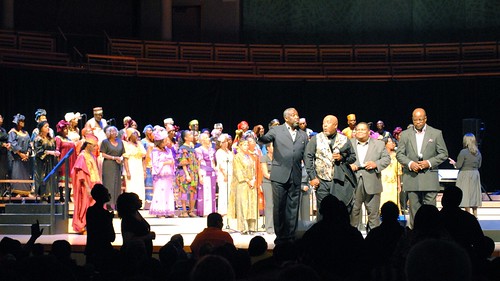
Hark! The Herald Angels Evangelize!

I've got a shameful confession: As a young adult, I once declared that Black Gospel music wasn't really about the Gospel because its aim wasn't to convert people to Christianity. It wasn't, in my estimation, saving souls from the clutches of hell.

Free Gospel Sundays

I was wrong. Black Gospel Music, far better than nearly any other type of music in the Contemporary Christian market or much anything else I've ever witnessed - and I would count evangelists in that - witnessed and proclaimed the gospel.

Allow me to clarify.

The term gospel means "good news", which any good Evangelical knows. We know that and we think that the good news being declared is the good news that Jesus paid for our individual sins with his death and, therefore, if we trust in him we are removed from the ultimate price of our sins and get to be with God when we die. This is alternately called salvation. The ultimate problem with this, from my perspective, is that we don't seem to understand what Jesus was attempting to save his followers from, let alone to.

Fortunately, understanding what the gospel entails can help to clarify and round that out a bit for us.

In the era of the Roman Empire, when Jesus was of age, the empire (which consisted of Palestine, where Jesus was born and spent the overwhelming majority of his life) centered around the one person of note: the emperor. Whenever an heir apparent was born or a new one rose to the throne, evangelists (messengers, from which we get the word "angels") were sent through the kingdom to spread the good news of the coming king.

In fact, they would say, "I bring you glad tidings of good news."

The birth anunciations of Jesus of Nazareth to the lowly shepherds were then a mocking of the Roman Empire with a different objective. Not only was this announcement about a new king, but about a new kingdom, a new way moving, new rules, new perspectives.

We can see what that new kingdom would look like throughout the gospel accounts of Jesus' life. "The blind receive sight, the lame walk, those who have leprosy are cured, the deaf hear, the dead are raised, and the good news is preached to the poor." (Luke 7:22)

The most precise account of this new kingdom presided by this new king may be in the Sermon on the Mount. Jesus assessed all of the current political/societal/religious views of the time and found them all severely lacking. He condemned the power-and-violence seeking of the Roman Empire, the violent reactionism of the zealots, the accommodations of the Herodites, the alleged purity of the Pharisees, the hiding and disconnection of the Essenes.

He offered something fresh, creative new, and utterly not-of-this-world. He offered healing and hope for the sick, the downtrodden, the forgotten, the poor, outcasts, the depressed, homeless, victimized, brutalized, oppressed. Slaves, women, children, gentiles - he welcomed them all with open arms and instructed his kingdom-mates to do the same.

So it makes sense that much of Black Gospel Music is about rejoicing in and pushing towards liberation rather than solemnly waiting for heaven (although many songs brilliantly did both). Because that's what "Gospel" means after all.

Blow your horn, Gabriel. Blow.

Thursday, December 22, 2011

The Humiliation of Living Humbly

My new friend David Henson wrote a story about Jesus being born into a migrant family that is worth a good read and meditation. It's a bit of a pick-axe if you're like me and you've heard Linus' gospel story on repeat since birth but can't quite make a tangible or visceral connection to it every year. The original hearers of this particular "gospel" story, after all, were quite shocked by it.

A small distraction from this meditation occurred when David proposed that modern readers tend to think of Jesus' birth as being a humble affair, rather than the humiliation he believes it was.

For most of us, I think he's right. We like to imagine being born into wealth, or at the least to rise into wealth so that our children can be privileged. Chances are, if you're reading this, you have some amount of fortune, if not of the wealth variety, then at least enough to find yourself with a computer, internet access, and some amount of spare time. Rare commodities in most of the world. We may pity those without such access and leisure.

I don't need any research to convince anyone that we actually enjoy imagining the life of the glamorous, the fabulous, and the wealthy. Those are what most movies and television shows portray. The roots and bark of hip-hop culture comes from poverty but bloom wealth fantasies. We play the game of watching the thrones. We like to envision ourselves as masters of fate, as having dominion and persuasion, luxury and attractiveness. The greatest crimes are being ugly, or poor, or weak, or humble, or servile.

But Jesus took the opposite approach. A later book in the New Testament said that the Christian God "emptied himself." A result is that he was, "of no stately appearance."

By our standards, it's safe to say that he may have been ugly, but he surely wasn't a sexy, strong stud.

David is right in that we gloss over the full revolution that Jesus' birth signified. But if we suggest that a position is humiliating, we must recognize that it is only that for those who are unwilling to be in such a position.

Angel
Such a humble birth - one amongst the beasts and belonging to street-level commoners in a strange land - may be humiliating for the apotheosis and divine cult of the Caesars. These are men who (and let's consider that empires and autocratic states have not changed their essence within the last two thousand years) were conferred the proof of their godness upon the state of their "superior" birth and measured by the tools of their wealth, accumulation, access, and power. The Roman emperor becomes a god to continue the oppressive system and keep the power base faithful. As long as he is faithful to the good of power accumulation - and hence exploiting all those and all that which can be used for the good of the power accumulation - then the god of power is served.

The Hebrew god becomes a man to "confound the wise", "shame the powerful", and turn the world freakingly upside down.  For a god to become man, or man-like, would require that he or she becomes man, and therefore is in tune with what it means to be human, not just become human. And when that god comes in the form of the lowliest of people (which is to say, most of them), then that god can not look down with pity or disgust at the "lowly". That god - Jesus - identifies with the common man because he is the common man.

Christians have a horrible habit of hagiographing everything we respect even though our holy book does not. If Jesus didn't look like the star from The Passion, then he we typically see him as otherworldly. Jesus would have never been tempted to cheat on a math test because he knew all the answers. He would never have struggled with lust, because that's what sinners do. He wouldn't have cried when his friend died, because Jesus knew that his friend was with God... No, wait.

It is nearly impossible for us to imagine our dear Lord and Savior being actual flesh and blood. And often when we do, we middle class Americans like to figure him as one of our own.

But he wouldn't be. Not in the least.

To be sure, if Jesus were born this generation, it's likely that he'd have been born in a ravaged part of the world - say, occupied Palestine or just-"liberated" Iraq. North Korea. Or in the slums of Calcutta, Johannesburg, or Warsaw. Or any number of war-savaged post-colonies throughout Africa and the Americas and Asia.

But if he was born in the US empire - and David makes a good point that Israel/Palestine was in the furthest reaches of its time's super-empire - then it's likely he would have been born to a migrant family, or to homeless vagabonds, or WalMart associates, or to out-of-work coal miners.

His angels would have likely spread their message ("gospel") to AIDS patients, dope fiends, prostitutes, hospice guests. The birth could've happened in a back alley, in North Lawndale, the projects, the Appalachian back roads...

All of which may be terribly shocking for those of us who secretly or openly aspire to be wealthy and beautiful and powerful and who therefore expect that god also worships the wealthy, the beautiful, the powerful. But to the god who became one with humanity, then it only follows that that god is enchanted by the outcasts and misfits - which is to say, all of us.

Sunday, December 26, 2010

Lazy Sunday Readings (Christmas Edition): The Word Made Flesh

The following is from a sermon delivered by theologian/pastor/historian NT Wright on Christmas five years ago.
What is this Word?  ‘In the beginning was the Word . . . and the Word was made flesh.’  We are so used to it, to the great cadences, the solemn but glad message of the incarnation; and we risk skipping over the incomprehensibility, the oddness, the almost embarrassing strangeness, of the Word.  The light shines in the darkness, and the darkness didn’t comprehend it; the world was made through him but the world didn’t know him; he came to his own, and his own didn’t receive him.  John is saying two things simultaneously in his Prologue (well, two hundred actually, but let’s concentrate on two): first, that the incarnation of the eternal Word is the event for which the whole creation has been on tiptoe all along; second, that the whole creation, and even the carefully prepared people of God themselves, are quite unready for this event.  Jew and Gentile alike, hearing this strange Word, are casting anxious glances at one another...

That is the puzzle of Christmas.  And, to get to its heart, see how it works out in the rest of John’s gospel.  John’s Prologue is designed to stay in the mind and heart throughout the subsequent story.  Never again is Jesus himself referred to as the Word; but we are meant to look at each scene, from the call of the first disciples and the changing of water into wine right through to the confrontation with Pilate and the crucifixion and resurrection, and think to ourselves, this is what it looks like when the Word becomes flesh.  Or, if you like, look at this man of flesh and learn to see the living God.  But watch what happens as it all plays out.  He comes to his own and his own don’t receive him.  The light shines in the darkness, and though the darkness can’t overcome it it has a jolly good try.  He speaks the truth, the plain and simple words, like the little boy saying what he had for breakfast, and Caiaphas and Pilate, incomprehending, can’t decide whether he’s mad or wicked or both, and send him off to his fate.

But, though Jesus is never again referred to as the Word of God, we find the theme transposed, with endless variations.  The Living Word speaks living words, and the reaction is the same.  ‘This is a hard word,’ say his followers when he tells them that he is the bread come down from heaven (6.60).  ‘What is this word?’, asks the puzzled crowd in Jerusalem (7.36). ‘My word finds no place in you,’ says Jesus, ‘because you can’t hear it’ (8.37, 43).  ‘The word I spoke will be their judge on the last day’, he insists (12.48) as the crowds reject him and he knows his hour has come.  When Pilate hears the word, says John, he is the more afraid, since the word in question is Jesus’ reported claim to be the Son of God (19.8).  Unless we recognise this strange, dark strand running through the gospel we will domesticate John’s masterpiece (just as we’re always in danger of domesticating Christmas), and think it’s only about comfort and joy, not also about incomprehension and rejection and darkness and denial and stopping the ears and judgment.  Christmas is not about the living God coming to tell us everything’s all right.  John’s gospel isn’t about Jesus speaking the truth and everyone saying ‘Of course!  Why didn’t we realise it before?’  It is about God shining his clear, bright torch into the darkness of our world, our lives, our hearts, our imaginations, and the darkness not comprehending it.  It’s about God, God-as-a-little-child, speaking the word of truth, and nobody knowing what he’s talking about.

That is the puzzle of Christmas.  And, to get to its heart, see how it works out in the rest of John’s gospel.  John’s Prologue is designed to stay in the mind and heart throughout the subsequent story.  Never again is Jesus himself referred to as the Word; but we are meant to look at each scene, from the call of the first disciples and the changing of water into wine right through to the confrontation with Pilate and the crucifixion and resurrection, and think to ourselves, this is what it looks like when the Word becomes flesh.  Or, if you like, look at this man of flesh and learn to see the living God.  But watch what happens as it all plays out.  He comes to his own and his own don’t receive him.  The light shines in the darkness, and though the darkness can’t overcome it it has a jolly good try.  He speaks the truth, the plain and simple words, like the little boy saying what he had for breakfast, and Caiaphas and Pilate, incomprehending, can’t decide whether he’s mad or wicked or both, and send him off to his fate.

But, though Jesus is never again referred to as the Word of God, we find the theme transposed, with endless variations.  The Living Word speaks living words, and the reaction is the same.  ‘This is a hard word,’ say his followers when he tells them that he is the bread come down from heaven (6.60).  ‘What is this word?’, asks the puzzled crowd in Jerusalem (7.36). ‘My word finds no place in you,’ says Jesus, ‘because you can’t hear it’ (8.37, 43).  ‘The word I spoke will be their judge on the last day’, he insists (12.48) as the crowds reject him and he knows his hour has come.  When Pilate hears the word, says John, he is the more afraid, since the word in question is Jesus’ reported claim to be the Son of God (19.8).  Unless we recognise this strange, dark strand running through the gospel we will domesticate John’s masterpiece (just as we’re always in danger of domesticating Christmas), and think it’s only about comfort and joy, not also about incomprehension and rejection and darkness and denial and stopping the ears and judgment.  Christmas is not about the living God coming to tell us everything’s all right.  John’s gospel isn’t about Jesus speaking the truth and everyone saying ‘Of course!  Why didn’t we realise it before?’  It is about God shining his clear, bright torch into the darkness of our world, our lives, our hearts, our imaginations, and the darkness not comprehending it.  It’s about God, God-as-a-little-child, speaking the word of truth, and nobody knowing what he’s talking about...

John’s Prologue by its very structure reaffirms the order of creation at the point where it is being challenged today.  John is consciously echoing the first chapter of Genesis: In the beginning God made heaven and earth; in the beginning was the Word.  When the Word becomes flesh, heaven and earth are joined together at last, as God always intended.  But the creation story which begins with the bipolarity of heaven and earth reaches its climax in in the bipolarity of male and female; and when heaven and earth are joined together in Jesus Christ, the glorious intention for the whole creation is unveiled, reaffirming the creation of male and female in God’s image.  There is something about the enfleshment of the Word, the point in John 1 which stands in parallel to Genesis 1.26–8, which speaks of creation fulfilled; and in that other great Johannine writing, the Book of Revelation, we see what’s going on: Jesus Christ has come as the Bridegroom, the one for whom the Bride has been waiting.

Allow that insight to work its way out.  Not for nothing does Jesus’ first ‘sign’ transform a wedding from disaster to triumph.  Not for nothing do we find a man and a woman at the foot of the cross.  The same incipient gnosticism which says that true religion is about ‘discovering who we really are’ is all too ready to say that ‘who we really are’ may have nothing much to do with the way we have been physically created as male or female.  Christian ethics, you see, is not about stating, or for that matter bending, a few somewhat arbitrary rules.  It is about the redemption of God’s good world, his wonderful creation, so that it can be the glorious thing it was made to be.  This word is strange, even incomprehensible, in today’s culture; but if you have ears, then hear it...

Listen, this morning, for the incomprehensible word the Child speaks to you.  Don’t patronize it; don’t reject it; don’t sentimentalize it; learn the language within which it makes sense.  And come to the table to enjoy the breakfast, the breakfast which is himself, the Word made flesh, the life which is our life, our light, our glory.

I really didn't want to steal the whole sermon. I think, even in reading it, there are some gaps that need to be filled in. But if you would like to read more by Wright, a good place to start would be NTWrightpage.com, which has many links to speeches, sermons, interviews, and even chapters that he's written. One of his most recent books, Surprised by Hope, is another great primer and one of my favorites.

Thursday, December 23, 2010

Merry Christmas, from the Great White North

Sarah Palin vs Rudolph the Red Nosed Reindeer, courtesy of the Great Coco!

Is this update fair? Should it have been Bambi's mom instead?

Speaking of Disney classics, I've just been watching (many times, on repeat) Dumbo with my daughter. Most of the Disney films deal with orphaned kids, but in this case, the loving, doting parent is neither murdered nor missing (and we see some tender moments between mother and child. In fact, the whole first fifteen minutes are told through her perspective) but is sent away to solitary confinement, leaving the child to - as all other Disney protagonists do - grow up on his own with the aid of a parental surrogate.

Nothing to do with the previous post (at least not without coffee and a loooot of stretching), but thought I'd share.

Monday, December 28, 2009

Thoughts on the Incarnation, pt. 2

My friend Carson C. played a wonderful little game with his Facebook status yesterday.

C: "Making sure 35M people have health insurance is clearly evil, as is banning the insurance companies from refusing to treat people with pre-existing conditions. They should be able to let people like me die if it's not financially advantageous. We must preserve our right to make money at the expense of lives. Anything else is an injustice!"

J: "oh, it's hideous. you know what else, "Christians" should gather together and pray against it!* after all, God HATES the sick and uninsured."

C: "Jason, Now don't be too extreme. I don't know that He hates them. I tend to think He just doesn't care."

J: "Carson, He *must* hate them. or they just did something bad to end up in the state they are in. and, judging by his followers in the US trying to take away every little bit that they have to get by (such as food stamps), i would say that the evidence simply lies against them.

God forsaken poor..."

The sad part is that I actually think it's true, that if I were to view God solely through the actions and statements of his most vocal followers (mostly, sadly, Evangelical Christians), then I'd have to come to the stark realization that this God is an a**hole, that 'He' is only concerned for the oligarchy, and that he probably has two horns and is fashioned completely out of Egyptian gold (cf. Exodus).

Fortunately, that's not the picture that the four writers of the Gospel canon give us. At. All. The gospels according to Matthew, Mark, Luke and John (and particularly Luke) all record a God who was born to a shamed teenager, in a stranger's house (yes, house. Not a barn nor a cave) in the farthest reaches of a cruel empire to a people that have not self-ruled for hundreds of years. His birth was announced to the lowest of working class people. In fact, these were the elements that he chose to come into the world in. Surrounded by the weak, by the poor, by women, by the downtrodden. This is the life he chose.

Yet this living revelation isn't just an indictment against my opponents on the far right, the demagogues and Dick Armies that make money by selling lies to people that will listen. The incarnation of their god is eerily similar to Al Franken's Supply-Side Jesus.

Yet, closer to home, I have many Christian friends who are compassionate and have made a great impact in my life, and yet feel that the government should have nothing to do with something as tangible as healthcare, nor that healthcare is a right for all. A few have argued that it should be the Church that takes care of the poor and uninsured through health clinics, et al. In theory, I love this idea.

But then I look at how few church-run health clinics I know of compared to how many churches have multi-million dollar budgets for their property. As if their business was buildings, not following the Incarnate God to the destitute and lonely, downtrodden and broken. Churches act as ongoing institutions in America, not non-violent insurrectionists - teaching people to care for all as all are made in the image of God as they did in the first couple centuries of their existence, before Constantine subdued it by bringing it into the power vortex.

Hit still closer to home by a great friend of mine, a redeemed ex-con and homeless advocate that my daughter calls Tio Flaco. He notices that at his church, which boasts of a ministry that helps the homeless, when the clients from that ministry come in on Sunday morning, they are virtually invisible...

"How can they do this to them? If Jesus were there they would ignore him too. Afterall, Jesus was homeless."

And he's right.

Which brings me to the closest point. The tyranny of my cold, dark heart.

Christmas day. I mutter rather loudly to one of the local vagabonds that if he is the person responsible for throwing the garbage all over my alley I will personally hurt him.

Why? Why the hell was I such an asshole myself? The guy's completely harmless, probably looking for something to comfort him (whether it be food, alcohol, maybe cans - though I doubt he's ever collected) in our trash cans. And most importantly, he's not the one I'm angry with.

But since I see him as less-than-human because of his condition/living arrangement, I can use him as an imaginary wall to fist, as an object of my overwhelming fury of which he is no part.

I belittle people too much. I turn them into chess pieces, objects of whim and fancy. And yet, the One who has any obligation whatsoever to do that... doesn't. Refuses to play by those manipulative power games. Refuses to believe that the least-of-these is somehow less.

Jesus, how I love him. Jesus, let me walk in your light and be as you are. Let me and my brothers and sisters in you live as Jesus Incarnate to all of those around us.

By the power of your Holy Spirit.
Amen.

* Oh, I wish I could say I was just satirizing, but alas, no. US Congresspeople Michelle Bachmann and Sam Brownback got together with prominent members of leading Evangelical groups Focus on the Family (among them the Dobsons and FOF's president Daly), the Call to Action (which I thought was primarily about prayer in a pietous way and for healing, but apparently...), and the Family Research Council (which is hosting it, thanks to Tony Perkins) to pray not just against government funding of abortion, but also the inevitable "rationing" of health care that happens in Wingnut-thought - and not, say, for the 35 million Americans lucky enough to be given the privilege of being denied the greatest health care in the world...

Friday, December 25, 2009

Thoughts on the Incarnation, pt. 1

My friend Edith M wrote a beautiful (and brief, for which I'm jealous) blog post on a freshly relevant view of God's incarnation as we Christians understand it. This idea that God-becomes-us, or God-with-us ("Immanuel") has many, many implications for a human race that feels, in largesse, that it is abandoned by some distant, bearded deity. And yet so few of them are imagined in masses throughout the country, unfortunately. Maybe because we have not learned to lose, as my friend has. But I'd venture it would best work out the opposite direction - that when we can imagine that God has already walked as we walk, that he has already been through the muck, the mire, the deep shit that we wade through (real and imagined), when he knows hunger pangs, when he has seen skin falling off dead nerves, when he's struggled looking for work along with other working class and servants, when he's being suffocated by zombie-like masses and power-hungry sociopaths, when he's felt urgent anger, and deep loss, when he fears for his immediate future - this is when we can better face tomorrow. This is when we can be connected to something bigger than ourselves.

I'd like to say that I'll write down further thoughts by the end of Christmas day (they are in my head, but I'm not the fastest typist nor the best at organizing thoughts... alas), but I don't want to lie.

Tuesday, December 08, 2009

Chicago Tuesdays

As much as I rag on the Evangelical movement, there is much that I love about it. Namely, its feet-on-the-ground approach to working with outcasts in society. The churches that I have been a part of all work regularly with the homeless and poor in their surrounding areas. Unfortunately, the communities have not always been receptive of that work.

So, it's a good day when many in the neighborhood are pouncing on an opportunity to share with their local church in the good work they do. Our current church in Logan Square, the Urban Vineyard, is gathering a toy store for families in the neighborhood. According to Pastor Ray Maldonado,

We have identified 50 families that we have been helping with food and clothes throughout the year. Almost all are from Goethe and Chase Schools. We ask our church members and anyone else that would love to help to bring new toys and/or items that they believe would be helpful for families. One church is giving us 120 coats. While we give away the toys or items that are designated to only be given, the toys and other items are sold at 15cents on the dollar. This does two things, it encourages the families who love the idea of "buying their children Christmas gifts" at a fantastically reduced rate and secondly, the money is used to buy more food for these same and other families in need.

If you, while reading this, are hit on the head with an idea or feel inspired to give in a similar
fashion, I won't stop you. Also, if you live in the area and would like to give or help out with this specific ministry (or even similar ministries), you can check out here or email here.

In other local nooze:

Cops really seem to have their priorities straight, right? Bros before justice. Wonder where the gangs get that mentality from....

Looking for original but cheap art? Anywhere from 0-200 buckaroos at the Seeking Art Bargain Basement on Saturdays at the Co-Prosperity Sphere. (via CRblog)

And, once again Ben Joravsky, the Chicago Reader's resident expert on the mangling of Chicago's taxes and local bodies that is known as the TIF is trying to spread knowledge - this time to the not-so-knowledgeable people who are supposed to be running the show. That would include the mayor, the Department of Community Development (who give us all the propaganda piece entitled, "The ABC's of TIF"*) and the city's Chief Financial officer.

*Which, by the way, was passed out to audience members at two different meetings I was involved in within the last year and both by people who have something to gain from the partial information inferred in this document.

Sunday, December 23, 2007

It's Christmas. Baby, Please Come Home.

Because of family obligations today, I wasn't able to attend church this morning. Nothing really new there. We (as a couple at least) have missed probably more than half the services since Joss was born. That's neither atypical nor criminal. But today was the last Sunday of Advent, the Sundays leading up to our celebration of the birth of our Savior and Lord, and I love sermons on the incarnation. I would have especially appreciated something from that lineage today, and more so because we are a part of a new church that tries to bridge the gap between the more ancient and modern worlds of the Body of Christ.

In any case though, the Advent Prayer for the week:

Today we relight the first three candles of the Advent Wreath — the candles of HOPE, PEACE and JOY.

Now we light the fourth candle of Advent. This is the candle of LOVE.

Jesus demonstrated self-giving love in his ministry as the Good Shepherd. Advent is a time for kindness, thinking of others, and sharing with others. It is a time to love as God loved us by giving us his most precious gift. As God is love, let us be love also.

In the Book of Deuteronomy we find these words:

“For the Lord your God is God of gods and Lord of lords, the great God, mighty and awesome, who is not partial and takes no bribe, who executes justice for the orphan and the widow, and who loves the strangers, providing them food and clothing. You shall also love the stranger, for you were strangers in the land of Egypt.
— Deuteronomy 10:17-19a

From the Gospel of John we hear:

“I give you a new commandment, that you love one another. Just as I have loved you, you also should love one another. By this everyone will know that you are my disciples, if you have love for one another.”
— John 13:34-35

Let us pray:
Teach us to love, O Lord. May we always remember to put you first as we follow Christ’s footsteps, that we may know your love and show it in our lives. As we prepare for our celebration of Jesus’ birth, also fill our hearts with love for the world, that all may know your love and the one whom you have sent, your son, our Savior. Amen.


h/t to Scot McKnight, who I just completely stole this post from.

Saturday, December 22, 2007

Go Jesus, It's Your Birthday

So, this is what the celebrations looked like in Bethlehem. I always pictured a stairway to heaven with angelic choral voices and whatnot.


Christmas in the Fifth Element of Hip Hop

h/t to Mark O from Youth Specialties (who I'm getting way too much good stuff from that I have not posted up, btw).

Also, since I have a more or less two week vacation starting last night, expect a heavier rotation.
Feliz Navidad

Saturday, December 23, 2006

Christmas means giving and getting - again and again and again, again

From the second Charlie Brown Christmas tv special (the one nobody watches):

Charile Brown: Would you like to buy a nice Christmas wreath?
Potential Customer: Oh, I see that you're adding to the commercialization of Christmas, Charlie Brown.
Charlie Brown: Not yet! I'm trying to.

I've always thought that the buying and giving and receiving and all that was merely a backdrop to the family gatherings, which I always found more fun and longer-lasting than the cheap RC race-tracks I used to get. I guess it's nice to think you're doing something for the ones you love, to show that maybe you know a little something about them, that maybe you're on to their tastes and sizes.

But that's hard, and we spend a lot of time in a post-Christmas blue period at the return register. So, yeah, gift cards are a necessary evil. Kind of like voting. But at least we know what stores to buy from.

P.S.
The new Over the Rhine Christmas CD, Snow Angels, is in the running for top of my year-end lists. It emphasizes best what I like about Christmas better than I can. Although every song on there is, as far as I can tell, a new composition, the songs are heavily borrowed - as in the remake of "O Little Town of Bethlehem" that becomes simply "Little Town", the Guaraldi-themed shuffle "Goodbye Charles" and several themes from earlier OtR records (such as the downward bass slides found in abundance on their masterpieces Ohio and Drunkard's Prayer and here on "All I Ever Get for Christmas Is Blue" and the rollicking uptempo numbers from DP). This mix of familiar and novel leads to a fresh nostalgia, a living memory. And really, isn't that what Christmas is all about? Isn't there something wonderful about the words "incarnation", "hark" and "glad tidings of good news"? Isn't there something wonderful in retelling old stories and making them new a hundred times?

Or is it just me?
Merry Christmas from us.