James Wagner, the president of Emory University, wrote an editorial on how compromise is a good thing, is fundamental to how the US operates, is a higher order for a good cause. It's important, he states, for getting by, for learning how to negotiate, and for political discourse.
He's wrong about pretty much everything. Citizens and students don't become better and wiser citizens and students through compromise. We do through listening and experience and higher ordered thinking and going through the wringer of experience and critical thinking and listening again and again. And we learn through history, especially history of the marginalized. And we make connections and we consider again and again how these connections are relevant to not just ourselves but those inside and outside our neighborhoods, those who work for us, those who make our products, those who are in our prisons, those the majority society consider less-thans.
And we repent where we need to repent. We recognize the evil and the grave mistakes that we as a society and a people have done and in many ways continue to do and we take that evil seriously in order to exorcise it from our collective and individual actions.
But James Wagoner demonstrates that White America has yet to repent. Has yet to listen or make connections or consider history or the present through non-privileged perspectives. Has yet to consider amends because it hasn't made a conscious choice yet to repent of the very horrible sins that made it phenomenally rich.
To much of White America, the three-fifths compromise was a necessity in order "to form a more perfect union." The ultimate compromise on slavery - which allowed it to operate mercilessly for generations and allowed its primary stakeholders undue influence in US politics - wasn't appalling, wasn't a sign that the United States was based more on slavery and destruction of human beings and families than on its alleged "freedom." No. According to Wagoner (and many textbooks from my own childhood), the need to bring the two opposing sides together for the lofty goal of making a United States was a "higher aspiration."
Higher, apparently, to minds in the 21st Century, than an unequivocal call for the end of any form of slavery, than for an end to the slave trade or the end to considering human beings as chattel.
Compromise may sometimes be a negotiable we have to work through. But consider what there is to negotiate. The so-called "Third Way" isn't necessarily a better way because it's more expedient. In the case of the Three-Fifths Compromise, the lives of millions of African and Black slaves were disregarded and then monetized for political "purity" of white folks. That's not a good thing. Not back then. Not now. In the case of the so-called Fiscal Cliff, the lives of millions of poor people hang in the balance of a highly politicized scandal of American-styled "justice."
It is a great evil that rich, white men can claim the stakes for everyone else and then dress up their card game as a noble pursuit.
Insert tired Frenchie joke here.
The underclass is not something to "balance" or compromise on, are not tokens, are not poker chips.
NOTE:
With his response/clarification, Wagner apologizes for his insensitivity, makes some profound statements that gave me pause to think that he would retract his earlier statement, but then doubles down on the "higher aspirations" language and reprints the original.
Why not just admit it was a complete failure? Are the "chattel" not worth it?
An occasional one-off with a semi-celeb on Twitter is what passes for a brush with celebrity for me. So, Chicago-based rapper and political activist (as well as would-be alderman) Rhymefest has tended to have a contentious interaction with the Occupy Movement. Unlike another Chicago-based rapper who's worked with Kanye, Lupe Fiasco, he sees the Occupiers as wasting time and space better used for direct political action.
@RHYMEFEST mr things change, mr they stay the same. While the GOP is off-the-cliff right (and anti-everybody), the DNC ain't repping the ppl
Rhymefest disregards the overriding lessons of the Emancipators and the Civil Rights Era as being out of time. Fine. But then tell me that Occupy hasn't helped to shape the discourse of American politics - tell me that the Tea Party movement also hasn't done so. Tell me that right now this whole Fiscal Cliff nonsense isn't largely directed by the rhetoric of one sort of radical, non-pragmatic paradigm or another.
He's a hostage!
Well, actually...
Tell me that the post-Sandy Hook imagination of the American populace isn't directed by one form of radicalism (the No-Restrictions-Ever-on-Guns NRA and their stand-ins) and the rest of us aren't trying to feebly talk about sensible gun control measures.
Imagine if a large, national peace movement were actually put in place some twelve years ago - rather than a late-to-the-game anti-GOP posturing. How would the conversation about war and violence be engaged now? Politicians, as historian Howard Zinn points out in his must-read work - including the Zinn Reader - do not lead - they follow. As much as Abraham Lincoln wanted to end slavery, he had to garner popular opinion in order to get to the office of president in the first place. And before that happened, the popular perception of slavery as being a largely harmless and beneficial financial institution had to be challenged.
So, the slave narratives. So, Douglass, and Garrison, and Sojourner Truth, and Beecher Stowe. These figures and their heroic, bristling words waged a war for the hearts and souls and minds of men and women.
The reformer is careless of numbers, disregards popularity, and deals only with ideas, conscience, and common sense... He neither expects nor is overanxious for immediate success. The politician dwells in an everlasting now... His office is not to instruct public opinion but to represent it.
- Wendell Phillips
The institution of slavery was peculiar to the South. It was an issue that, as a force of evil, was only understood to a small minority of the white population. Yet all were responsible for its continuation even as it was cloaked through being race-based and therefore imperceptible to the White mind as - as a deliberate matter of dividing and conquering - it was out of the sight and experience of the Whites of the North, and out of the personal physical and psychic reality of the majority of White Southerner. The South and the North needed the issue of slavery to be pushed in the open and come to a volatile head - otherwise it would have stayed hidden. Not that slavery itself wasn't a constant threat to the very Southern "way of life" that Southern elites were trying to maintain at all, unbelievable costs. But slavery may never have ended if its death knolls weren't forced through abolitionism (which, again, isn't the same as saying that abolitionists "caused" the secession. But, regardless, they had a hand in forcing the Southern elites to take a form of action, and they opened the way for Lincoln to sign both the Emancipation Proclamation and then the 13th Amendment)
That possibility would not have been the case were it not for the rebellious acts of the slaves themselves opening up the remote possibility of a way out - opening up the imagination of White Americans in the late 18th and early 19th Centuries to the radical reality that Black slaves were not property but people. I contend that slavery would have been much more profitable and therefore more desirable to the entire US if the slaves hadn't acted out in various ways against the bitter institution of slavery
All true Reformers are incendiaries. But it is the hearts, brains and souls of their fellow-men which they set on fire, and in so doing they perform the function appropriated to them in the wise order of Providence.
- James Russel Lowell
It wasn't Abraham Lincoln that freed the slaves. It was the actions of the slaves which energized the abolitionists who powered the imagination and moral compass of the United States which brought the conflict to a crucible. This crucible was important, for it meant that the slave-holding elite of the South believed that reparations with an abolitionist-leaning North were now impossible, ergo, they had to go on and make their own country and go so far as to start a war with their free neighbors to the North (Southern Apology Myths withstanding).
In all ages, it has been first the radical, and only later the moderate, who has held out a hand to [those] knocked to the ground by the social order.
The moderate, whose sensitive ears are offended by the wild language of the radical, needs to consider the necessary division of labor in a world full of evil, a division in which agitators for reform play an indispensable role.
- Howard Zinn
To use biblical imagery, when the reformer is the voice of the prophet, we have Moses confronting Pharaoh "Let my people go." Or we have a newly liberated people, who are slightly more liberated, but then codified back into serfdom through Solomon. In the meantime, we have Moses, Joshua, Saul, and David - each of whom represents the law, each tightening the screws on their people. Each inching just a bit closer, in their kingly duties, to the role of Pharaoh over Hebrew slaves - though this time, the Hebrew ruler was enslaving his own as well as neighbors - despite the warnings against doing such in the Mosaic law.
Then there's the Samuels and the Nathans. The prophets who spoke to and against, who checked, who lacked fear in the face of the terrifying, who dared speak against the thieving, murderous ways of the kings against common sense.
We need more Samuels and fewer would-be Solomons. We don't need our Garrisons to turn into Lincolns. We need Occupiers to continue to Occupy the American imagination, not pragmatically bow to the whims of a fickle populace.
First in occasional series of direct quotes from the Howard Zinn Reader.
These quotes are all taken from the chapter entitled, "Abolitionists, Freedom Riders and the Tactics of Agitation"
At issue are a number of claims advanced by liberal-minded people who profess purposes similar to the radical reformers, but urge more moderate methods. To argue a case too heatedly, they point out, provokes the opponent to retaliation. To urge measures too extreme alienates possible allies. To ask for too much too soon results in getting nothing. To use vituperative language arouses emotions to a pitch which precludes rational consideration. To be dogmatic and inflexible prevents adjustment to rapidly changing situations. To set up a clash of extremes precipitates sharp conflict and violence...
To jump to the cry "extremism" at the first glimpse of the unfamiliar is like a boy with his little telescope peering onto the heavens and announcing that the star he dimly perceives at his edge of vision is the farthest object in the universe...
Anna Gardner (1816-1901) was a teacher, writer, secretary of the New
England Anti-Slavery Society, worker for women's rights, universal
suffrage, and temperance.
It is paradoxical that the historian, who is presumably blessed with historical perspective, should judge the radical from within the narrow moral base of the radical's period of activity, while the radical assesses his immediate society from the vantage point of some future, better era. If progress is desirable, and if escape from the bonds of the immediate is healthy, whose perspective is more accurate - that of the agitator, or that of the scolding historian?
James Russell Lowell wrote in 1849: "... the simple fact undoubtedly is that were the Abolitionists to go back to the position from which they started, they would find themselves less fanatical than a very respectable minority of the people. The public follows them step by step, occupying the positions they have successively fortified and quitted, and it is necessary that they should keep in advance in order that people may not be shocked by waking up and finding themselves Abolitionists."...
[Lloyd] Garrison was quite aware that most of the American population to which he was appealing was not sympathetic with his views, and he was completely conscious of how distant were his own fiery convictions from those of the average American. But he was persuaded... that only powerful surges of words and feeling could move white people from their complacency about the slave question. He said once in Philadelphia: "Sir, slavery will not be overthrown without excitement, a most tremendous excitement." He must lash with words, he felt, those Americans who had never felt the whip of a a slaveowner... "I have need to be all on fire, for I have mountains of ice about me to melt."...
The politician is annoyed and angry at the pushing of the radical reformer, and the moderate observer thinks the radical unfair and injudicious in making extreme demands of the man in office, but both critics fail to distinguish between the social role of the politician and that of the agitator. In general, this distinction is perceived more clearly by reformers than by office-holders. Wendell Phillips put it neatly: "The reformer is careless of numbers, disregards popularity, and deals on with ideas, conscience, and common sense... He neither expects nor is overanxious for immediate success. The politician dwells in an everlasting now... His office is not to instruct public opinion but to represent it."
James Russell Lowell expressed the idea in another way: "The Reformer must expect comparative isolation, and he must be strong enough to bear it. He cannot look for the sympathy and cooperation of populace majorities. Yet these are the tools of the politician... All true Reformers are incendiaries. But it is the hearts, brains, and souls of their fellow-men which they set on fire, and in so doing they perform the function appropriate d to them in the wise order of Providence."
I think Newt Gingrich may know history. And he hates it. He hates the fact that African Americans and poor Whites ever rose up and questioned the power structure that he represents.
And so he's trying to re-write it by the sheer fact of speaking. In his act of speech, he actively gives support to those who likewise feel animosity towards African Americans, even as they themselves are usually poor whites in slightly better shape than the African Americans they attack - but in far worse shape than Newt himself is in (no fat jokes, please).
The schema of the power base (the very base that conservatives support by their very essence, since to be a conservative is to keep the status quo as much as possible) is to keep the masses distracted. Much of that distraction comes from consumptive waste (hello, Christmas shoppers!), another portion from sports demagoguery, or from the cult of celebrity worship, from too much revelry, pop culture... We are distracted from our lack by our excess.
The largest distraction for who are actually interested in the political arena is the popularity contest of politics, of course. But the biggest distraction for those aware of their lack of political (and economical) capital is the tried and true game of Divide & Conquer.
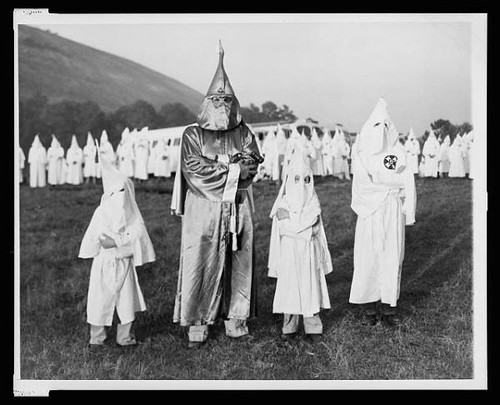
Hence the relationship between the White Citizen's Council and the Ku Klux Klan. Between Newt Gingrich and uneducated voters who come to hear his coded tirades out. Chuck Colson and older Evangelicals trying to shut up their more social-justice-oriented Evangelicals - typically younger folks like most of you, myself, Rachel Held Evans, Kurt Willems, Fred Clark of Slacktivist... But also older, more established activists, believers, and groups that are both Evangelical and concerned about the 'least of these': Tony Campolo, Dr. John Perkins and the Christian Community Development Association, Rob Bell, as well as any Christian that dare have some connection with the Occupy movement.
To not attack dissidents subtly or boldly through getting fellow sufferers against them is a sure way for the power elite to relinquish power.
But let's reconsider the bond between the White Citizen's Council and the Ku Klux Klan. Although they both were prominent in the fight against the civil rights movement of the fifties and sixties in the American south and both were fearful of the rise of black power and their lack of economic or political power therein, the constitution of each was distinct. Whereas the latter consisted of working class men, the WCC were the powerful elite: politicians and city elders, mayors and preachers, governors and leading businessmen. The Klan worked exclusively in intimidation and brute violence. The Council was a little more shrewd, however.
However, despite these tangible differences, the two groups worked in perfect symbiosis - each rubbing the back of the other. The WCC was able to say that they don't traffic in violence by comparing themselves to the obvious terrorism tactics of the KKK. Meanwhile, they spurred violence in their rhetoric given in public speeches (which were attended by Klan members). The Council was able to use the Klan as a moral guard (See?At least we're not like them!) while the KKK was able to use the WCC as a moral impetus. The Council sanctioned the violence that the KKK carried out, but then washed their hands of the bloody affairs (with a knowing *wink*), once the shootings or lynchings occurred.
Do you sense a pattern here? It's the pattern of the powerful. D&C and then re-write history.
When they take over property and goods and resources and any other means to self-preservation, they set themselves up as experts and gods. Then they tell those they've dis-empowered from that their real enemies are those people in even worse conditions. Then they watch, disengaged, as those struggling groups rip each other apart.
Of course, if the poor White and Black groups could work together, they'd be unstoppable and they could be secure in having enough food and land to secure what they need. But as long as the elite kept the poor whites and blacks fighting for scraps... well, people are hungry.
In my religious tradition - or at least for the last thirty years - that's meant that a Francis Schaeffer or a Chuck Colson or a Jerry Falwell or a James Dobson will tell the rest of us who or what our "real" enemy is.
And though they'd NEVER {faint} approve of violence against Muslims or homosexuals, they lobby violently against them, doing actual damage of ostracizing, maligning, and humiliating those who are different. Non-Christians and non-straights are scorned and denied basic civil rights that others hold. Constantly held in contemptible suspicion, these crews are perpetually suspended in a secondary citizenship status specifically because conservative Christian leaders aim to maintain their power base of fear. And that's just their direct actions, - the specific lobbying and ignorant preaching against homosexuals, against Muslims and other non-Christians (secular, atheists, Buddhists, etc.), often against the poor, against those whom may threaten communism.
None of these tactics or topics, are advocated by Jesus, of course. But that doesn't keep them from being top priorities for the so-called Moral Majority.And if the leaders say those things are evil from their (bully) pulpits, what can the congregants do but to listen? And then to attack and hurt and bomb the mosques, or mock the little "butch" girl until she hangs herself.
This is the face of bullying. Bullying works most efficiently when it's a scare tactic of the powerful to maintain their own power and keep the rest of us occupied.
And so, (dialectic history lesson approaching!) a couple years ago, when Obama began in office and he was extremely popular, Newt Gingrich, of all people, figured that Republicans can attack Obama and, in so doing, may recover some prominence. He was right, politically speaking. By blocking and obstructing the Democratic Party, the Republican Party actually may have prolonged the recession (though that is debatable), slowed down any growth for many middle class and working-class families, and made Democrats look like spineless cowards. It worked in that sense, but it has done tremendous harm to the typical American family while income inequality has spread incrementally even more so.
The rich are getting richer and the poor are getting poorer. And Newtron Gangly actually helped to make that possible.
So, what is his solution? Fire unionized janitors at schools and hire the students to clean up the schools. Because, he reasoned, inner city students (read: African American and Latino youth and children) are surrounded by inner city adults (read: African American and Latino adults) and therefore, have neither an innate desire to work for pay* nor any role models to teach them how to do an honest day's worth of legal labor. Never mind that this isn't true in the least (we will get to that in a separate blog), but the fact that he was scolded off the planet and IN FACT leads the Republican nomination now does not bode well for our country.
But it's okay, right? Because Gingrich's hands are clean. He's not going to actually go out and personally intimidate young children of working class, Black and Latino kids and refuse to acknowledge their humanity. Right? And his party would NEVER intentionally kick out large swaths of working middle-class African Americans, while simultaneously blaming them for every social evil in the planet - therefore setting the stage for a violent confrontation over non-existent means to survive. Because that would be evil. Right?
So, yeah, N00t is trying to re-write history. And if we don't learn and share the lessons of history - of how the powerful elite claw and maintain their power through our shared sacrifices and in-fighting - then we will continue to lose out.
There are always going to be conservatives - those who, by definition, believe that society is working just fine, that we should not struggle so hard for new things. New developments, they argue, may be at odds with the natural and right order of the world*, or they may be good things that will come about in their due time if we only wait for the good timing of the good people running the town.
Of course nothing is perfect, they reassure us. So when we replace one system, we'll just get another imperfect one to replace it and we'll have to ask, why oh why did we ever waste so much time and energy? Because, rest assured, that system will be just as bad as - if not worse than - the one that it replaced.
It is understandable that the rich and powerful beat this drum. It is their livelihood that is in danger if the world were to turn upside down and every person demanded what was theirs to have. The only reason it's unsurprising that women and minorities and working class white males add their gongs and timpanies and harps and bongos and shakers and tom-toms and djembes and horns and keys and cymbals and whistles and chimes and congas to the deafening cacophony is because history has shown this to be the case time and again. The house slave is elevated above the field slave for the master's own manipulative purposes. The white sharecroppers often side with the white shareholders, not just because of their shared skin color (which is a component), but also because they are afraid of losing what little they have, not to mention losing the remote possibility that they may one day be rewarded for playing according to the rules and see a plentiful harvest in their days.
It all reminds me of teaching in the public schools. I wasn't the best. I wasn't anywhere near what I wanted to be as a classroom manager. A few managed to do all right, though. Some of my colleagues managed to excel. But at a great price. The odds were stacked against our students and they knew it. Whereas white kids in the burbs had a pretty good idea of the options in front of them, most of our Latino and African American students did not see a correlation between what we were offering in the classroom and what few options the world offered them after they left campus - whether for the day or for good.
Largely as a result of this disconnect, I think, and as a growing disconnect between the black young male and his environment (wherein many of the older would-be role models are incarcerated) male black students almost routinely envision themselves as pro-basketball stars. Against impossible odds, this is where they hope to be. The ONLY place they can see themselves. The very system comprised of systemically isolated and ostracized individuals within larger, but forcibly broken communities - made of impoverished youth and women, imprisoned and blackballed men, and a tiny sliver of very wealthy athletes playing for even wealthier white men - this system should not be questioned because it means the end of an impossible dream.
This dream will only be realized for 1 out of every 1,000 of those who are enthralled in it. For the other 99.9%, they are simply victims in its horrible wake.
As odd as it may be for the police state apologists to recognize thus, however, they are in a similar, fantastic and fatalistic predicament.
-------------------------------------
*c.f., Slavery, Apartheid, Jim Crow, the need for universal health care
What happens when you mix worthless "historians" with America-first jingoism, abysmal nationalism, horrible writing, and crap-awful animation?
Mike Huckabee presents Learn Our History dot Com! Watch out for the pop-up talking Mike Huckabee, by the way.
You can view the whole video by purchasing it from LOH (hmmm... is this a secret giveaway?) for the low price of $10. In fact, if they sell two copies, they will run a profit!
Alisa made me consider putting in the hilarious (and awfully ironic, coming from the Religious Right theocrats and war-mongers) WWII sneak-peek as well.
Notice how swiftly they move those bikes on the beach to avoid becoming collateral damage!
Notice how passionate the newsie is as he talks about enlistment!
Notice that Hitler is talking about his mission being from God (and how they have to get rid of an inferior race)!
"Even the gals were in on it!"
You go, girl!
All this - AND MORE - can be yours for the low, low price of around fifteen dollars.
Have you ever heard of a history textbook not written by a historian - or at least an acknowledged history teacher? Have you ever heard of a history book's content coming almost exclusively from Teh Google?
Now, I know times are hard. States and municipalities have budget shortfalls because of this lousy economy, and they need to make up ground somewhere. Every public good is under the microscope... But, still. Messing with education (in this case, by giving them vastly inferior textbooks) is messing with the region's abilities to compete and hold its own in the near future (which is part of the reason that arguments against educating immigrants' children doesn't make a lick of sense). But that's my theory of what's behind these shoddy textbooks.
I can't be the only person who thinks that these districts should be fully refunded, right? Then again, maybe they can do a swap with Texas...
In order to understand where Chicago is going, we must look back to where Chicago was. In order to put the current mayoral run in Chicago into perspective, we must look back at the singularly most powerful figure in local politics from the last century, Mayor Richard J. Daley.
From Adam Cohen and Elizabeth Taylor's magnificent American Pharaoh's prologue:
Daley, who served as mayor of Chicago from 1955 until his death in 1976, was the most powerful local politician America has ever produced. He possessed a raw political might that today, in an age when politics is dominated by big money and television, is hard to imagine. He personally slated, or selected, candidates for every office, from governor to ward committeeman.... When he wanted something from them - whether it was a congressman's vote on the national budget or a patronage position in the county sheriff's office - he almost always got it... But Daley's influence reached far beyond the borders of his city and state. His control over the large and well-disciplined Illinois delegation made him a kingmaker in selecting Democratic candidates for president -- he was, Robert Kennedy once declared, "the whole ballgame."
To what end did Daley use all of this power? He reigned in an era rich with ideological leaders. Martin Luther King Jr. was battling for civil rights, and George Wallace was fighting for segregation; Eugene McCarthy was campaigning to end the Vietnam War, and President Johnson was struggling to win it. Daley had an ideology of his own: the flinty conservatism that prevailed in Bridgeport and in much of white ethnic, working-class America in the 1950s and 1960s. A devout Catholic and loyal machine member, he believed deeply in authority. He favored the strong over the weak, the establishment over dissidents. Daley liked presidents, business leaders, and powerful institutions; he was offended by anti-war protesters, civil rights protesters, and hippies, who sought to influence policy without doing the hard work of prevailing at the ballot box. Daley believed that poor people should pull themselves up by their bootstraps, as his Bridgeport neighbors struggled to do. And he believed in racial segregation, of the kind that prevailed in his own neighborhood. Blacks stayed in the Black Belt to the east of Wentworth Avenue, and whites stayed to the west.
Daley shaking his fist at those d***ed hippies at the DNC in Chicago in '68. More on this story here, where I lifted this pic.
Those were Daley's views, but his agenda in office was less complicated: he was motivated first and foremost by a drive to accumulate and retain power. That was the way of the Chicago machine, and it was Daley's -- make deals and share the wealth with the Church or the syndicate, with black political leaders or anti-black neighborhood organizations, and with anyone else whose votes would help elect the machine's candidates. Daley's primary test of a political cause was whether it would increase or decrease his power... He formed alliances with politicians who could deliver votes, and ruthlessly cut them off when they were no longer useful - or when they became so strong that they posed a threat.
Daley came to see the great liberal crusades of the 1950s and 1960s - civil rights, the War on Poverty, and anti-war movement - as a threat to his power, and he battled against all of them. His focus was Chicago, but his power and influence were such that he ended up quickly shaping the national agenda. Nowhere was this more true than on civil rights. Daley was elected at the dawn of the civil rights era... The ... movement first took hold in the South, where Jim Crow enshrined racial segregation in the law books, but its implications for Chicago were substantial. The city was in the midst of a demographic revolution when Daley took office. The city's black population was reaching record levels, as trainloads of blacks fled their hard lives in the rural South for the promise of a better life in northern cities.
Chicago under Daley became America's major northern civil-rights battleground. After his success in the South, and after winning the Nobel Peace Prize, Martin Luther King Jr. decided to take his movement to the North - and he chose Chicago as the place to start it off. King moved into a tenement on Chicago's South Side for eight months in 1966 and spearheaded the Chicago Campaign, personally leading open-housing marches into the city's white neighborhoods. Daley responded to King's drive with a brilliant campaign of his own. Daley did not make the same mistake so many southern governors and mayors had: he refused to let the movement cast him as the villain in its drama. In the end, Daley's handling of the Chicago Campaign would have far-reaching effects on the civil rights movement across the country. Daley also played a key role in preserving racial segregation in education, both in Chicago and nationally. Chicago's public schools were nearly as segregated as the southern schools that were being ordered by federal courts to integrate. Daley fought back attempts to integrate Chicago's public schools, and took on the federal government when it tried to force school desegregation on the city.
Daley was also a leading opponent of President Johnson's War on Poverty, and again his victory was felt far beyond Chicago. Daley did not share Johnson's moral commitment to using government programs to lift the disadvantaged up from poverty, but his greatest objections were political. Johnson's poverty programs incorporated the liberal notion of "maximum feasible participation," which meant that poor people should have as much control as possible over how poverty programs were run. Daley saw these programs as a threat to the machine, because they put money and power in the hands of independent community activists.
It goes on to acknowledge his great, grand mid-20th century accomplishments: the wide Dan Ryan expressway, the busy O'Hare Airport, the tall Sears Tower, the illustrious Magnificent Mile. But then the authors note that these accomplishments worked to further segregate the city and to give the greatest benefits to the wealthiest.
The segregation is still widely felt within this city, whether through the forced displacements of gentrification or through the apartheid-like differences in schools with nearly universal Black and/or Latino students versus those serving more White students.
It's important to know that the city has a history of strong segregation, because then one may understand why a progressive Black candidate like Danny K. Davis would give up his mayoral run (a fairly decent one) in order to give his endorsement to Carol Moseley-Braun (who is much more centrist), so that an African-American can stand a better chance against the White candidate, Rahm Emanuel (who is being supported now by former President Clinton). Ordinarily, wouldn't one progressive want to support another progressive - if that progressive truly believed in progressive causes? I think so, but in this case, the segregation issue was just too big to ignore. (Although a true progressive policy would make it so that all parties are heard and given a true chance to succeed. Which is what I believe that Miguel del Valle offers.)
Aaron Huey, photographer, spent some time with the Lakota people. Here he presents a chronological history of lies, broken promises, and war-ish aggression against the tribes cut against contemporary photos of the people and their communities.
In fact - and I had never considered this before - he refers to the reservations as "Prisoner of War Camps." Definitely worth a view. I'll have to watch again.
I'm here today to show my photographs of the Lakota. Many of you may have heard of the Lakota, or at least the larger group of tribes called the Sioux. The Lakota are one of many tribes that were moved off their land to prisoner of war camps now called reservations. The Pine Ridge Reservation, the subject of today's slide show, is located about 75 miles southeast of the Black Hills of South Dakota. It is sometimes referred to as Prisoner of War Camp Number 334, and it is where the Lakota now live. Now, if any of you have ever heard of AIM, the American Indian Movement, or of Russell Means, or Leonard Peltier, or of the stand-off at Oglala, then you know that Pine Ridge is ground zero for Native issues in the U.S.
So I've been asked to talk a little bit today about my relationship with the Lakota, and that's a very difficult one for me. Because, if you haven't noticed from my skin color, I'm white, and that is a huge barrier on a Native reservation. You'll see a lot of people in my photographs today, and I've become very close with them, and they've welcomed me like family. They've called me brother and uncle and invited me again and again over five years. But on Pine Ridge, I will always be what is called wasichu, and wasichu is a Lakota word that means non-Indian, but another version of this word means "the one who takes the best meat for himself." And that's what I want to focus on -- the one who takes the best part of the meat. It means greedy. So take a look around this auditorium today. We are at a private school in the American West, sitting in red velvet chairs with money in our pockets. And if we look at our lives, we have indeed taken the best part of the meat. So let's look today at a set of photographs of a people who lost so that we could gain, and know that when you see these people's faces that these are not just images of the Lakota, they stand for all indigenous people.
I want it to be abundantly clear that my post yesterday was not a salvo in some War on Thanksgiving. I abundantly love this feast of abundance - as my girth can attest. I love spending time with family. I love turkey. I love tryptophan and naps. And sweet potato and pumpkin pies. And NFL games somewhere playing in the fray.
But history needs to be acknowledged in full. Too many of our friends and neighbors and cousins have suffered too long because we are too full of ourselves to acknowledge that we and our families have done and do bad things.
A friend found my last post to be too anti-Thanksgiving. Granted, the story within the story does seem awfully harsh. I do not, however, apologize for another writer's excesses (if that's how one wants to describe them as). If that's how Robert Jensen feels, that's how he feels. I have no qualms nor arguments therein. I also would not be angry with various indigenous tribes people who also felt a need to not acknowledge the Thanksgiving tradition in this country as some sort of benevolent or good remembrance. After all, do we recognize their fests, let alone their sufferings? Can one enjoy one without sharing the other?
I however, would like to talk about our history as a means of redeeming ourselves, rather than the lazy work of redemptive 'history' that's been making its way through the Great American Redemptive Mythos.
This, then, is my response to my friend:
If the blog comes across as anti-Thanksgiving, that is my error in message control. I'll have to check and edit then.
My intention, however, wasn't to butcher the day - one of my favorites - but to highlight a much-neglected context.
If I heard correctly, Winthrop hosted a second large Thanksgiving feast fifteen years after the initial one to thank God for their successful campaign against the lpcal tribes*. We need to tell our history straight. It needs to include both the inclusion and the exclusion, welcoming and murder, community and violence.
To do less is to do a disservice to our heritage and to neglect our current DNA as well as its majestic and horrible potential.
We can begin to remedy the situation by taking simple steps. Like spreading support for current laws to support current tribes, such as the H.R. 1385:
Title: To extend Federal recognition to the Chickahominy Indian Tribe, the Chickahominy Indian Tribe-Eastern Division, the Upper Mattaponi Tribe, the Rappahannock Tribe, Inc., the Monacan Indian Nation, and the Nansemond Indian Tribe. This Act may be cited as the `Thomasina E. Jordan Indian Tribes of Virginia Federal Recognition Act of 2009'.
....
There is a provision in current law that allows unrecognized tribes to gain recognition through appeal to the Bureau of Indian Affairs. Source
Virginia's Racial Integrity Act of 1924 has hurt the Virginia tribes in their prior appeals to the BIA, according to the Washington Times. Tribe officials say the Act forced Indians to identify themselves as "colored" and led to the destruction and alteration of genealogical records. Source
Tribal proponents say the Virginia law amounted to a "paper genocide" and makes the bureau process difficult for the six groups, although there are some genealogical records that do exist and have been submitted to the bureau. Va. Gov. Tim Kaine called the vote "a major step towards reconciling an historic wrong for Virginia and the nation." Source
President Barack Obama has reversed from past presidents and pledged to support recognition of the Lumbee Tribe, which has sought federal oversight for more than a century. According to the AP, Obama has not said whether he will support recognition of the Virginia tribes. Source
Update: Clarification on any perceived anti-Thanksgiving bias and a chance for action here.
In looking to the United States' history as a nation of genocidal power over the original Nations (Native Americans, the Tribes, Indians, First Settlers), Robert Jensen asks how we can just so easily rub aside our murderous past? Especially as this murderous past is not *just* our past, but - I add - a part of our very current DNA.
How does a country deal with the fact that some of its most revered historical figures [Washington, Jefferson, T Roosevelt] had certain moral values and political views virtually identical to Nazis [in desiring all 'Redskins' to die]? Here's how "respectable" politicians, pundits and professors play the game: When invoking a grand and glorious aspect of our past, then history is all-important. We are told how crucial it is for people to know history, and there is much hand-wringing about the younger generations' lack of knowledge about, and respect for, that history.
In the United States, we hear constantly about the deep wisdom of the founding fathers, the adventurous spirit of the early explorers, the gritty determination of those who "settled" the country -- and about how crucial it is for children to learn these things.
But when one brings into historical discussions any facts and interpretations that contest the celebratory story and make people uncomfortable -- such as the genocide of indigenous people as the foundational act in the creation of the United States -- suddenly the value of history drops precipitously, and one is asked, "Why do you insist on dwelling on the past?"
This is the mark of a well-disciplined intellectual class -- one that can extol the importance of knowing history for contemporary citizenship and, at the same time, argue that we shouldn't spend too much time thinking about history.
Our past does not just lie in our past, but it is a part of our national character, and as long as we can spin it so that we are a benevolent and graceful people, then we can continue atrocious acts of imperialism and genocide throughout the world (what is The War on Terror if not a small-scale act of genocide being perpetuated against Muslims and Arabs?).
Jensen further:
This off-and-on engagement with history isn't of mere academic interest; as the dominant imperial power of the moment, U.S. elites have a clear stake in the contemporary propaganda value of that history. Obscuring bitter truths about historical crimes helps perpetuate the fantasy of American benevolence, which makes it easier to sell contemporary imperial adventures -- such as the invasion and occupation of Iraq -- as another benevolent action.
Very simply and close to home, how can we continue to live as if nothing horrible actually happened between the White structure of the US and the various indigenous tribes and nations? If we can come to grips with this, maybe then "illegal" immigration won't be such a bother*. To further this: how can we now go about and trivialize their histories by naming professional and collegiate sports teams after them? We profit from their misery and then offer that somehow we are "honoring them"? Imagine Henry Ford had killed my great-grandparents and all of their brothers, sisters, and cousins some eighty years ago because they were standing in the way of progress. And now his company wants to introduce the Dye brand of luxury cars?
If the Native tribes say that we are dishonoring them, than we should probably listen to them. If not, we are triply dishonoring them, first by the initial act of dishonor, then by not listening to them, and third by being racist enough to not consider their opinions about themselves as being even equal to our opinions of them.
*As it is, many White opponents to immigration contend somehow that the European settlers had broken no laws in emigrating to what is now the US. I guess the universe doesn't have laws? Let alone, the Bible that they were supposed to follow? But this absurdity and logic FAIL demonstrates the reality that laws benefit those who write them. If only those Injuns had lernt to read and write some laws, then...
A few thoughtful blog posts have been written recently concerning the American Independence celebrated on July 4th here, and often uncritically embraced by some of the more conservative American churches. All of the following blogs (most written by facebook friends) are written by American Christians who are somewhat critical of Nativism and uber-patriotism (none of them, as far as I can tell, would be described as a radical or America-hater, except by those on the far-right I suppose):
As Christians, we need to recalculate our past and allow the gospel to be critical of certain things we now celebrate. Is it honorable to kill because people don’t like being taxed? I think the Jesus who says, “Love your enemies and pray for those who persecute you” would probably say “No.”
Church historian Mark Noll said the following in an article he wrote for Christianity Today about just war and the Revolutionary War:
During this confused misunderstanding, the Bible was used as a reservoir of images, moral principles, and types. Many sermons in America (and some in Britain) supported revolt, while a few in America and England argued against it. Serious exegesis, however, of what would seem to us like the relevant passages (such as Romans 13) was very rare. Rather, it was much more common for patriots to liken George III to Pharaoh and George Washington to Moses, or to depict the conflict as a struggle between the Woman and the Beast of Revelation 12. Patriots and Loyalists were both much more likely to add scriptural authority to political reasoning rooted in some other ideology than they were to attempt reasoning from the ground up on the basis of Scripture.
This war was not rooted in scripture but in a false political agenda. Noll reminds us of how history played itself out: “Americans fought a war to gain the kind of freedom that Canada, New Zealand, and Australia were simply given after not too many decades.” Our nation, in other words, killed other Christians in order to gain independence that would have eventually been granted to them in a “just” fashion, had the founding fathers not been so trigger-happy over issues of taxation.
1) American colonists had the world's highest standard of living in 1776. Not much economic suppression there.
2) The rallying call of "no taxation without representation" ignores the fact that the vast majority of the English at the time did not meet the property requirements for voting. Even John Wesley opposed the war on these grounds, pointing out that not even he could vote.
3) The media's reporting of most of the events leading up to the war was sensational at best. Take the "Boston Massacre" as an interesting case study. One of our key Founding Fathers and future presidents, John Adams, agreed that the "massacre" was provoked by drunk Americans and was no massacre but was self-defense, as evidenced in the legal defense and acquittal he provided for those soldiers despite the personal fear he had over the negative impact it'd have upon his political ambitions.
1. The most critical of celebrating July 4th on Sunday are progressive evangelicals and liberals. 2. The defining characteristic of progressive evangelicals and liberals is justice. 3. Celebrating freedom and release from oppression and reveling in the achievement of peace and justice are God-directed in the Bible.
I think the critics are missing a great opportunity.
So, let's turn the day into a universal celebration of justice. Let's not hear about muskets and the British Crown and Boston; let's hear about the importance of peace and justice and that God wants us to live justly.
That's the argument I was given just now on a Facebook thread. I guess the argument flows from the logic that because modern medicine (and the ability to mass administer it) is so novel and expensive that there is no precedent for it. It doesn't fit into the rubric of older, now-established human rights. Or at least that's the thought.
The same argument was made before. But allow me the liberty to transpose. Because the underlying, unstated argument is that you can only get adequate health care if you can afford it and/or you're fortunate enough to work in one of the remaining companies that's still covering its employees. It's a bit like saying that you can only vote if you're white enough. Or male enough. Or landed enough. You can only enter into an establishment if you're considered human (read: not like those blackish brutes) enough. Your lips can only touch this water fountain, your children can only enter this school if you are white enough - coming from the God-blessed European roots. Oh, and preferably Protestant...





Jason M Dye Game Time! Let's do history as told through tweets today. Funucational!!