The essence of the Southern economic model is not low taxation, but a lack of bargaining power by Southern workers of all races. Bargaining power at the bottom of the income scale is created by tight labor markets; unions; minimum wage laws combined with unemployment insurance; and social insurance, such as Social Security and Medicare and Medicaid.
Naturally, the 21st-century descendants of Jefferson Davis and John C. Calhoun want to weaken everything that strengthens the ability of a Southern worker to say to a Southern employer: “Take this job and shove it!”
Tight labor markets are anathema to Southern employers. They want loose labor markets that create a buyer’s market in wage labor. That is why, at a time of mass unemployment among low-skilled workers in the U.S., most of the calls for expanding unskilled immigration in the form of “guest worker” programs are coming from Southern and Southwestern politicians. Guest workers — that is, indentured servants bound to a single employer and unable to quit — are the ideal workers, from a neo-Confederate perspective. They are cheap and unfree.
The article is worth a read. But it contributes to the malaise of false dichotomies. As if the North and the Rustbelt weren't taking on these same practices. Wisconsin, Indiana and even Michigan have elected pro-big business governors and legislatures who are working hard to dismantle worker's rights to bargain and act as professional organizations to temper corporate malaise affecting both the public and private sectors. Even union-happy Chicago is under attack from our overwhelmingly-elected mayor, a Democrat who was former Chief of Staff for President Barack Obama.
So, yeah, there's that. Meanwhile, capital created by workers continues to climb back to the top - or rather, flow back to the lowest levels- the ultrarich. But it's the working poor who are blamed for being poor and demanding anything of worth for their work. Got it.
Oh, and there is this from Lind's article for my fellow Christians who either hear or peddle the nonsense that charities should take care of the poor, not government (and for whom the words "economic justice" do not ring a bell):
In order to maximize the dependence of Southern workers on Southern employers in the great low-wage labor pool of the former Confederacy, it would be best to have no welfare at all, only local charity (funded and controlled, naturally, by the local wealthy families).
Peruvian professor, author and theologian Gustavo Gutierrez wrote a primer on Latin American Liberation Theology, A Theology of Liberation five years after the first conference of Catholic bishops met in Medellin, Colombia to talk about this emerging theology from and of the poor and indigenous of the regions south of the United States. Some years after the groundbreaking work had begun to be cataloged by Gutierrez, the movement thoroughly expanded to other continents, and to other repressed people - including those within Latin America. And Gutierrez recognized this and added a chapter-long introduction called "Expanding the View." It is from this introduction that we present our Lazy Sunday Reading.
In the final analysis, poverty means death: lack of food and housing, the inability to attend properly to health and education needs, the exploitation of workers, permanent unemployment, the lack of respect for one's human dignity, and unjust limitations placed on personal freedom in the areas of self-expression, politics, and religion. Poverty is a situation that destroys peoples, families, and individuals; [the Liberation Theology conferences of] Medellin and Puebla called it "institutionalized violence" (to which must be added the equally unacceptable violence of terrorism and repression).
At the same time, it is important to realize that being poor is a way of living, thinking, loving, praying, believing, and hoping, spending leisure time, and struggling for a livelihood. Being poor today is also increasingly coming to mean being involved in the struggle for justice and peace, defending one's life and freedom, seeking a more democratic participation in the decisions made by society, organizing "to live their faith in an integral way" (Puebla), and being committed to the liberation of every human being.
All this, I repeat, goes to make up the complex world of the poor. The fact that misery and oppression lead to a cruel, inhuman death, and are therefore contrary to the will of the God of Christian revelation who wants us to live, should not keep us from seeing the other aspects of poverty that I have mentioned. They reveal a human depth and a toughness that are a promise of life. This perception represents one of the most profound changes in our way of seeing the reality of poverty and consequently in the overall judgment we pass on it. ...
Various experiences of being a part of the world of the poor have brought me to a less theoretical knowledge of that world and to a greater awareness of simple but profoundly human aspects of it, apart from which there is no truly liberating commitment. The struggles of those who reject racism and machismo (two attitudes so deeply rooted in the culture and custom of peoples and individuals), as well as of those who oppose the marginalization of the elderly, children, and other "unimportant" persons in our society, have made me see, for example, the importance of gestures and ways of "being with" that some may regard as having little political effectiveness.
In addition, the experience of these years has shown me that generous solidarity with the poor is not exempted from the temptation of imposing on them categories foreign to them and from the risk of dealing with them in an impersonal way. Sensitivity to these and other dangers is part of a human and Christian praxis whose truly liberating effects extend to those also who are trying to carry on such a praxis for the benefit of the poor and exploited. If there is no friendship with them and no sharing of the life of the poor, then there is no authentic commitment to liberation, because love exists only among equals. Any talk of liberation necessarily refers to a comprehensive process, one that embraces everyone.
Shout with the voice of a trumpet blast. Scratch the needle on the DJ's table!
Shout aloud! Don’t be timid.
Tell my people America of their sins!
Yet they act so pious, so righteous, so deserving!
They come to the Church every Sunday and Wednesday,
and seem delighted to learn all about me.
They act like a righteous nation
that would never abandon the laws of its God - they even make laws in my name.
They ask me to take action on their behalf,
pretending they want to be near me.
‘We have fasted before you! We have committed prayers,’ they whine. ‘Why aren’t you impressed? We sure are!
We have been very hard on ourselves,
and you don’t even notice it!’
“I will tell you why!” I respond.
It’s because you are fasting to please yourselves. Even while you fast, you keep oppressing your workers.
What good is fasting
when you keep on fighting and quarreling?
This kind of fasting
will never get you anywhere with me.
You humble yourselves
by going through the motions of penance,
bowing your heads
like reeds bending in the wind. You dress in sadness and cover yourselves with ashes. You cry during prayer gatherings. You bemoan presidents and policies.
Is this what you call fasting? Do you really think this will please the Lord?
No, this is the kind of fasting I want: Free those who are wrongly imprisoned;
Then your salvation will come like the dawn,
and your wounds will quickly heal.
Your godliness will lead you forward,
and the glory of the Lord will protect you from behind.
Then when you call, the Lord will answer.
‘Yes, I am here,’ he will quickly reply. Remove the heavy yoke of oppression. Stop pointing your finger and spreading vicious rumors! Feed the hungry, and help those in trouble.
Then your light will shine out from the darkness,
and the darkness around you will be as bright as noon.
The Lord will guide you continually,
giving you water when you are dry
and restoring your strength.
You will be like a well-watered garden,
like an ever-flowing spring, full of veggies and fluoride-free.
Some of you will rebuild the deserted ruins of your cities. Then you will be known as a rebuilder of walls
and a restorer of homes.
Keep the Sabbath day holy.
Don’t pursue your own interests on that day,
but enjoy the Sabbath
and speak of it with delight as the Lord’s holy day.
Honor the Sabbath in everything you do on that day,
and don’t follow your own desires or talk idly.
Then the Lord will be your delight.
I will give you great honor
and satisfy you with the inheritance I promised to your ancestor Jacob.
I, the Lord, have spoken!
(Slight edits to make it more contemporary. But really, shoot, what hasn't changed here?)
Essayist and book critic William Dereseiwicz wrote an opinion piece in the New York Times on Sunday called "Fables of Wealth." It's worth both lengthy excerpts and a few discussions, because its topic, a criticism of capitalism as a system that benefits psychopaths, is so rarely laid forth so brutally in mainstream press - even in so-called liberal media as the Times, even in an op-ed piece. But here we have it.
A recent study found that 10 percent of people who work on Wall Street are “clinical psychopaths,” exhibiting a lack of interest in and empathy for others and an “unparalleled capacity for lying, fabrication, and manipulation.” (The proportion at large is 1 percent.) Another study concluded that the rich are more likely to lie, cheat and break the law…
The only thing that puzzles me about these claims is that anyone would find them surprising. Wall Street is capitalism in its purest form, and capitalism is predicated on bad behavior...
Enron, BP, Goldman, Philip Morris, G.E., Merck, etc., etc. Accounting fraud, tax evasion, toxic dumping, product safety violations, bid rigging, overbilling, perjury. The Walmart bribery scandal, the News Corp. hacking scandal — just open up the business section on an average day. Shafting your workers, hurting your customers, destroying the land. Leaving the public to pick up the tab. These aren’t anomalies; this is how the system works: you get away with what you can and try to weasel out when you get caught...
There are ethical corporations, yes, and ethical businesspeople, but ethics in capitalism is purely optional, purely extrinsic. To expect morality in the market is to commit a category error. Capitalist values are antithetical to Christian ones. (How the loudest Christians in our public life can also be the most bellicose proponents of an unbridled free market is a matter for their own consciences.) Capitalist values are also antithetical to democratic ones. Like Christian ethics, the principles of republican government require us to consider the interests of others. Capitalism, which entails the single-minded pursuit of profit, would have us believe that it’s every man for himself...
Wall St Solo - Montusci via Flickr
And on the "Wealth Creators" and "Shouldn't the Risk-Takers and the Hard-Workers and the Smartest Earn their Rewards?" fables:
[I]f entrepreneurs are job creators, workers are wealth creators. Entrepreneurs use wealth to create jobs for workers. Workers use labor to create wealth for entrepreneurs — the excess productivity, over and above wages and other compensation, that goes to corporate profits. It’s neither party’s goal to benefit the other, but that’s what happens nonetheless...
MOST important, neither entrepreneurs nor the rich have a monopoly on brains, sweat or risk. There are scientists — and artists and scholars — who are just as smart as any entrepreneur, only they are interested in different rewards. A single mother holding down a job and putting herself through community college works just as hard as any hedge fund manager. A person who takes out a mortgage — or a student loan, or who conceives a child — on the strength of a job she knows she could lose at any moment (thanks, perhaps, to one of those job creators) assumes as much risk as someone who starts a business.
He then ends with a quote by Kurt Vonnegut from Slaughterhouse 5, but I'd like to excerpt a longer quote:
America is the wealthiest nation on Earth, but its people are mainly poor, and poor Americans are urged to hate themselves.... It is in fact a crime for an American to be poor, even though America is a nation of poor. Every other nation has folk traditions of men who were poor but extremely wise and virtuous, and therefore more estimable than anyone with power and gold. No such tales are told by American poor. They mock themselves and glorify their betters. The meanest eating or drinking establishment, owned by a man who is himself poor, is very likely to have a sign on its wall asking this cruel question: “if you’re so smart, why ain’t you rich?” There will also be an American flag no larger than a child’s hand – glued to a lollipop stick and flying from the cash register.
Americans, like human beings everywhere, believe many things that are obviously untrue. Their most destructive untruth is that it is very easy for any American to make money. They will not acknowledge how in fact hard money is to come by, and, therefore, those who have no money blame and blame and blame themselves. This inward blame has been a treasure for the rich and powerful, who have had to do less for their poor, publicly and privately, than any other ruling class since, say Napoleonic times. Many novelties have come from America. The most startling of these, a thing without precedent, is a mass of undignified poor. They do not love one another because they do not love themselves.
What Vonnegut says here is complicated and needs a moment to unpack. It has elements of damning truth and yet damning self-defeating lies in it. Throughout the history of the world, the most generous people have been the poor. But they've also tended to be those with the most violence inflicted upon them. The first to go to war, the first to be attacked, the first to go hungry or homeless, to last to receive medical attention, the last to be protected and the first to be unprotected. But with what little they have, they share. That's the nature of hospitality and community. That's why, when Sodom is condemned in the Hebrew Scriptures, it is for the sin of inhospitality (in both the Genesis and the Ezekiel accounts - both the Law and the Prophets condemned them for being mean to strangers and to their own). That's why Jesus tells his disciples to go from town to town and just accept the open arms and doors and meals of those they meet in their way. Because, generally speaking, they can expect to find that. It wasn't a miracle; it was the way of life. And if a town did not accept them? They were to insult them by wiping the dust from their feet.
People on Stairs - Patrick Moyan via Flickr
This level of hospitality is much harder to come by in America. We've been trained that being able is to be fully self-sufficient and completely independent. We've been trained to believe that if we're not self-sufficient, there is something wrong with us. We've been trained to believe that if we work hard and smart and long enough, we'll reach that plateau finally, the one we deserve - self-sufficiency and, even more anticipated, luxury. As a friend from the Middle East put it, in the US we are so used to outsourcing everything we are not able to find the assets of our own community.
This isn’t true across the board, even in America. Poor and working class communities of color tend to be more community-oriented than poor and working class white communities – but this culture of outsourcing and consumeristic value has deeply infected much of the African American community as well, which is part of the reason SUVs and items of clothing are symbols of status - are seen as a replacements for the breakdown and rape and humiliation of their history and culture by the ruling classes, who are eased by the social and psychological humiliation they've heaped on to lower class whites, many of whom blame other poor people - in addition to themselves secretly - for their status.
It is here where it becomes important to note that we need solidarity, not more division. But without recognizing the sources of our division, we cannot truly unite.
-------------------------------------------------
Now, about those studies that purport that the rich are less ethical than the poor?
Abstract:
In studies 1 and 2, upper-class individuals were more likely to break the law while driving, relative to lower-class individuals. In follow-up laboratory studies, upper-class individuals were more likely to exhibit unethical decision-making tendencies (study 3), take valued goods from others (study 4), lie in a negotiation (study 5), cheat to increase their chances of winning a prize (study 6), and endorse unethical behavior at work (study 7) than were lower-class individuals. Mediator and moderator data demonstrated that upper-class individuals’ unethical tendencies are accounted for, in part, by their more favorable attitudes toward greed.
Well, it seems my conservative Christian friends will finally get their chance to prove how awesome and correct they are if the House has its way.Representative Paul Ryan "aims to empower" those closest to the problem of poverty to do something about it by... Well, by putting the onus of caring for the poor directly and squarely and solely on their lap.
As Bread for the World notes, Congress is planning on leaving such a humongous multi-billion dollar hole (169,000,000,000 smackeroonis, in fact) in food assistance benefits that thousands upon thousands of families will starve. A few members of said Congress whom are proposing these cuts suggested that local religious organizations should plug in that hole. What they failed to mention is that each and every church or religious congregation in the US would have to pony up roughly $50,000 a year just to make up for this shortchange.
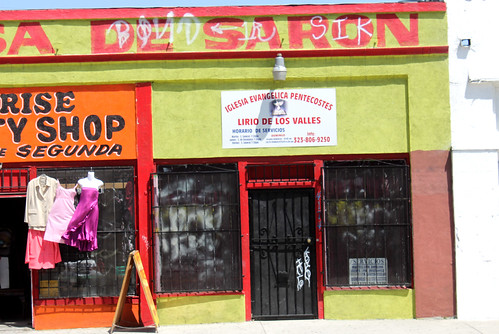
Churches like this one in LA. (Lord Jim via Flickr)
This isn't counting, of course, the staff and volunteer hours needed for this. This isn't counting the hours to pick-up, deliver, stockpile, organize, throw out bad food, and distribute the food.
The suggestion that churches rather than government should serve the poor is, in other words, foolishness that comes out of the mouths of people with little direct involvement in the actual work of food pantries, soup kitchens, congregational work (or lack thereof), church finances, congregational politics.
First, it's not an either/or issue. Local parishes/synagogues/mosques cannot possibly cover this need on their own, but they play an integral part of a much larger whole. Secondly, though there is a lot of money invested in our churches, most of it is centralized and/or tied into real estate which is not so easy to liquidate.
Which is not to say that congregations can't put in more than they are currently. Nor that communities shouldn't be the center of aid. But all of our interactions are, as a friend recently put it, outsourced. Which means, partially, that we need to recover them. Which means that we need to recover property that's centralized, which largely goes to profit for the benefit of a few. A few of whom go to big churches, where the majority of liquid church assets are apparently centralized.
Of course, it's all much more complicated than the way it appears here. Most churches that I've run into - tax-free or not - don't have that kind of money - even if they weren't to pay their light bills, heating, and the cost for the essential staff. Certainly not in those areas where the need is great. A few megachurches easily spend that much money and maybe more aiding some of the smaller churches in their sphere of influence. But there's no way that a Willow Creek - for instance - could possibly keep up with the needs of the most needy of such churches in its metro area, even splitting with other area megachurches.
And that's just in terms of just the money for the aid. What of workers?
There are good ways to fight poverty locally (I argue for local sustainability), there are barely adequate, problematic ways (relying on a greedy, full-of-itself, centralized US Congress, for instance), and then there are the ways of people who've maybe spent a couple days in food ministry and who spot a few people "misusing" food benefits and therefore give the US Congress a justification out of their basic moral obligation. But actual people starve when we say such stupid, ignorant bunk. "Deserving" or not.*
American Christians, join in the efforts of your local food pantry, soup kitchen, homeless outreach for about ten years. Limit your budget to about ten thousand a year for a few years (Oh, what's that? You got a family, you say? Ok, 18,000, then), while leasing - or trying to pay mortgage (Note: college years don't count). Evangelicals: Meet up with your local Christian Community Development Association-connected ministry and run your ideas by them. Catholics: I can think of any number of impoverished parishes you could join and assist.
Then feel free to speak up about the "unworthy" poor, or how the government is just getting in the way of volunteer and charity efforts.
Or, think about it in terms of cracks. What do you do when you see people falling through the cracks? You help them out, right? But what if those cracks are too big for you and all your friends to help out the millions of people falling through them? What if everybody around you was poor and in need of basic food? What do you do then? You seek assistance from where you can find it - even if it feels degrading to ask the government to help your family eat because you just don't make enough.
If this is not news to you, if you believe that the work of TANF is necessary to the survival of families and workers and the unemployed, please sign this petition.
------------------------------------------------
*It's beyond troubling that a religion which posits itself on grace and the idea that we are all made in God's image would allow for such anti-Christ talk.
Several years ago, a church that I was heavily involved in spent good parts of its summers bringing in youth groups from White suburban and exurban churches. This fulfilled a few needs. The need for the church to bring in some funds so it could pay its youth pastor full-time. The need for White youth a million miles removed from urban poverty to see it for a few days and feel better about themselves. The need for our neighbors to shake their heads at lost white kids in their neighborhood.
They usually did service projects, like picking up scattered trash in the neighborhoods and running Vacation Bible Schools. But, come to think of it, cleaning trash is probably a perfect metaphor for this type of poverty colonialism. White people coming to make a difference, not aware of their surroundings, not aware of who they are coming to serve, involved in futile projects that effectively shame those they are there to help. And then leaving - themselvesfeeling a little frustrated by the wind that blows all the trash back, by the generational sands of poverty that didn't recede during the three days of their visit, and by the humiliation of public service.
Although, I hasten to add, as far as these things are concerned, the church learned to take steps to educate their guests in a primer of urban living, using natives from the church for that task*. And I got to sit in during a screening of a local PBS documentary on the decades-long project of tearing down the notorious (but strategically located, prime real estate) Cabrini Green housing projects. The Greens were being shuttled for a mixed-income privatized project of town homes. The idea behind it is that the poor Black families that will remain (after the displacement of hundreds of families) will benefit from having upper middle class neighbors who diligently go to work every day to earn their keep and better their lives.
Some protest arose from the young viewers: How can the residents not want their help. It's obvious they need whatever help they can get!
Cabrini Green, from "Life in Chicago" by Pulitzer Prize-winning photojournalist John White, 1982. Found on Flickr.
This all struck close to home. After all, gentrification had been happening (and is still happening) in the surrounding neighborhoods and our own congregants were finding themselves unable to live in their neighborhoods anymore nd found themselves scattered from their networks of support and family. To those with plenty of money and who can afford alternatives methods of networking and support, this may not be such a primary need and they may not recognize it for what it is. But that's the heart of the matter of Poverty Colonialism: Educated white males are trained from an early age to truly believe we know better. This belies the heart of racism. We think we know better because - whether or not we have come to grips with it - we think we are better...
Teju Cole does an outstanding job of laying out the problems of Poverty Colonialism - what he and most others call the White Savior Industrial Complex (page 2 here) - in the Atlantic. I think the article needs to be required reading for all of us would-be saviors.
Some long-ish excerpts:
I disagree with the approach taken by Invisible Children in particular, and by the White Savior Industrial Complex in general, because there is much more to doing good work than "making a difference." There is the principle of first do no harm. There is the idea that those who are being helped ought to be consulted over the matters that concern them...
I am sensitive to the power of narratives. When Jason Russell, narrator of the Kony 2012 video, showed his cheerful blonde toddler a photo of Joseph Kony as the embodiment of evil (a glowering dark man), and of his friend Jacob as the representative of helplessness (a sweet-faced African), I wondered how Russell's little boy would develop a nuanced sense of the lives of others, particularly others of a different race from his own. How would that little boy come to understand that others have autonomy; that their right to life is not exclusive of a right to self-respect? In a different context, John Berger once wrote, "A singer may be innocent; never the song."
One song we hear too often is the one in which Africa serves as a backdrop for white fantasies of conquest and heroism. From the colonial project to Out of Africa to The Constant Gardener and Kony 2012, Africa has provided a space onto which white egos can conveniently be projected. It is a liberated space in which the usual rules do not apply: a nobody from America or Europe can go to Africa and become a godlike savior or, at the very least, have his or her emotional needs satisfied. Many have done it under the banner of "making a difference."...
How, for example, could a well-meaning American "help" a place like Uganda today? It begins, I believe, with some humility with regards to the people in those places. It begins with some respect for the agency of the people of Uganda in their own lives. A great deal of work had been done, and continues to be done, by Ugandans to improve their own country, and ignorant comments... about how "we have to save them because they can't save themselves" can't change that fact...
If Americans want to care about Africa, maybe they should consider evaluating American foreign policy, which they already play a direct role in through elections, before they impose themselves on Africa itself. The fact of the matter is that Nigeria is one of the top five oil suppliers to the U.S., and American policy is interested first and foremost in the flow of that oil. The American government did not see fit to support the Nigeria protests... This was as expected; under the banner of "American interests," the oil comes first. Under that same banner, the livelihood of corn farmers in Mexico has been destroyed by NAFTA. Haitian rice farmers have suffered appalling losses due to Haiti being flooded with subsidized American rice. A nightmare has been playing out in Honduras in the past three years: an American-backed coup and American militarization of that country have contributed to a conflict in which hundreds of activists and journalists have already been murdered. The Egyptian military, which is now suppressing the country's once-hopeful movement for democracy and killing dozens of activists in the process, subsists on $1.3 billion in annual U.S. aid. This is a litany that will be familiar to some. To others, it will be news. But, familiar or not, it has a bearing on our notions of innocence and our right to "help."
Let us begin our activism right here: with the money-driven villainy at the heart of American foreign policy. To do this would be to give up the illusion that the sentimental need to "make a difference" trumps all other considerations. What innocent heroes don't always understand is that they play a useful role for people who have much more cynical motives. The White Savior Industrial Complex is a valve for releasing the unbearable pressures that build in a system built on pillage. We can participate in the economic destruction of Haiti over long years, but when the earthquake strikes it feels good to send $10 each to the rescue fund...
-----------------------
* Full disclosure, I had an opportunity to go over the script with one of the groups. I laid it in a bit heavy. I try not to be such an arse in public anymore. But anybody who follows me here or on Facebook knows where I put that energy.
Be wary of the shrewd advice that tells you how to get ahead in the world on your own. Giving, not getting, is the way. Generosity begets generosity. Stinginess impoverishes.
- Mark 4 (The Message)
The poor tend to know this. Out of spirit, we share, knowing that we usually get back when it is necessary and when we least expect it. And often a hundred-fold. It's a communal, involuntary insurance.
And it leaves us being gracious for what we have in terms of not just property, but family.
But sometimes we give out of our poverty and we're hurt for it.
A fellow, a neighbor, a stranger, a cousin, burns us. Steals from us when we house him. Lies to us about her kid's hunger or medical needs. Jimmy bums loose squares, always promising to pay back and never delivering. Some real nice lady does a business transaction with us but she runs into some problems and in an effort to speed up the process, we end up losing thousands of dollars that we don't have. Roy comes over for dinner every other day but then starts mocking the food and service.
It's easy to forget. To become stingy at this point. To take on the work and personality of the world around us.
Let's not. Let's not succumb to use the tools of the mean-spirited. He is in solidarity with no one; he cannot even trust himself. He dies alone and miserable, and lives alone and miserable.
Let us be continuously generous, for then we live as free men and women. Our wages may be restricted, our generosity even trampled on, but when we abandon our sisters and brothers in their time of need, when we refuse to share in the bounty of our meager harvest, we break the bonds of humanity, of friendship, of family, of our own very selves.
Share. It will be given back to us. A thousand-fold.
Yesterday's Lenten reading was in Mark 3, where Jesus finds himself in the awkward position of defending his healing and feeding habits during the Holy Day. And in this, Jesus asks a simple question:
What kind of action suits the Sabbath best? Doing good or doing evil? Helping people or leaving them helpless?
(The Message)
What kind of action is truly holy? What kind of action is actually religious?
This brings us to austerity. Austerity is sanctions against the poor and assistance to the rich. Maybe that sounds disengenuous to some readers. But it is what it is: Leaving the poor, the elderly, the sick, and those with the least amount of help with little-to-no help. Under austerity, workers, seniors, and the working poor lose assistance, benefits, or sometimes even wages under the guise of state poverty. The state cannot afford to continue to sustain such lavish payouts, austerity advocates proclaim.
Yet on the other hand... Austerity gives humongous tax breaks to those who can most afford to pay their taxes. These corporations and extraordinarily wealthy people make their riches through the infrastructure afforded them by a free state. Yet the Austerians defend them and decry the leeching poor.
Yes, it's backwards. This that benefit the most are "heroes" and those exploited for the profits of the heroes are lazy parasites. Ayn Randism all over again.
Austerians claim that the way to help the poor is to hurt them into self-reliance. "Give a man a fish," begins their favorite proverb, "and he eats for a day. Teach a man to fish and he eats for a lifetime."
This is agreeable on the surface. Those of us who have had to or presently rely on some form of government aid would love to be able to make it by our own means. We do not want to rely on someone else's assistance and often feel worse for it. So getting help to provide for our own selves by our own means is something we tend to desire.
But that's not happening. Certainly not within Austeria.
- In Austeria, educational funding for the poor - already tremendously deficient - has been drastically reduced for profit. And despite what the Austerians are declaring, they themselves are not teaching the poor.
- In Austeria, the poor do not have access to the good water with the good, healthy fish. Those lakes and streams have been closed off - with high and wide electric fences, pinching dobermans, security guards with bees coming out of their mouths, moats filled with living fire.. Austerians claim that this is necessary. Their argument is that only the rich know how to properly care for the best resources. Somehow, we believe this nonsense.
- In Austeria, the waters that are available to the poor are tremendously polluted, dangerous, and filthy. The fish are limping along, gasping, gills cluttered with waste, scales covered with oil residue, vision impaired despite the new third eye. Yet it is the rich who have poisoned our waters and then charged the rest of us for their crimes.
--------
All of this is not to say that the poor are helpless, wailing away in incompetence. They have done stunningly well for generations with what little they are given. But that's a relative "stunningly well". As in, the poor may live meaningful and productive lives, but we constantly worry about our next meals, about our children's health, about our parents' care.
To allow the poor even less assistance while continuing to deny them access to the means to live securely is, simply put, evil.
Have mercy on our souls for allowing this evil to flourish, Jesus.
I'm reading a fascinating interview in The Boston Review with David Graeber, activist, anthropologist, and author of the book Debt: The First 5,000 Years, about the history and trap of debt, about how money is largely a way What the book does as a reading exercise is enliven one’s imagination to the multitude of possibilities there are in how we can think about debt.
One reason to spread the canvas so broadly—the same thing that drew me to anthropology—is that you fight the idea that all these questions are settled, that there’s really only one way to run the economy, the political system, society. What you see when you look at history, if you look anthropologically across the world, even at any one time, is a dazzling infinite variety of social possibilities. Which you would never have dreamed possible until you see them. It makes it much more difficult to make the argument that nothing except what we’ve got is possible.
One of the primary arguments that Graeber makes is that throughout history, the financing system has largely been rigged toward the lender. Even prior to money, there was lending and even then the lenders had the upper-hand. It follows that coin/paper currency was used as a way to broaden and strengthen the debtors' margins of profit.
This fits in with what we've been thinking here: That we need to rely less on paper and globalized currency and more on localized systems of organic economies. Not so much that currency is evil, but that a strict reliance upon it leaves most of the world indebted and imprisoned to the monied few. And this isn't how nature works nor how we act naturally. Currency-based economics actually colors and poisons our relationships.
Most interactions with people that you trust, people that you love, or people that just need to cooperate with on an immediate basis, take the form of “From each according to their abilities, to each according to their needs.” It doesn’t matter if you’re working for the government, working for a corporation, or working in your family; if you need to fix the toilet because it’s leaking and you say “Hand me the wrench,” the other guy doesn’t say “What do I get for that?” It’s not an exchange; people act according to their abilities to chip in.
That's how we tend to operate amongst people we live with and amongst. We've had many friends and relatives stay with us at their time of need, and many have had me during my times of need. Not because I'm awesome, but that's how we do people we're close to. There is no record of debts or wrongs.
Which only further convinces me of the need for a local-based organic, sustainable economy. Before we talk more about this later this week, I'll leave you with this.
[O]ne of the more dramatic consistencies I’ve noticed in the history of debt: debts between equals are not the same as debts between people who are not equals.
Debts between either poor people or rich people, that they have with each other, can be renegotiated or forgiven. People can be extraordinarily generous, understanding, forgiving when dealing with others like themselves. But debts between social classes, between the rich and the poor, suddenly become a matter of absolute morality.
According to the National Alliance to End Homelessness, back in 2007, back before the massive foreclosures:
On any given night, approximately 750,000 men, women, and children are homeless in the US.
* 56% are living in shelters and transitional housing, while 44% are unsheltered.
* 59% are single adults and 41% are persons living in families.
* 98,452 are homeless families
* 23% are chronically homeless according to HUD’s definition.
Regarding hunger:
The [Greater Chicago] Food Depository defines "food insecurity" as "reports of reduced quality, variety, or desirability of diet," or, put simply, "unsure where they will find their next meal." Overall, Chicago has a 20.6 percent rate of food insecurity. That means 581,558 people are food insecure, a fairly terrifying number. Even worse, 36% of those who are food insecure are thus not eligible for federal nutrition programs because of their income - suggesting that the income cap for those programs may be too low.
In the impoverished, underresourced, segregated South side neighborhoods of Englewood and East Garfield Park where I've taught, nearly a third of residents (31.2%) face food insecurity.
We don't, oddly enough, have a shortage of houses or food. Just as we don't have a shortage of doctors or pharmaceuticals. We have a shortage of meaningful, living-wage jobs that provide adequate means to food, shelter, medical care, transportation, and a degree of economic security. There need not be a shortage of ingenuity nor of resources*. But there sure seems to be a shortage of imagination. Not because we are not intelligent, but because all of our thoughts of work and resultant earnings have been reduced (by the Powers That Be and, sadly, by our own complicity with them) to thinking about making paper money. How one job or another can afford us more paper money than another, what that can afford us, and how far that can last or get us.
Rather, I propose, we should be thinking in terms of direct ownership of our tools, talents, work, hands and how these can get us direct access to that which we need.
The world as it is set up is simply needlessly complicated. Wagery. That's what we live for. A certain amount of money that may or may not have anything to do with our skills, use, talents, passion, vision, focus. Nor the usefulness of those to people or the environment. Our aspiration is largely wasted on wagery.
The non-irony in all of this is that the most-compensated - the best waged - are those who control and run the Big Wagery. The Money People are those who, in general, receive the Most Money. And their control over us is predicated on our need for wages. Wage jobs give us money and with money we get...
Stuff.
Stuff like food and clothing and and electronics and housing and transport to our distant jobs and schools and stores where we may continually purchase food and clothing and... stuff. Much of which we know we could live without.
We are like fish who have been incepted to love us some bicycles.
It's all both largely important and immeasurably futile. We are playing a game of life and death - with someone else's rules, and on his island.
And until we loosen their control over our lives and get off their damned island, we have little control over our own lives.
I think Newt Gingrich may know history. And he hates it. He hates the fact that African Americans and poor Whites ever rose up and questioned the power structure that he represents.
And so he's trying to re-write it by the sheer fact of speaking. In his act of speech, he actively gives support to those who likewise feel animosity towards African Americans, even as they themselves are usually poor whites in slightly better shape than the African Americans they attack - but in far worse shape than Newt himself is in (no fat jokes, please).
The schema of the power base (the very base that conservatives support by their very essence, since to be a conservative is to keep the status quo as much as possible) is to keep the masses distracted. Much of that distraction comes from consumptive waste (hello, Christmas shoppers!), another portion from sports demagoguery, or from the cult of celebrity worship, from too much revelry, pop culture... We are distracted from our lack by our excess.
The largest distraction for who are actually interested in the political arena is the popularity contest of politics, of course. But the biggest distraction for those aware of their lack of political (and economical) capital is the tried and true game of Divide & Conquer.
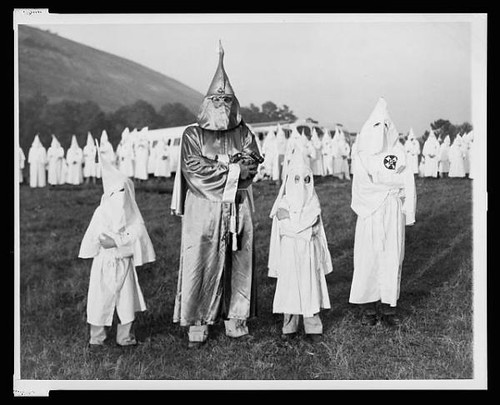
Hence the relationship between the White Citizen's Council and the Ku Klux Klan. Between Newt Gingrich and uneducated voters who come to hear his coded tirades out. Chuck Colson and older Evangelicals trying to shut up their more social-justice-oriented Evangelicals - typically younger folks like most of you, myself, Rachel Held Evans, Kurt Willems, Fred Clark of Slacktivist... But also older, more established activists, believers, and groups that are both Evangelical and concerned about the 'least of these': Tony Campolo, Dr. John Perkins and the Christian Community Development Association, Rob Bell, as well as any Christian that dare have some connection with the Occupy movement.
To not attack dissidents subtly or boldly through getting fellow sufferers against them is a sure way for the power elite to relinquish power.
But let's reconsider the bond between the White Citizen's Council and the Ku Klux Klan. Although they both were prominent in the fight against the civil rights movement of the fifties and sixties in the American south and both were fearful of the rise of black power and their lack of economic or political power therein, the constitution of each was distinct. Whereas the latter consisted of working class men, the WCC were the powerful elite: politicians and city elders, mayors and preachers, governors and leading businessmen. The Klan worked exclusively in intimidation and brute violence. The Council was a little more shrewd, however.
However, despite these tangible differences, the two groups worked in perfect symbiosis - each rubbing the back of the other. The WCC was able to say that they don't traffic in violence by comparing themselves to the obvious terrorism tactics of the KKK. Meanwhile, they spurred violence in their rhetoric given in public speeches (which were attended by Klan members). The Council was able to use the Klan as a moral guard (See?At least we're not like them!) while the KKK was able to use the WCC as a moral impetus. The Council sanctioned the violence that the KKK carried out, but then washed their hands of the bloody affairs (with a knowing *wink*), once the shootings or lynchings occurred.
Do you sense a pattern here? It's the pattern of the powerful. D&C and then re-write history.
When they take over property and goods and resources and any other means to self-preservation, they set themselves up as experts and gods. Then they tell those they've dis-empowered from that their real enemies are those people in even worse conditions. Then they watch, disengaged, as those struggling groups rip each other apart.
Of course, if the poor White and Black groups could work together, they'd be unstoppable and they could be secure in having enough food and land to secure what they need. But as long as the elite kept the poor whites and blacks fighting for scraps... well, people are hungry.
In my religious tradition - or at least for the last thirty years - that's meant that a Francis Schaeffer or a Chuck Colson or a Jerry Falwell or a James Dobson will tell the rest of us who or what our "real" enemy is.
And though they'd NEVER {faint} approve of violence against Muslims or homosexuals, they lobby violently against them, doing actual damage of ostracizing, maligning, and humiliating those who are different. Non-Christians and non-straights are scorned and denied basic civil rights that others hold. Constantly held in contemptible suspicion, these crews are perpetually suspended in a secondary citizenship status specifically because conservative Christian leaders aim to maintain their power base of fear. And that's just their direct actions, - the specific lobbying and ignorant preaching against homosexuals, against Muslims and other non-Christians (secular, atheists, Buddhists, etc.), often against the poor, against those whom may threaten communism.
None of these tactics or topics, are advocated by Jesus, of course. But that doesn't keep them from being top priorities for the so-called Moral Majority.And if the leaders say those things are evil from their (bully) pulpits, what can the congregants do but to listen? And then to attack and hurt and bomb the mosques, or mock the little "butch" girl until she hangs herself.
This is the face of bullying. Bullying works most efficiently when it's a scare tactic of the powerful to maintain their own power and keep the rest of us occupied.
And so, (dialectic history lesson approaching!) a couple years ago, when Obama began in office and he was extremely popular, Newt Gingrich, of all people, figured that Republicans can attack Obama and, in so doing, may recover some prominence. He was right, politically speaking. By blocking and obstructing the Democratic Party, the Republican Party actually may have prolonged the recession (though that is debatable), slowed down any growth for many middle class and working-class families, and made Democrats look like spineless cowards. It worked in that sense, but it has done tremendous harm to the typical American family while income inequality has spread incrementally even more so.
The rich are getting richer and the poor are getting poorer. And Newtron Gangly actually helped to make that possible.
So, what is his solution? Fire unionized janitors at schools and hire the students to clean up the schools. Because, he reasoned, inner city students (read: African American and Latino youth and children) are surrounded by inner city adults (read: African American and Latino adults) and therefore, have neither an innate desire to work for pay* nor any role models to teach them how to do an honest day's worth of legal labor. Never mind that this isn't true in the least (we will get to that in a separate blog), but the fact that he was scolded off the planet and IN FACT leads the Republican nomination now does not bode well for our country.
But it's okay, right? Because Gingrich's hands are clean. He's not going to actually go out and personally intimidate young children of working class, Black and Latino kids and refuse to acknowledge their humanity. Right? And his party would NEVER intentionally kick out large swaths of working middle-class African Americans, while simultaneously blaming them for every social evil in the planet - therefore setting the stage for a violent confrontation over non-existent means to survive. Because that would be evil. Right?
So, yeah, N00t is trying to re-write history. And if we don't learn and share the lessons of history - of how the powerful elite claw and maintain their power through our shared sacrifices and in-fighting - then we will continue to lose out.
Slightly edited exchange on Facebook about giving away - or not - candy on Halloween.
Starts when a friend of mine, John G., ribs his numerous conservative/Republican friends with this provocative status update:
Tonight, I will answer the door as a Republican. When asked for candy, I will tell them that I am not interested in giving them handouts, but I DID throw some candy up on the roof and if they want to stick around and wait for the "trickle-down" effect, they are welcome to. Then I will make them show me their green cards.
A few comments later, one of the numerous replies:
You can't be a democrat unless you first took from the kids that went out and collected their own, and then gave that, plus a healthy subsidy that you borrowed from the store on credit to the ones who stayed at home and didn't make the effort. Then, you went back and arrested the parents of the kids who went out for abuse because they dressed them up funny.
Now, how would you reply to that?
I kinda think it's important we consider that because people are watching. And many of them simply don't know what to make of such dirty, filthy assumptions. I know sometimes the hypocrisy and blatant contempt for working families boils into red hot rage in my skin. I waited a few minutes and gave my reply:
that's a bit of class warfare, don'tchathink? After all, it's not like all of the wealthiest ten percent - who receive the most money from the government - are lazy. There are a few, to be honest. But there are also model, hard working members of the corporate welfare crew.
In a recent story in the venerable Cracked (which I generally adore, by the way), I ran across this paragraph and got my little danders up:
Hating capitalism is not on the table. This is America. Capitalism defines our history, our economy, and our national psyche And the purpose of this protest cannot be a naive attempt to change the very souls of American businesspeople. To punish businesses for their greed. It's the wrong message and counterproductive. Call me jaded, but I thought we all just took it for granted that businesses are amoral creatures driven by profit. Being enraged at Corporate America for being greedy is like reading Cracked.com and being enraged by its use of the list format. This is who we are.
I'm constantly bemused but really always annoyed by variants of this claim I just read in Crack'd: Why punish the greedy bankers?
Maybe it's the fact that the question is a distraction. It's a ruse, meant to frame complex issues into bloody solutions.
Maybe it's the sheer hypocrisy of the statement. After all, rarely do the same people argue that we shouldn't punish immigrants for jumping a fence and an arbitrary border to allow their families to survive and give their kids a chance in life. Sort of akin to this:
Or maybe it's the fact that I'm a moralist and supposedly, so are those who usually argue this point. Many are Christians. The Cracked writer self-identifies as a liberal. And yet the very question is antithetical to two basic tenets of Christianity and liberalism.
Sharing is good.
Greed is bad.
Any economical, political, and social system based on greed is one that deprives the majority of basic needs.
And while the rich can afford mansions, the shrinking middle class increasingly steal away into gated communities, and the noveau-rich try out sampler McMansions, those of us who question the system are patronized like children.
"But you can't say what they should and should not make, nor what they should or can buy with those. Besides, they work hard for their money."
I know many families scrunch together in one measly apartment. We have personally taken in people who would otherwise be homeless for various periods of time, partially because the housing laws and practices are unfair for those with bad credit. But also because people were in between jobs, or were treated unjustly by the system, or recently divorced.
Yet tons of acres of land are currently unused in the barrios and ghettos that could be turned into affordable or sustainable housing, or community gardens and even farms, but landowners don't want to give up temporary rights.
Families were foreclosed on their homes - even if they were making their mortgages - when the bubble burst. Even though they invested in their properties and lived in them and were finally settling into a place of their own they were told was theirs by the very people who would forcibly take it from them, they were out on the streets and lost their investment.
And their homes.
Let's view it from another perspective, though. One-fourth of all jobs in the US now pays enough to qualify as poverty-level or below. That is one out of every four jobs that the typical American could have - from the shrinking few that are available - is making less money than necessary to survive on, under an old rubric that needs to change.
The old rubric of poverty is based on food. Because food was a much more expensive portion of the typical American family's budget, it was estimated to be a third of the monthly cost of living. And that is what the rubric of the poverty level is based on: How much would it cost an American family to sustain themselves on emergency food - and then multiply that by three. Which may be a fine way to still describe who qualifies for federal or state aid, but it's completely disastrous if, say, it's no longer relevant.
While the overall prices of food have largely stabilized and not moved much over the last thirty years or so (of course, we are dealing with that cost in other ways), the costs of housing and insurance have bloated far out of proportion. While food used to account for a third of the budget and housing roughly one-fourth, now food counts for a seventh of the typical budget while families are lucky to find a place to live that will only cost them a third of their intake. But at poverty levels, without subsidized housing it's nearly impossible for a working class family to find safe housing - let alone housing that is easily accessible to their places of work (often, they are across town from their low-paying jobs) that costs anywhere near fifty percent of their wages.
And, again, we are in a recession. And the first cuts during a recession are to social programs of uplift. Programs that would help ease the financial burden of finding affordable housing. Oddly, the very programs that are most necessary during these very times for the most people. But, since those people don't have access to the halls of power, more of those people are left under the burden of both food and living scarcity.
So, after their regressive payroll taxes are taken out, what little remains for a vast amount of working class Americans is chewed up between child care (if possible), food, clothes, car notes, gas to get them across the city to their low-paying jobs, and rent. Health care may not be an option because they aren't wealthy enough to afford it and are considered too wealthy to go on Medicaid.
Everything is in a constant state of emergency for a third of US citizens.
This is unacceptable.
And frankly, I'm not interested in blaming landowners, or bankers, or even banks - as a whole (Some are guilty, for sure. But not all). I'm interested in dismantling a system.
There are solutions, but I am under the conviction that it would mean changing our entire society's values around.
To live more simply.
To truly have a love revolution of sharing.
To give control back to community.
To live off the earth and therefore employ everybody who is able to work.
It is called Localism. We're continuing to talk about that, but I also want to talk about my possible run for a political seat.
My name is JasDye. And I will speak truth to power with the American people. Because, for most of us, the Rent Is Too Damn High.
Businessmen do not know how to educate. Most of them have never taught - or if they have, it's been of fellow businesspersons with principles that work almost exclusively in business. They don't know much about multiple intelligences or adolescent behavior or learning disabilities or childhood development. They certainly don't know about alternative means of evaluation in the classroom besides those concerning a #2 pencil and a bunch of bubbles on a strip of paper.
But yet, they are always put in charge of what is taught in the classrooms. And what those classrooms are allocated. And how long those classes should be. And the objectives of those classrooms. And how students should be evaluated. And how teachers should be evaluated...
Because they know how to make money? Because they know how to lay-off people, or know the profit margins? Does that make them better and more qualified to teach the teachers than other teachers who study and experience teaching? Because that's the trend these days. No Child Left Behind, Arne Duncan, Chicago 2020, school vouchers, maximized tests, teaching to the tests, Waiting for Superman, most charter schools...
Take the wording on this phone survey that Chicago Mayor Rahm Emanuel's pals floated last week. Of course, this sort of pseudo-"reform" in education has been happening for well over a hundred years. And it's generally been just about anything but reform. Often, the more these "reformers" talk about tests and studies, the less likely that they've been paying attention to educational experts who study learning and pedagogy, and the more it has to do with taking and comparing fill-out-the-correct bubble tests.
In Chicago there are three things its highest performing schools have in common: Active Local School Councils (LSC) that are well-trained in how to run their school; principals in those schools being on four-year contracts with clear goals set out by the Local School Council leaders; and a very active cadre of unionized teachers who work closely with the principals and LSC. To get some idea of how far away these mooks are from reform, they've eliminated the active cadre of union teachers from the mix and appear to be about to greatly curtail or perhaps even completely liquidate the powers of the LSCs. That's 2/3 of the three most effective reform measures taken in Chicago. Sweet, let the Great Leap Forward continue.
In Chicago, that's what that means. From that, we can grapple a few universals. This is what I've heard/experienced tend to be universal concepts to improve the state of education:
Allow the children to work on goals and curriculum of their own choosing, with guidance from their teachers. Invest them with education that allows them to - now, not just some time way down in the future - put the rubber of the classroom on the road of their world. Education is not relevant just because it could lead to a good job somewhere in the distant future (which is understandably not enough for youth who rarely ever see those good jobs), but for the worlds it opens up and has us fiddle with in the present. It gives power within that world. Power to affect meaning and change.*
Don't just say you're listening to the community and parents. Actually do it. All signs say that even the smaller schools are being torn from their active communities.
Engage and empower the parents and families throughout the calendar year. One benefit of Catholic schools is that they do just that. And though not everybody can afford to pay or live on a Catholic school teacher's wages (which are missionary-like low), we could benefit from being involved in our children's schools and volunteering a certain amount of time per year. And the schools could benefit in MANY ways by having game nights, movie nights, adult education classes, government boards for parents and community members (like the Local School Councils that are being disempowered in Chicago, for example), etc.
Open the school for parents in multilingual capacities and allow them to see their children's work and progress on-time.**
Incentivize teachers to collaborate and cooperate with each other. Much of the talk from "reformers" is going towards destructive competition. Which, of course, means that teachers will not share resources, skills, or classroom projects. They will not be able to learn from each other and develop each other as only fellow teachers can. Rather, with the 'incentives'-type of plans in place, each instructor will fight for her share of the increasingly-shrinking pie. This builds distrust and teaches the students the worst possible lesson: to survive is to destroy others. Of course, businesspersons should know better. Sometimes I think they do know better...
Realize that funding for education isn't a liability or an expense, but an investment. A severe investment. If these businessfolk know what's good for them, they'd ask to invest more of their hard-earned money into the education of their future workers, associates, partners, and clients. Unless they believe that having uninformed clients is better than having a beneficial work and living environment, that is (which I doubt many of them do).
We must ask, "Are we truly willing to spend more money on prisons than on schools?" Because that is what is happening. Who's advocating for the teachers to be able to teach with all their tools handy? There sure are quite a few people advocating for bigger and badder jail cells.
--------
*I want to demonstrate this concept of making education present and active and relevant by telling a story of Brian and his students in Cabrini-Green.
Cabrini-Green was one of the most notorious housing projects in Chicago, not to mention one of the most infamous neighborhoods in the US. It was a text-book case of Northern segregation - both racial and socio-economic. And it was multi-generational. The Chicago Housing Authority had a plan to clean it up. Not because they necessarily wanted to backtrack and do everything right this time, or clean up their mess, or help these families make it to the next level. But because the property is next to some rich, rich real estate. The Gold Coast, Magnificent Mile, Old Town, Lincoln Park, and of course the Lake Shore within walking distance. All that wealth wouldn't mean that they'd be fixing or rehabbing the area, even the parts that were salvageable. It's almost as if they felt that the buildings should come down on their own, only to be replaced by paying customers.
Or at least I'm sure that's how it felt to the students at a local grade school just outside the complex. And so they got together with their teacher, Brian, and brainstormed a bunch of ways to fix up their school (their idea) for their social studies project. They interviewed people on the street and in the school, as well as bureaucrats. They petitioned. They argued and hassled each other. They brainstormed and collaborated with each other. They took pictures. They wrote detailed letters to the editors and to state senators and talked to members of the press - going so far as to getting on the local news with their side of the story. Their conclusion was that the school needed to be rebuilt completely.
Our school building, Richard E. Byrd Community Academy, has big problems. There are too many problems to mention in this letter, but we want to tell you about some of the most important ones. These main problems are what we think are important issues: the restrooms, temperature in our building, the windows and the lack of a lunchroom, a gym and a stage. We need a new school because of these problems. It is really important for our learning so we can be great when we grow up.
The Board paid lip service to them and their suggestions, of course. And then shut-down the school completely. The students were dispersed, and a few stopped going to school. The new school was too far away and the route too violent (considerations that the Board doesn't like to consider).
But many of them would come back to Brian and each other and reminisce and wonder why school can't always be so challenging. So rewarding. So frustrating, empowering, so active. So hands-on.
And ever since I heard their story, I wondered the same danged thing...
**Here is a big failure of mine. If I could turn back time like Cher...
Of course, not the fact that teachers' pensions and rights-to-arbitration are on the chopping block. Not the fact that our city is being sold, block-by-block, to the highest or most-connected bidder. Not the fact that there are very few jobs available in much of the West and South side neighborhoods so young adults from those neighborhoods have to go downtown or to the North side in order to find barely minimum wage jobs in the first place. If they're fortunate enough to have a job, that is. Not the fact that mega-conglomerate/uber-rich corporations are getting tremendous tax breaks at the expense of social programs, schools, and homeowners. Those aren't nightmares to the power brokers and gate-keepers that get to define what is and isn't a nightmare.
The fact that few impoverished adolescents of color are afforded the kinds of opportunities that those of us of White heritage take for granted - and that Chicago is geographically segregated by those opportunities - is the long, horrible nightmare to me...
Which isn't to say that Wilding isn't important. Nor that it shouldn't grab headlines (besides, how else are you going to sell newspapers these days? You can only talk about Sarah Palin so much, y'know). But it would've been nice to see those headlines and to hear the desperation in the police superintendent's voice way back when the incidents began and these kids were almost exclusively terrorizing black men, women, and children in the South and West sides.
But then, the local media and the city's halls of power would have to acknowledge that African Americans are real Americans and citizens, right? Not just votes to discard after election season...
She's sick. Sick! of the hypocrisy. It's always the poor with this crop of Wisconsin corporatists that are being humiliated, shunned, exploited. And the rich who are not just excused, but groveled for.
Representative, please, represent the people of Wisconsin.
I mean, as governor.
And I thank you for standing up and representing the people of Milwaukee (and the rest of Wisconsin).
While doing a quick surf on the interwebz yesterday, I rediscovered why I so much hate Megan McArdle's pseudo-intelligent writing. This famous statement from Jesus was a title for one of her posts that - as usual with this cryptic statement - was used to justify an anti-poor agenda. In her case, she was arguing against the validity of at-risk hunger in the American poor. The logic was akin to, "See, they're all so fat! Ergo, they don't need MORE food money."
It's a pretty despicable show of aggression against the marginalized, but Christians all throughout this country use Jesus' words against his intentions all the time. On Facebook, some of my friends and I were discussing this term and what it means. I like some of their alternative perspectives - that it may be about the "poor in spirit", that it's also a sign that Jesus used the poor as an example to look to when he would no longer be around. We were discussing this term, of course, because we hear it being used as an excuse to do nothing for the poor - or nothing structurally, at least. That and, "All people are sinful. Therefore, whatever we do will simply fail. We will have to wait until Jesus comes."
The thread itself was on this great resource, Let the Churches Do It Is a Deceptive Myth (h/t to Slacktivist), that makes the - all-too-rare - case that churches cannot and will not pick up the slack for government if the "government would only get out of the way." It also clarifies that there is tremendous work still to be done with/for the poor NOW, and we don't have to wait for the gov't to get out of the way, but rather partner with them and fill in missing pieces.
But back to "The poor will always be amongst you..."
Jesus was quoting the Old Testament. He does that a lot. Sometimes when you're reading your bible, it'll point that out for you. Sometimes you have to dig a bit deeper. Sometimes he makes commentary on and updates the ancient scriptures. Sometimes, he uses the ancient scriptures to put the present reality into horrible context. This is what he was doing in this case.
The original quote is found in the book of Deuteronomy. Not one of the nicest books in the world, let alone the Hebrew canon. But it is within this passage where we discover that all servants/slaves must be released from their debt service during the seventh year. In fact, all debts are to be canceled on the seventh year (pretty outstanding, even by today's standards). And it is here where we find this about treating the poor:
There need be no poor people among you, for in the land the LORD your God is giving you to possess as your inheritance, he will richly bless you, if only you fully obey the LORD your God and are careful to follow all these commands I am giving you today. For the LORD your God will bless you as he has promised, and you will lend to many nations but will borrow from none. You will rule over many nations but none will rule over you.
If anyone is poor among your fellow Israelites in any of the towns of the land the LORD your God is giving you, do not be hardhearted or tightfisted toward them. Rather, be openhanded and freely lend them whatever they need. Be careful not to harbor this wicked thought: “The seventh year, the year for canceling debts, is near,” so that you do not show ill will toward the needy among your fellow Israelites and give them nothing. They may then appeal to the LORD against you, and you will be found guilty of sin. Give generously to them and do so without a grudging heart; then because of this the LORD your God will bless you in all your work and in everything you put your hand to. There will always be poor people in the land. Therefore I command you to be openhanded toward your fellow Israelites who are poor and needy in your land. (Deuteronomy 15; NIV)
This isn't just about a bunch of nice individuals. This isn't just about being kind. This is to be a concerted effort by the collective people of Israel. In other words, "the government"...
The writer, Moses, mentions specifically that there will be plenty of resources to share, so there should not be any poor amongst them. However, he knows their hearts, and he knows reality enough to say that "There will always be poor people in the land."