Showing posts with label #occupywallst. Show all posts

Monday, December 31, 2012

Forgiveness Us Our Debts

Fresh starts. That's what New Years is about, right? Last year was a mess, so I'm going to clean up myself starting this year. But what if it's not solely about ourselves? What if I constantly fail at my resolution because they depend upon me and me alone to get my ish together, but under the same weight I labored under and got nowhere with to this point?

And this brings us to the fresh starts and to forgiveness. And what that means... As a Christian, I look back to the example of Jesus.

 Matthew 6:14-15 “If you forgive those who sin against you, your heavenly Father will forgive you. But if you refuse to forgive others, your Father will not forgive your sins."

That "But" is key.

image courtesy: Iran Press Watch

When Jesus talks about forgiveness - and he does a lot - much like in the rest of the gospels, he's talking about what it means to live in the Kingdom, or kingdom-ly (or what we called a couple months ago, the un-Kingdom). Take that for what it's worth. It may or not be advice, but it points to an subversive understanding, a more better way, and an alternative to the corrupt powers of the other kingdoms (the world) - a completely different path than lay in the realm of the "powerful" of Rome, Egypt, Assyria, Babylon, the United States. What Jesus says should not be applied as law, but as the preferred method of those who follow him and his Way.

But notice this in your readings of forgiveness: in nearly every instance, Jesus speaks about both financial forgiveness and personal forgiveness simultaneously - as if he cannot separate the two. They are necessarily side by side.

In Luke 7, Jesus is at the home of some religious leaders and in barges the town prostitute.  And the hosts are offended that Jesus would let her near without condemning her, let alone touch him. She's sobbing with regret. Most likely hurt. I doubt she wants to be sexually exploited and turned into a commodity day and night again. Its likely that it is due to the social structures and rules these very hosts employ and implement and justify that she finds herself in this predicament selling her body in the first place.

So Jesus finds it necessary to share a riddle:

Two men were in debt to a banker. One owed five hundred silver pieces, the other fifty. Neither of them could pay up, and so the banker canceled both debts. Which of the two would be more grateful?
- Luke 7 (the Message)

Such stories in the Gospels are common - and disruptive. Disruptive to the norm, to the regulatory forces*, to the status quo and its comfort with itself and its self-righteous. There's the Lord's Prayer hinted at above, of course. There's the parable of the rich debtor, but there's also Jesus' very own inaugural sermon, when he declared the following to be about his ministry:
The Spirit of the Lord is upon me,
    for he has anointed me to bring Good News to the poor.
He has sent me to proclaim that captives will be released,
    that the blind will see,
that the oppressed will be set free,
     and that the time of the Lord’s favor has come.
- Luke 4 (NLT)

These lines themselves were adapted from latter Isaiah (Chapter 61 with some modification from chapter 58), which themselves were an expansion on the concept of Jubilee. Jubilee is a concept that the Mosaic Law introduced into Hebraic customs several hundred years prior. The idea is that every fifty years, families can reclaim their ancestral homes, debts are forgiven, prisoners are released. For a peasant class always under financial duress, the Year of Jubilee would be the Year of the Lord's Favor.

So forgiveness is necessary for financial justice.

But it's also necessary for spiritual justice.

Some Christian-led groups have been calling for Jubilee-like debt forgiveness for the poorest and most debt-ridden nations for years, most famously with the Jubilee 2000 campaign (and its offshoots) led to coincide with the Catholic Church's celebration of the Great Jubilee. This campaign had the intent of wiping out several billions of dollars of debt incurred to** Third World nations in Africa and Latin America. More recently and closer to home, an offshoot project of the Occupy movement (which has some tenuous connections with Christian and interfaith theology and practices) named the Rolling Jubilee is looking to subvert the bankers and collection agencies and those who profit from debt incursions by buying back debts and forgiving debtors (at pennies on the dollar). As of press, they have raised over $500,000 to absolve nearly 10.5 million dollars.

Say what you may about the situation - about how and why people and nations get into debt at astronomical rates - but to be released from that obligation and being able to focus on the day-to-day, on the familial and financial and community-based obligations that are also pressing and immediate, is an immense blessing, for lack of a better word.

But even still, taking care of the material, monetary debt is necessary, but we must not forget the spiritual, mental and emotional debt that needs forgiveness. After all, none can live on bread alone.

Now, when people in the Christian church talk about forgiveness, there seems to be a fundamental power imbalance. As my friend Sarah Moon so graciously points out, oftentimes victims of abuse in a church setting are commanded to forgive their abusers. Often, we are told that Jesus forgave the child molester. Ergo, everything is all good and that person should be allowed to work in the nursery (true story. Too often). Or spouses are commanded by the pastors to go back to their abusive partners (waaaay too often). Or the pastor, well, he's been pardoned by God for his "inappropriate" behavior. And so you are to pardon him too. Now!

But that's not forgiveness. That's forced, compelled, coerced, controlling, lying, false, insincere, dangerous, unhealthy, and ugly manipulation. Whatever it is, it is not forgiveness.

Forgiveness cannot work without boundaries. It cannot be forced. It needs to be nurtured and nourished. It needs to operate in safety. It cannot allow for injustice. Forgiveness does not allow for the pedophile to work with children - it recognizes that some behaviors will not change over night (if ever) and so makes a zone of safety for all those affected: children, spouses, parishioners, family, neighbors, constituents, you, me. That zone may require papers to be signed, people to be notified, offenders to be jailed. It will probably require time and distance.

But within that safe zone, miracles can happen. Miracles that both release the debtor and the indebted. Miracles that free the soul from the oppressive dictatorship of guilt and bitterness.

I find the act of forgiveness - of the spiritual and financial varieties - (though not necessarily forgetting or allowing back) to be fundamentally freeing. But if I'm honest, anything that is completely liberating is also as scary as hell.

When I recite the Lord's Prayer with my daughter and I get to the line about forgiving transgressions, I always pause. And I often bite hard.

And then I continue. A little bit lighter.

And in this practice, I tug away at the roots and branches and leaves of bitterness or frustration or angst laying deep beneath, or flourishing just above the surface, or suckling out the sunlight like anti-plants. They steal our joy. They steal our peace of mind. They take root and they rob us of sunshine and air and water and all the good elements - they lurk in the back of our minds and convince us that life is for the dead, these anti-plants.

The anti-plants need to eventually be uprooted. Only then can our gardens grow. Only then can we be set free from the prisons of our minds and hearts and from the prisons of indebtedness to others that we could never repay. This opens up boundless opportunities - not just for the self, but for those that we are near. And herein, a new cycle appears. For we are not just free as scattered individuals, but as members and parts of networks, families, communities. The effects of liberation on our communities are innumerable.

Nelson Mendela, after 27 years of imprisonment


------------
*Jesus takes note that the Pharisees did not really welcome him, did not wash his feet - but this lowly prostitute just walking off the street cleans them with her tears and hairs
**Let us refuse to say "by" as if the countries asked for or deserved to be in debt for the crime of being plundered of economic, labor and natural resources

Friday, December 21, 2012

Moving Abe

An occasional one-off with a semi-celeb on Twitter is what passes for a brush with celebrity for me. So, Chicago-based rapper and political activist (as well as would-be alderman) Rhymefest has tended to have a contentious interaction with the Occupy Movement. Unlike another Chicago-based rapper who's worked with Kanye, Lupe Fiasco, he sees the Occupiers as wasting time and space better used for direct political action.


Image will appear as a link


Rhymefest disregards the overriding lessons of the Emancipators and the Civil Rights Era as being out of time. Fine. But then tell me that Occupy hasn't helped to shape the discourse of American politics - tell me that the Tea Party movement also hasn't done so. Tell me that right now this whole Fiscal Cliff nonsense isn't largely directed by the rhetoric of one sort of radical, non-pragmatic paradigm or another.

He's a hostage!
Well, actually...
Tell me that the post-Sandy Hook imagination of the American populace isn't directed by one form of radicalism (the No-Restrictions-Ever-on-Guns NRA and their stand-ins) and the rest of us aren't trying to feebly talk about sensible gun control measures.

Imagine if a large, national peace movement were actually put in place some twelve years ago - rather than a late-to-the-game anti-GOP posturing. How would the conversation about war and violence be engaged now?

Politicians, as historian Howard Zinn points out in his must-read work - including the Zinn Reader - do not lead - they follow. As much as Abraham Lincoln wanted to end slavery, he had to garner popular opinion in order to get to the office of president in the first place. And before that happened, the popular perception of slavery as being a largely harmless and beneficial financial institution had to be challenged.

So, the slave narratives. So, Douglass, and Garrison, and Sojourner Truth, and Beecher Stowe. These figures and their heroic, bristling words waged a war for the hearts and souls and minds of men and women.

The reformer is careless of numbers, disregards popularity, and deals only with ideas, conscience, and common sense... He neither expects nor is overanxious for immediate success. The politician dwells in an everlasting now... His office is not to instruct public opinion but to represent it.
- Wendell Phillips
The institution of slavery was peculiar to the South. It was an issue that, as a force of evil, was only understood to a small minority of the white population. Yet all were responsible for its continuation even as it was cloaked through being race-based and therefore imperceptible to the White mind as - as a deliberate matter of dividing and conquering - it was out of the sight and experience of the Whites of the North, and out of the personal physical and psychic reality of the majority of White Southerner. The South and the North needed the issue of slavery to be pushed in the open and come to a volatile head - otherwise it would have stayed hidden. Not that slavery itself wasn't a constant threat to the very Southern "way of life" that Southern elites were trying to maintain at all, unbelievable costs. But slavery may never have ended if its death knolls weren't forced through abolitionism (which, again, isn't the same as saying that abolitionists "caused" the secession. But, regardless, they had a hand in forcing the Southern elites to take a form of action, and they opened the way for Lincoln to sign both the Emancipation Proclamation and then the 13th Amendment)

That possibility would not have been the case were it not for the rebellious acts of the slaves themselves opening up the remote possibility of a way out - opening up the imagination of White Americans in the late 18th and early 19th Centuries to the radical reality that Black slaves were not property but people. I contend that slavery would have been much more profitable and therefore more desirable to the entire US if the slaves hadn't acted out in various ways against the bitter institution of slavery

All true Reformers are incendiaries. But it is the hearts, brains and souls of their fellow-men which they set on fire, and in so doing they perform the function appropriated to them in the wise order of Providence.
- James Russel Lowell
It wasn't Abraham Lincoln that freed the slaves. It was the actions of the slaves which energized the abolitionists who powered the imagination and moral compass of the United States which brought the conflict to a crucible. This crucible was important, for it meant that the slave-holding elite of the South believed that reparations with an abolitionist-leaning North were now impossible, ergo, they had to go on and make their own country and go so far as to start a war with their free neighbors to the North (Southern Apology Myths withstanding).

In all ages, it has been first the radical, and only later the moderate, who has held out a hand to [those] knocked to the ground by the social order.
The moderate, whose sensitive ears are offended by the wild language of the radical, needs to consider the necessary division of labor in a world full of evil, a division in which agitators for reform play an indispensable role.
- Howard Zinn

To use biblical imagery, when the reformer is the voice of the prophet, we have Moses confronting Pharaoh  "Let my people go." Or we have a newly liberated people, who are slightly more liberated, but then codified back into serfdom through Solomon. In the meantime, we have  Moses, Joshua, Saul, and David - each of whom represents the law, each tightening the screws on their people. Each inching just a bit closer, in their kingly duties, to the role of Pharaoh over Hebrew slaves - though this time, the Hebrew ruler was enslaving his own as well as neighbors - despite the warnings against doing such in the Mosaic law.

Then there's the Samuels and the Nathans. The prophets who spoke to and against, who checked, who lacked fear in the face of the terrifying, who dared speak against the thieving, murderous ways of the kings against common sense.

We need more Samuels and fewer would-be Solomons. We don't need our Garrisons to turn into Lincolns. We need Occupiers to continue to Occupy the American imagination, not pragmatically bow to the whims of a fickle populace.

Sunday, November 04, 2012

Occupy/Incarnate

Jesus, we Christians must remember, was not content to be a removed deity, off in the sky judging humanity and moving efforts from the heavens. The story of Gospels is the story of an incarnational God - a God who not only walked among men and women, but was one of them. A lord who did not lord, a religious leader who welcomed all into the work of ministry. The story of the Gospels is, therefore, a testimony against centering and lording forces such as imperialism, statism, and capitalism, an alternative to presidents and corporations.

In that sense, however, the greatest remaining legacy to the witness of the incarnation in the US may not reside in the four walls of the institutional church. It does not belong to the power-hungry Religious Right in its various incarnations (let alone the Billy Graham Evangelistic Association). It does not belong to the Republicans, nor to the Democrats (shockers, I know!). But it also doesn't honestly belong to me or my friends in the Christian Left or much of progressive Christianity (at least as far as bloggers) - though I like to think we're preparing groundwork and pointing the way.

No, those on the ground, those in the trenches, those doing the dirty work - those are the ones demonstrating the incarnation by being and doing interconnectedly. Such actors are in every community of course, but as far as any large body where I see the work of community and salvation being worked out without authoritarianism, without massive centralization, that distinction goes to the Occupy Movement. Still. While the rest of us have just about forgot about them save a few slogans, they've been involved and part of communities in need; they've been incarnational this whole time.

So how did an offshoot of Occupy Wall Street, best known as a leaderless movement that brought international attention to issues of economic injustice through the occupation of Zucotti Park in the financial district last year, become a leader in local hurricane relief efforts?  Ethan Murphy, who was helping organize the food at St. Jacobis and had been cooking for the occupy movement over the past year, explained there wasn’t any kind of official decision or declaration that occupiers would now try to help with the hurricane aftermath.  “This is what we do already, “ he explained: Build community, help neighbors, and create a world without the help of finance.  Horst said, “We know capitalism is broken, so we have already been focused on organizing to take care of our own [community] needs.” He sees Occupy Sandy as political ideas executed on a practical level. (Emphasis mine)
How to make a difference that will last? Be incarnational.

Saturday, September 01, 2012

More About That Big Ol' Table with All the Homeless and the Homosexuals

Continuation of this post.

The third critique I want to get into here goes beyond Chick-fil-A or gay people or churches or conservatives or liberals or where we find ourselves in these divides: It is the fundamental fact that our own reliance on consumerism as a way of life, as a culture, and as an economic system is fundamentally destructive - literally, figuratively, physically, socially, spiritually destructive. It is consumerism, rather than creativity combined with sustenance, that is not just killing us in terms of health problems (obesity, diabetes, heart disease, strokes), not just in terms of the ecology (which indirectly but even presently affects all of our health in tremendous ways - from ice caps to greenhouse to toxins in the air, land and water), but in terms of actual starvation - specifically of third world children, women and men.

While we argue over whether or not we should support or boycott one fast food franchise, our habits of eating meats and processed foods are actively stealing necessary resources from the majority of the world, just to feed us more (and yet less) than what we need to remain healthy. If American Christians really cared about the starving of the world, we'd eat out a lot less, we'd drastically consume less meat, we would support community farms and gardening so as not to steal grains from overseas. Because when we have such an over-reliance on a small stock of grains (and specifically genetically modified ones), we erode topsoil and limit precious farming land - allocating what property and work third world farmers have towards the propulsion of our already full tummies.

But if we cared for the poor of the world and the US, we wouldn't just stop there. We'd not only not shop at Wal-Mart (which I've made a pretty good habit of boycotting over the last decade ever since I saw what they did to the small stores in my parents' town in Oklahoma. All the stores. Every last one), we'd cease shopping at any ridiculously low-priced store, any big-box, any retail location that doesn't pay living wages to its employees and doesn't pay its vendors enough to maintain a living wage for their employees. We'd shop locally, at little shops, at local machinists, at bakers' shops, getting ingredients from local millers and nearby organic farms, because that money tends to stay in the community - rather than going to some corporate office somewhere where it then goes into hiding. Our money should be circulated to afford more higher-paying jobs.

Space Junk

But then, the majority of poor and lower-middle class people who shop at Wal-Mart do so because it's exactly what they can afford with what little they have. I stock up on highly-processed foods from Aldi because it's 20-60% cheaper than buying from a major grocery chain, let alone a corner grocer, and a lot easier than making food from scratch - which is something that I'd like to do, but, like a lot of this country's poor, I run low on energy and/or time and/or resources when it comes to this. Generally speaking, the working poor cannot afford to shop at the farmer's markets, even when we're well aware how much better they are for us, even when they allow for TANF credits (though I just found out that TANF will match, dollar for dollar up to ten dollars, what is bought each visit to a city-sponsored farmer's market in Chicago - and these are in poor neighborhoods in Chicago such as Austin and West Humboldt Park), even when everybody tells us we should and why we should.

How do we allow for a place to address social-class, poverty, sexuality, racial, gender issues, though? Especially when some of those issues are self-perpetuating, or seemingly at odds with each other - when homosexuals feel that black men and women are working against their interests and black families feel slighted by non-black LGBTQ, or when African Americans are slighted by the service industry - whether they be police or waitstaff or banks - or when Black, Latino or indigenous students become distrustful of the very same educational systems that they are told are supposed to deliver them from poverty. These things do not happen without reason. They are not imagined problems.

I pledge a round table. No kings, no positions above or below. No servants, nobody is slighted nor unwelcome. A table of shared humanity and talents and skills where the learning and the restoring can begin.

We must discover this fact together. We must find out why they are not imagined. We must discover anew the fine art of friendship - extended beyond our borders and the limits we have manufactured to protect ourselves and our ways of life..

And when I say "we" here, I mean "we privileged." Whites, males, heteros, English-speaking, middle and upper class, educated, professional class, Christian, with able bodies and minds and all that stuff that many of us take for granted and in whatever area that we have privileges. Once we recognize our privileges - those bonuses in life that give us a distinct (though rarely recognized) advantage over others who do not share those identity traits - then maybe we are ready to sit at the table. But perhaps we should go over some ground rules before we shed our shoes, elbow up, and grub on down.

We'll touch on those ground rules in the next installment. Let's just say that those who've spoken will need to shut, and the currently shut down will open. Oh, and lots of work, and lots of sharing, and lots of good stuff. I promise. Soon.

But I'd like your ideas. What would be some good ground rules for a great gathering? For a place of learning and sharing? A place of equilibrium, of justice, of feeding.


Wednesday, July 04, 2012

The Strings Attached Are Attached to All of Us

We live in this big, intricate, messed up, imperfect world filled with imperfect humans. And it seems like most of us know that and take that for granted. Most American Evangelical Christians sure do. What many of them don't seem to notice, or at least acknowledge, is that we also live in this interdependent, intricately connected, living, breathing society.

Society is not just a concept. It's not an out-there thing disassociated from our everyday reality. It is very present and it is very real. We may not be able to touch it like the hard oak of this heavy but falling-apart table I like to rest my feet on occasionally, but it is every bit as real as the sweat gleaming off my forehead.

So it bothers me to no little effect when people complain about having to participate in society and act as if they owe it nothing - as were the basic arguments raised this last week over the healthcare ruling from the Supreme Court. It's an argument that the poor are using the government to steal from the rich (rather than the truth that the rich are stealing from the poor), or that we're being forced to buy something we don't need. And for all the problems of the Affordable Care Act - and there are many, many - these reasons don't come into play, but expose a deeper problem in contemporary American society and politics: we believe we do not benefit from the very systems that benefit us and we believe that our benefit is not the result of exploiting the very poor of our country and the world.

But first the good stuff. We benefit largely as a result of shared work. That's how a society functions. Everybody puts in; everybody gets results.

The dreams we have, the work we do, the benefits we enjoy, the language we possess, the identities we carry, the food we eat (less that you hunt and grow), the health care we enjoy, the cars we drive, the streets we roll down, these are all effects of the shared work of society. One cannot decide to not participate. One cannot decide that they owe nothing to society nor that society has not given them and continues to give them what they need and often what they desire. If these people want to live like a hermit, fine. Let them fix their own water, electricity, food. Keep them off our roads. Allow them the privilege of developing their own language for their imaginary conversations with imaginary friends. They need to stop using ours for their fantasies.

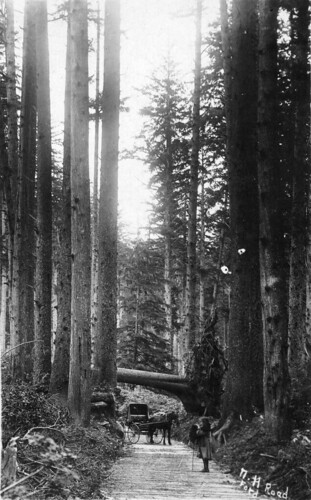
Plank road in forest in Tillamook County, Oregon
Look, a socialist road!
Now, if you drive, you have to have insurance, right? Because you're socially responsible for the economic burden that could happen due to any accident that may occur to or as a result of your car. It's part of the price of participating in sharing the roads. Sometimes the cost is nearly unbearable, but when we run into a problem, we're better off for it. That day may not happen for some of us - but it could happen to any of us no matter how safe and responsible we are (or believe we are) as drivers - and that is the point.

Everybody needs healthcare insurance. There is no getting around that. If you don't have it, but something, anything, unexpected pops up (an unidentified lump, an accident, a heart murmur) everybody else pays for it. Everybody needs it. If you don't want it, it doesn't matter. You need it. That's why it's called "insurance."

Everybody shares the load. That's what makes a society. If you can't handle that, never ask for a job, fix your own water, become a hermit. Because we don't deserve to have to share the cost of society with selfish people who take without considering to help and then want to cut off food and survival functions for workers and mothers and children who do or will or want to give back through their sweat, who create wealth for the privileged classes.

Which brings us back to our second point.

American patriots constantly point out how generous the United States is, both in terms of government and private charity. But we don't acknowledge the strings that come attached. We talk about how much we help Haiti and African people but ignore the fact that they are in such dire straights because of oppressive economic lending practices, because we deplete their resources, because we have installed leaders that were horrible for their countries but were good for us.

That's how it's always turned out, in Southeast Asia, in Latin America, in the Pacific... With our influence and money, we get to curry favors and effectually rob what we now deem "developing" countries so that they need to ask for more favors - wherein we or our surrogates come in to effectively own the country and its resources (be it water, energy, diamonds, gold). To add demonic joy, we love playing these countries against each other to distract other countries in the region while we keep them in check (cf, the Middle East).

These are the costs of society that we need to gather and figure how we can do without and how we can run off. We live in Orwellian times. "Freedom" means the freedom of rich white people to steal from most of the rest of the world and not give a sh*t about the rest of us.

We may be free to dream of a better world for us all, but we're not allowed to speak it outloud, for fears that somehow a better world for all is somehow fascist. I believe conservatives should focus more on reducing the costs of healthcare rather than putting all their efforts in oppressing the poor and keeping them from receiving it.

So some things you don't have a choice on. So what? A lot of people don't get to decide whether or not they'll sleep with one eye open or whether or not their home will be collateral damage for our War on Drugs or our War on Terror or our War on War or whatever other euphemism we can figure for Blowing People Up for Political Expediency and to Extend Our Imperialism and Corporate Interests.

Get over it. Get involved in society and help us find better ways to live and act as a civil social humane society.

Until we get to the point where all are protected and truly represented in an equitable system, though, I believe that the government's obligation is to protect the most vulnerable.

I'm a socialist. But I'm one because Jesus and the prophets taught me to be one. If the Christian Right (and most every interaction with people who complain about having to help other people I have had in the last few years has been with a conservative Christian) does not believe in sharing and helping (and it's pretty obvious they don't), and they can't see where the Bible tells us to bear one another's burdens both as neighbors and as citizens through government, I'm not sure what Bible they're reading. Tt's not the Hebrew and Christian one. It's not the one written by Commie Pinkos. Perhaps the Satanic Bible...


Friday, June 29, 2012

The Gods of Comfort vs the Prophets of Discombobulation

"But against any of the people of Israel, either man or beast, not a dog shall growl; that you may know that the Lord makes a distinction between the Egyptians and Israel."

Walter Brueggeman, on Moses, Egypt, impartiality as read through the lens of Exodus 11:7, quoted above:

[This declaration] occurs not in a doctrine but in a narrative and an uproven memory that we must let stand in all its audacity. It is not reflective theology but news just for this moment and just this community. The God who will decide is not the comfortable god of the empire, so fat and well fed as to be neutral and inattentive. Rather, it is the God who is alert to the realities, who does not flinch from taking sides, who sits in the divine council on the edge of his seat and is attentive his special interests. It is the way of the unifying gods of the empire not to take sides and, by being tolerant, to cast eternal votes for the way things are... 
There is not much here for the reasoned voices. No prophet ever sees things under the aspect of eternity. It is always partisan theology, always for the moment, always for the concrete community, satisfied only to see only a piece of it all and to speak out of that at the risk of contradicting the rest of it. Empires prefer reasoned voices who see it all, who understand both sides, and who regard polemics as unworthy of God and divisive of the public good. But what an energizing statement! In his passion and energy, Moses takes sides with the losers and powerless marginal people; he has not yet grown cynical with the "double speak" of imperial talk and so dares to speak before the data are in and dares to affront more subtle thinking... 
Seen at a distance, this bald statement is high theology. It is the gospel; God is for us. In an empire no god is for anyone... [T]he urging I make to those who would be prophets is that we not neglect to do our work about who god is and that we know our discernment of God is at the breaking points in human community.


It is not that the prophetic voice isn't looking for truth, but she will not be satisfied by the "There are two sides to every story" false equivalence. He is not placated when he sees injustice. The prophets leave the comfort and familiarity of home and hearth and even their own country to report and point and scream and jump up and down and shock the kings and queens with discomforting stories. The prophetess does not side with the people she was raised with, but with her new people. Her people are now the marginalized, the oppressed, the downtrodden, the hurt, the evicted, the suffering, the sick, the rounded up, the pushed out, the expatriats.

protest


The gods and priests of the empire - of the markets, of consumption - in their "impartiality" are truly really partial. They prefer the way things they are. They do not like to be upset. They want all to remain as it has been and forever will be. They may change a few seats on the deck, but the boat remains in the same direction, the majority of those seated remain seated, barking out orders followed by men with bullhorns and whips, demanding extra sweat, extra steam, extra breath from the rowers and steam room workers.

These are the gods, and their priests, who do not concern themselves about the oppression. Because concerning themselves about such things in any significant manner means to upset the cart. And the cart cannot be upset. The order of things cannot change nor be brought down. They must, at all costs, remain. They do not hear the cry of the slaves, the sick, the outsiders and lepers.

But God and the prophets of God do. They hear, and they cry out to the pharaohs and demand to, "Let my people go!" And when they are not heeded, when Pharaoh and his gods do not relent but harden their hearts, the Almighty Bearer of Justice liberates them by overthrowing the carts, by flinging the chariots and their horses (and their industrial bombers and nuclear weapons) into the sea. It is the prophets' job to declare liberation and seek justice - and not to settle for the way things are. Because the way things are is not right, and the God of Justice seeks to make all right.

Wednesday, May 23, 2012

Restoring the Lands

The housing bubble of the 00's followed in Chicago's westside Austin neighborhood as if on steroids. The median sales price of a house in Chicago at the beginning of the decade was roughly $150K, and for a house in the 60644 zip code was 100,000. Just before the bubble crashed the Chicago-wide value climbed over twice as much, fueled by speculation, predatory lending, greed, widespread beliefs (spread by experts) that the value of housing will never depreciate, and - most importantly - from a can't-fail attitude by the banks and loaning institutions that were eager to cash in on rising prices.


As we can see, the prices rose over a period of time to astronomically silly levels. In another Chicago neighborhood, Logan Square, my pastor showed me several houses and the sky-rocketing prices that they went for as much as twice to three times to then even quadrupling over what they previously were sold for within the range of about fifteen years. The largely Mexican American residents and working class whites were being sold and forced out of their homes by rising tax properties or landlords who smelled opportunity. In the meantime, they were losing their homes and communities, friends, schools, churches, doctors, support networks.

When the prices astronomically dropped (about three-fourths in Austin overnight), many others had lost what little equity they had.

Doesn't sound like losing much to some people. Middle class whites like to say, "If you don't like it, just move." And maybe it's easier for them, but when it's been your home for a generation, and when you consider that a sizeable portion of our society is constantly on the brink - deciding between housing and food and clothes and medicine and insurance becomes much harder when you also have to factor in extra transportation costs and time, plus the thousands of hidden costs related to moving. When you consider that landlords usually now demand two and a half months, at least, for rent and deposit before moving in and that most working poor families do not have that kind of cash available, or that credit ratings for poor are low - and disproportionately so for people of color - and therefore deny access to decent living accommodations, it's little wonder that many displaced families end up homeless in the same neighborhoods they've just been residing in for the last generation.

But what if the very people of these communities had power to control their destinies? What if the property they took care of, rejuvenated, lived in, worked from, and worshiped, went to school, and shopped nearby, the property they inhabited fully - what if that property were given back to the local community? What if we could fill all the now-vacant houses with the families currently out in the streets? What if families did not necessarily need to double-up just to make it by, sharing one bathroom and two bedrooms with eight or more people?


What if - and this may sound cah-raaayyyyy-zeeeee - what if the empty lots that line every block - sometimes residing in nearly one-third of the area - could be turned into gardens and even mini-farms for fresh, healthy, affordable food? Could that even be a means of providing local jobs and meaningful work for several of our community members? What if the abandoned factories, closed storefronts and shops, and vacant warehouses could be creatively reborn?

Community Garden 4


Daycare and after-school centers. Job training. Clothes manufacturing. Bicycle repair. Computer and phone refurbishing and repairing. Alternative energy. Sign manufacturing. Specialty restaurants. Mechanics (locally-based, so you can trust them? Nice). Health clinics, including mental wholeness. Library co-ops. Music centers. Recycling/Reusing/Renewing centers. Office space rentals. Art galleries. Furniture manufacturing and repair. Think tanks for scientists, artists, entrepreneurs, mothers, community leaders, students, and environmental workers to go, study, research, teach, learn about how to holistically restore the community.

Factory (sash window)


Okay, so I'm not the most creative. But the point is, the community decides what it needs, what it has, what it can give and offer, what it is skilled at and what skills and resources it needs to build. But it needs space to occupy, ferment, and accomplish its dreams. It needs its own space. And then it'll need less from the center. We won't need to worry about food stamps or medicaid or social security, because the community will be able to take care of its own.

So long as others are in control of our land, we are not truly empowered and we are - to a significant degree - dependent on their mercy. That is what happens when our entire society is centered around a consumerist modus operandi. We give everything away to far off places via trading and buying merchandise and pray and expect that we'll receive back in monetary value that we spend, again, on merchandise that is centralized in far off places - corporations that do not invest in our communities except on the rarest of occasions (and with the most triumphant of fanfare). We need a space of our own and an economy of our own.

We desire, earnestly, to work with our minds, our hands, and our lands.

Wednesday, May 16, 2012

Under the Brunt of The American Dream: Narcissistic Stockholm Syndrome IV

Essayist and book critic William Dereseiwicz wrote an opinion piece in the New York Times on Sunday called "Fables of Wealth." It's worth both lengthy excerpts and a few discussions, because its topic, a criticism of capitalism as a system that benefits psychopaths, is so rarely laid forth so brutally in mainstream press - even in so-called liberal media as the Times, even in an op-ed piece. But here we have it.
A recent study found that 10 percent of people who work on Wall Street are “clinical psychopaths,” exhibiting a lack of interest in and empathy for others and an “unparalleled capacity for lying, fabrication, and manipulation.” (The proportion at large is 1 percent.) Another study concluded that the rich are more likely to lie, cheat and break the law…
The only thing that puzzles me about these claims is that anyone would find them surprising. Wall Street is capitalism in its purest form, and capitalism is predicated on bad behavior...
Enron, BP, Goldman, Philip Morris, G.E., Merck, etc., etc. Accounting fraud, tax evasion, toxic dumping, product safety violations, bid rigging, overbilling, perjury. The Walmart bribery scandal, the News Corp. hacking scandal — just open up the business section on an average day. Shafting your workers, hurting your customers, destroying the land. Leaving the public to pick up the tab. These aren’t anomalies; this is how the system works: you get away with what you can and try to weasel out when you get caught...
There are ethical corporations, yes, and ethical businesspeople, but ethics in capitalism is purely optional, purely extrinsic. To expect morality in the market is to commit a category error. Capitalist values are antithetical to Christian ones. (How the loudest Christians in our public life can also be the most bellicose proponents of an unbridled free market is a matter for their own consciences.) Capitalist values are also antithetical to democratic ones. Like Christian ethics, the principles of republican government require us to consider the interests of others. Capitalism, which entails the single-minded pursuit of profit, would have us believe that it’s every man for himself...
Wall street solo
Wall St Solo - Montusci via Flickr

And on the "Wealth Creators" and "Shouldn't the Risk-Takers and the Hard-Workers and the Smartest Earn their Rewards?" fables:
[I]f entrepreneurs are job creators, workers are wealth creators. Entrepreneurs use wealth to create jobs for workers. Workers use labor to create wealth for entrepreneurs — the excess productivity, over and above wages and other compensation, that goes to corporate profits. It’s neither party’s goal to benefit the other, but that’s what happens nonetheless...
MOST important, neither entrepreneurs nor the rich have a monopoly on brains, sweat or risk. There are scientists — and artists and scholars — who are just as smart as any entrepreneur, only they are interested in different rewards. A single mother holding down a job and putting herself through community college works just as hard as any hedge fund manager. A person who takes out a mortgage — or a student loan, or who conceives a child — on the strength of a job she knows she could lose at any moment (thanks, perhaps, to one of those job creators) assumes as much risk as someone who starts a business.

He then ends with a quote by Kurt Vonnegut from Slaughterhouse 5, but I'd like to excerpt a longer quote:
America is the wealthiest nation on Earth, but its people are mainly poor, and poor Americans are urged to hate themselves.... It is in fact a crime for an American to be poor, even though America is a nation of poor. Every other nation has folk traditions of men who were poor but extremely wise and virtuous, and therefore more estimable than anyone with power and gold. No such tales are told by American poor. They mock themselves and glorify their betters. The meanest eating or drinking establishment, owned by a man who is himself poor, is very likely to have a sign on its wall asking this cruel question: “if you’re so smart, why ain’t you rich?” There will also be an American flag no larger than a child’s hand – glued to a lollipop stick and flying from the cash register.
Americans, like human beings everywhere, believe many things that are obviously untrue. Their most destructive untruth is that it is very easy for any American to make money. They will not acknowledge how in fact hard money is to come by, and, therefore, those who have no money blame and blame and blame themselves. This inward blame has been a treasure for the rich and powerful, who have had to do less for their poor, publicly and privately, than any other ruling class since, say Napoleonic times. Many novelties have come from America. The most startling of these, a thing without precedent, is a mass of undignified poor. They do not love one another because they do not love themselves.

What Vonnegut says here is complicated and needs a moment to unpack. It has elements of damning truth and yet damning self-defeating lies in it. Throughout the history of the world, the most generous people have been the poor. But they've also tended to be those with the most violence inflicted upon them. The first to go to war, the first to be attacked, the first to go hungry or homeless, to last to receive medical attention, the last to be protected and the first to be unprotected. But with what little they have, they share. That's the nature of hospitality and community. That's why, when Sodom is condemned in the Hebrew Scriptures, it is for the sin of inhospitality (in both the Genesis and the Ezekiel accounts - both the Law and the Prophets condemned them for being mean to strangers and to their own). That's why Jesus tells his disciples to go from town to town and just accept the open arms and doors and meals of those they meet in their way. Because, generally speaking, they can expect to find that. It wasn't a miracle; it was the way of life. And if a town did not accept them? They were to insult them by wiping the dust from their feet.

people on stairs
People on Stairs - Patrick Moyan via Flickr

This level of hospitality is much harder to come by in America. We've been trained that being able is to be fully self-sufficient and completely independent. We've been trained to believe that if we're not self-sufficient, there is something wrong with us. We've been trained to believe that if we work hard and smart and long enough, we'll reach that plateau finally, the one we deserve - self-sufficiency and, even more anticipated, luxury. As a friend from the Middle East put it, in the US we are so used to outsourcing everything we are not able to find the assets of our own community.

This isn’t true across the board, even in America. Poor and working class communities of color tend to be more community-oriented than poor and working class white communities – but this culture of outsourcing and consumeristic value has deeply infected much of the African American community as well, which is part of the reason SUVs and items of clothing are symbols of status - are seen as a replacements for the breakdown and rape and humiliation of their history and culture by the ruling classes, who are eased by the social and psychological humiliation they've heaped on to lower class whites, many of whom blame other poor people - in addition to themselves secretly - for their status.

It is here where it becomes important to note that we need solidarity, not more division. But without recognizing the sources of our division, we cannot truly unite.

-------------------------------------------------
Now, about those studies that purport that the rich are less ethical than the poor?

Abstract:
In studies 1 and 2, upper-class individuals were more likely to break the law while driving, relative to lower-class individuals. In follow-up laboratory studies, upper-class individuals were more likely to exhibit unethical decision-making tendencies (study 3), take valued goods from others (study 4), lie in a negotiation (study 5), cheat to increase their chances of winning a prize (study 6), and endorse unethical behavior at work (study 7) than were lower-class individuals. Mediator and moderator data demonstrated that upper-class individuals’ unethical tendencies are accounted for, in part, by their more favorable attitudes toward greed.
Support

It's like we're all lost in the supermarket...

Monday, April 30, 2012

Scrape Goatin'

Ancient societies often chose an animal to burden all of their sins upon, all of the grievances of that society, the wrongs they have done. They would symbolically load their guilt onto a goat or a sheep as a valve to untie themselves from their own blunders, miscues, crimes. All their societal evil.

We still practice this. In my city, fans of the dreadful Northside baseball team have literally blamed a goat for the last hundred years of championship drought.

Severed goat head hung from Harry Caray statue at Wrigley Field
"Severed goat head hung from Harry Carey Statue at Wrigley Field", by  guano via Flickr
(This is the goat who, according to myth, was denied a seat at the 1945 Championship game. The man to the right cursed the Cubs and that's been more powerful than years and tears and reverse curses, apparently)


One year last decade the Chicago Cubs got awfully close, but choked under pressure. Being the team of choice of yuppies and douchebags they couldn't deal with the ensuing existential angst, so they blamed a goofy looking dude wearing a walkman and a baseball cap. Steve Bartman.


Despite the fact that his reaching out for a ball - while everybody else in the stands was also reaching for that ball - cost the Cubs an easy out, Bartman's not to blame for what followed afterwards. Which is to say, the Cubs, with a comfortable lead in the series, sucked. And lost. And haven't recovered and boo-hoo-hoo. Despite the fact that Bartman was just another goofy Cubs fan doing what goofy Cubs fans do - looking for souvenirs and saint relics wherever they may be found - the Cubs' general ineptitude and suckiness was placed solely upon his shoulders; it became his cross to bear. And many were all-too-eager to place him on it.

I'm not sure if he ever suffered physically, but there were threats, and there was plenty of reputation-marring. Cubs fans, being the douchebags that they are, don't care about others' feelings or lives (remember, they're also yuppies), so they were free to get carried away, placing all of their frustrations on Bartman's back. He became the sacrifice guy.*

But scapegoats aren't always so naive, goofy, or innocent. In some cases, they can be guilty of the crimes they are being accused of, with the added bonus that in punishing the scapegoats, we are trying to free ourselves of our own guilt for our collective crimes - but without actually ever resolving the crimes themselves.

Take Charles Graner and Lynddie England and the 320th Military Police Battalion at the Abu Ghraib prison in Iraq. Americans were shocked when we learned of and certainly when we saw the horrible, debasing, degrading, and lethal human rights abuses of prisoners and alleged terrorists at this and other prisons. The people who committed the acts of torture were punished, but those who led them to those acts in the first place and sanctioned them went off scot-free. By this, I don't just mean the Dark Sith Lord VP Cheney. I do mean him, but I also mean to extend the nets.

I mean those of us that were so set for vengeance that we cleared the way for the Afghanistan and Iraq Wars in the first place. I mean Republicans and Democrats. I mean the blood-thirsty news watchers. I mean myself, at the time, hungry to retaliate, to see not only blood-for-blood, but a hundred times as much if not more.

While guilty of disgusting and atrocious national and international crimes against humanity and humankind themselves, Graner and England were fall guys for both the military-industrial complex that drives on fear and debasement and racism and xenophobia, but also for an American society that runs on those fears and allows us to serve our most base, our most disgusting, our most heinous selves with the slightest push.

The very-public punishment of the 320th did not eradicate this from ourselves, but it did make us feel better about ourselves - even as we continue our wars against Third World nations, Muslims, Arabs (and now Iranians) - even within the US.

This shouldn't be a complete shocker to those who have studied our legacies of the Trail of Tears, Slavery, Japanese Internment Camps, Tuskegee, Jim Crow Laws, or the New Jim Crow. But then, we like to pretend that we've evolved past racism, which brings us to our next point.

This year has witnessed a new guilty scapegoat, George Zimmerman. The difference is tremendous, of course. Nobody died when Bartman reached his gloves out, but someone did when Zimmerman pulled out his gun.

What I've noticed from the right shortly after Trayvon Martin's death was hand-wringing followed by a lot of, "Well, let's not rush to judgment" statements. I thought these were overkill. The point is that there was no judgment. That's why we were and are so angry. That a murder had happened, a white man had gone free and a black, unarmed youth had been hunted down and killed. It was a little late to say, "Let's not rush to judgment."

Beyond, of course, the alleged (and close-to-home) hate crimes allegedly committed by black youth to older white men, the ignorant and destructive address-publishing, and posturing by silly hate groups like the New Black Panther Party and the Whiteheads of Tallahassee, or whatever they're called, beyond the Who-Struck-Who-First/Who Screamed/How Bloody Was Zimmerman? arguments, beyond the calls for Zimmerman's head on a platter when he was released on bail (Seriously? Do you have any idea how much danger he was in while locked up? Is that what fellow progressives want, revenge? I don't think so and I hope not), we should recognize that something's happening here and we may not know what it is.**

What Zimmerman did was awful and evil and bloody and ignorant and reckless. And it ended a life that he most likely hunted under the false pretense of protecting his own. This is no stupid game of stupid baseball. But it captured our national attention because it was symbolic of a much larger, much more systemic evil. There are millions of Trayvon Martins in our country right now, young men and women relegated to the outskirts of acceptability, an overzealous wannabe (or real) cop's trigger pull away from breath, bordering on the fists of fury and lethal energy simply because laws and policies have made their existence inconvenient as a way to make life as convenient for the White Upper Class Male Higherarchy (TM) as possible.

They want us to fight over the whether or not we could possibly qualify the second amendment, without considering that they've already vastly curtailed our first and fourth, fifth, sixth, seventh, and eighth amendment rights. They want us to ignore that incarceration rates for black males are seven times the incarceration rates for white males, while Latino males are incarcerated 2.5 times as highly.

Those numbers are largely indicative not of crime innate to each race (that's racist thinking along the lines of The Bell Curve and David Duke, but it's unspoken among perhaps a majority of white Americans), but of wider systemic sins of violence and racial oppression against people of color as a means of class oppression, turning white brother against black sister to distract us from the work of the upper 0.1% who control and hoard the vast wealth of the land and leave the rest of us to fight over the scraps. With bloody consequences.

Whether or not he's convicted of it, Zimmerman is guilty of recklessly and needlessly ending the life of a young black man for the mere fact that this young man was a black male and therefore deemed a threat. And yes, I hope we find justice. But justice is different from revenge. Justice causes us to seek out the problems, the wrongs, the immoralities, the sins of our entire society and correct them. Not just push them off on someone else and edge her toward the crevice or hang him on a tree in order to continue to believe that we live in a post-racial, color-blind society. Because we don't.

We're gonna have to ask, In what ways are we actively allowing the deaths of thousands of Trayvon Martins every year? The answers may surprise us...

---------
*See what I did there? Huh?
**Bob Dylan's birth name? Robert Zimmerman. See what I did there?

Saturday, April 21, 2012

Two-Tiered Fight

Like I said the other day, the GOP is acting so abysmally, they're gonna make this man right here personally knock on doors for the Democrats. In Chicago. Progressives in Chicago - let alone those of us to the left of progressives - don't tend to trust Democrats. We've seen enough of the Daleys, the Emanuels, the Berrios...

Yeah. Many of these Republican leaders are that bad. Really, really horrible people. I'm not saying this as a political thing. I'm not saying this to volley shots in the game of presidential year politics. I'm saying this because what they are doing affects negatively the lives of millions upon millions of people already living on the edges in American society. The most vulnerable are daily offered as sacrifices for their head-games.

It's just. Not. Funny.

Their main man is a vulture capitalist who made his multi-millions buying companies, pushing them into bankruptcy, laying off their workers, having the government bail out their pensions (for millions of dollars), and cheating the workers out of severance packages before netting hundreds of millions of dollars in profit for their investments.

Other leaders, like Eric "#2" Cantor are following a formula of F+(sUckers)(2) as evidenced by this clip:
CANTOR: We also know that over 45 percent of the people in this country don’t pay income taxes at all, and we have to question whether that’s fair. And should we broaden the base in a way that we can lower the rates for everybody that pays taxes. [...]
KARL: Just wondering, what do you do about that? Are you saying we need to have a tax increase on the 45 percent who right now pay no federal income tax?
CANTOR: I’m saying that, just in a macro way of looking at it, you’ve got to discuss that issue. … How do you deal with a shrinking pie and number of people and entities that support the operations of government, and how do you go about continuing to milk them more, if that’s what some want to do, but preserve their ability to provide the growth engine? … I’ve never believed that you go raise taxes on those that have been successful that are paying in, taking away from them, so that you just hand out and give to someone else.

Nevermind that these 45% - if they make any income at all - already pay a much larger percentage of their income (income that they can not really afford to give away when they are on the verge of losing their homes or barely eating) into payroll taxes than the Romneys or Cantors. As long as Cantor can continue to pretend that these scum-of-the-earth types are living off the fat of the land while the virtuous super-rich (like Romney, who paid a whopping 12% of his income back to Federal Income Taxes last year) are sacrificed on W2 crosses.

And then there's the War Against Women. Consecutive attacks against the rights, bodies, wages, and health care of women - some under the pretense of pro-life (though rarely ever thoughtfully pro-life), but many others are deliberately and purposefully and blatantly anti-woman.

Here are some highlights of anti-woman legislation from a list compiled by a friend*:


Attacks from the GOP's War on Women


  1. Republicans not only want to reduce women's access to abortion care, they're actually trying to redefine rape. After a major backlash, they promised to stop. But they haven't yet. No bueno.
  2. A state legislator in Georgia wants to change the legal term for victims of rape, stalking, and domestic violence to "accuser." But victims of other less gendered crimes, like burglary, would remain "victims."
  3. In South Dakota, Republicans proposed a bill that could make it legal to murder a doctor who provides abortion care. (Yep, for real.)
  4. Republicans want to cut nearly a billion dollars of food and other aid to low-income pregnant women, mothers, babies, and kids.
  5. In Congress, Republicans have a bill that would let hospitals allow a woman to die rather than perform an abortion necessary to save her life.
  6. Maryland Republicans ended all county money for a low-income kids' preschool program. Why? No need, they said. Women should really be home with the kids, not out working.
  7.  And at the federal level, Republicans want to cut that same program, Head Start, by $1 billion. That means over 200,000 kids could lose their spots in preschool.
  8. Two-thirds of the elderly poor are women, and Republicans are taking aim at them too. A spending bill would cut funding for employment services, meals, and housing for senior citizens.
  9. Congress just voted for a Republican amendment to cut all federal funding from Planned Parenthood health centers, one of the most trusted providers of basic health care and family planning in our country.
  10.  Republicans are pushing to eliminate all funds for the only federal family planning program. (For humans. But Republican Dan Burton has a bill to provide contraception for wild horses. You can't make this stuff up).
  11. Reauthorization for the Violence Against Women Act is currently being debated in the Senate. In January of 2012, it passed through the Senate judiciary committee. Every Democrat on the committee voted yea, while every Republican voted nay. The act was to be extended to give protection to same sex couples as well as women on Indian Reservations.
  12. Wisconsin state senator Glenn Grothman (R) said "unwanted or mistimed" pregnancies are the “choice of the women” who should learn "that this is a mistake." Grothman recently introduced Senate Bill 507, which would formally consider single parenthood a contributing factor to child abuse if passed into law.
  13. The sweeping anti-abortion bill working its way through the Kansas legislature would levy a sales tax on women seeking abortions, including rape victims. Under the proposal, women who end up receiving abortions would not be able to deduct the cost of the abortion as a health care expense if they had not purchased special abortion insurance. Last year, Kansas enacted a law removing abortion coverage from health insurance plans in general. Women can purchase a special rider to cover the procedure in advance of a pregnancy.
  14. Idaho GOP Lawmaker Suggests Women Use Rape As Excuse For Abortions
  15. Arizona Senate Passes Bill Protecting Doctors Who Withhold Information In Order To Prevent Abortions The Arizona Senate passed a bill Tuesday that will prohibit medical malpractice lawsuits against doctors who withhold information from a woman that could cause her to have an abortion.
  16. Nebraska Republicans Aim To Pass Freedom Of Conscience Clause That Targets Women’s Health Nebraska Republicans have made it a priority to pass a freedom of conscience clause that would allow doctors to refuse to perform procedures they object to such as abortions and just about any other procedure they have a religious, ethical, or moral objection to.
  17. Arizona Senate Committee Endorses ‘Tell Your Boss Why You’re On The Pill’ Bill Arizona has taken up yet another draconian law for women’s health – this time replicating but broadening the federal push to let employers deny women access to birth control. The bill stipulates that, unless a woman brings in a note proving she is not using it to avoid getting pregnant, an employer .
  18. Tom Corbett, Pennsylvania Governor, On Ultrasound Mandate: Just 'Close Your Eyes' During a discussion of a far-reaching mandatory ultrasound bill, Pennsylvania Gov. Tom Corbett (R) on Wednesday dismissed off-handedly the insinuation that the measure goes too far, saying, "You just have to close your eyes."
  19. A North Carolina county commission turned down about $9,000 in state money for contraception. The Commissioner says, "If these young women were responsible people and didn’t have the sex to begin with we wouldn’t be in this situation." 
  20. Georgia Rep Wants To Force Women To Carry Stillborn Fetuses…Like Cows Do Georgia’s state representative Terry England wants to force us to carry stillborn fetuses to term–just like cows and pigs do, he says. Yet another expert on women.
  21. Idaho Senate Passes Forced Ultrasound Bill Idaho Senator Chuck Winder proposed a bill which would force every woman to undergo a mandatory ultrasound prior to having an abortion. But it's a good thing the Transvaginal Rape bill isn't being pursued in Rhode Island. Amirite? Nope? Shoot...
  22. New Hampshire House Republicans Pass Bill Forcing Doctors To Tell Women That Abortion Causes Breast Cancer. Republicans have successfully pushed an anti-abortion bill through the New Hampshire House of Representatives that would require doctors to lie to women in order to scare them from having an abortion. Yes, lie. Because there is no proof that doing so causes breast cancer.
  23. Wisconsin State Senator says that women make less money than men because money is more important for men. Um... Yeah. This happened when Wisconsin "Governer" Scott Walker (R) quietly repealed his state’s equal pay law last week, a decision that will make it harder for victims of wage discrimination to sue for lost earnings and back wages. You know, that one discrimination that makes women get a whole freaking 75 cents for every dollar a man makes for equal work and equal seniority.

Now, granted, most of this mess is political parlour tricks. It's a way of ginnying up the base and sticking it to The Other Side (in this case, Democrats). In a bit, they'll grow weary of fighting and report to their fan base that they gave it the ol' college try but those rascally DemoNcrats blahblahblah... And we'll all think we're safe and go on supporting whoever it is we supported, but meanwhile they've let a couple of these elements in and they've moved the conversation further against equity and equality.

I think we should and we need to fight these political ploys. But notice what this is: It's a social, a personal, a community issue that affects the lives of millions and millions of innocents. And they have the gall to play games with it (much like they do with their other wars).

Game Over
Game Over, by MarcXphotography found via Flickr

In a sense, reducing it to the level of games (of politics rather than policy) means that they win. The GOP can say they were just doing their job defending American liberties or patriots or freedoms or whatever other catachresis** they want to mean they're not very good people and they're afraid of extending the rights and access already guaranteed to a few to the many because they're a part of the few and they want to be in the good graces of the even-fewer.

And therein lies the rub. I've long wondered why some/many/most politicians and pundits have fought so hard to deny equal rights to everybody. Giving every person equal access could be scary for the uber-privileged few because it means they would have to share the stuff they stole. But then I discovered if we give equal rights to everybody, equal access follows.

And we can fight this game for a million years and gain the slightest bit of traction. Voting, calling, writing, marching, petitioning - these are all important, but they may do little more than protect the equality that we already have. I think we need to start thinking at a whole 'nother level as well. We need to be the change. We need to retake the property. We need to make sure every single person in our communities is fed, is clothed, is housed properly. That every grown man or woman has the opportunity to work and provide. That every child receives a proper and good and rewarding and relevant and self-actualizing education. Neither Washington nor our state capitals will provide those for us. Providing equal access goes against the political and social systems' nature. We can and must seek them for basic protection of basic human rights. But we're also gonna have to take this thing to a different tier.

----------------------------------------------------
*Thanks, Linda N!
**Thanks, Michele.