I have depression. Not the seasonal affective type. But the lack of sunshine doesn't help. So I look forward to waking up and even going to sleep while the sun is out. I look forward to the eventual warming up. I look forward to sunlight and heat and being able to see things again for all their radiant splendor.
Variously, in my slacktivism endeavors, I'll be asked if I'm envious. Or bitter. Or hateful. Or angry.
The correct answer, of course, is: no, no, no, yes.
If you're not familiar with biblical language that I'm using here, allow me to elaborate.
There are various accounts of prophets in the Hebrew scriptures. Some were major, some minor, some poets.
And then there was Jonah. If you're like me, you remember Jonah as the guy who got swallowed by a whale (yes, he was pwnd).
All the prophets had words from God - messages of salvation, condemnation, warnings. The prophets had no choice but to speak the Hebrew God's words to the intended audience, whether doing so meant praise, death, or torture for the prophet, because God's words were "Shut up in my bones like fire."
They all had their messages and their particular model. Most of them were angry about injustice done to or by their people, the most famous case being Amos. As a result, most of the prophets were unpopular, viewed as grumpy, angry, crazed folk. No prophet was accepted in her or his casa, according to Jesus. Yet they felt no option but to deliver their messages, with their "tongues on fire."
Jonah was the exception. Jonah, an Israelite, was to send a message of deliverance and redemption to the Ninevites. Nineveh was the empire that ruled and subjugated Israel, and Jonah, being a proud Israelite, detested the captors.
When God told this prophet to love his enemies, he didn't turn the other cheek. He turned and fled.
So, a boat, a large storm, a straw match, an intentional man overboard, and three days in the belly of a fish later, Jonah finds himself back on the journey he despised in the first place.
In the Message translation of the third chapter of the book:
Next, God spoke to Jonah a second time: "Up on your feet and on your way to the big city of Nineveh! Preach to them. They're in a bad way and I can't ignore it any longer." This time Jonah started off straight for Nineveh, obeying God's orders to the letter.
Nineveh was a big city, very big—it took three days to walk across it.
Jonah entered the city, went one day's walk and preached, "In forty days Nineveh will be smashed."
The people of Nineveh listened, and trusted God. They proclaimed a citywide fast and dressed in burlap to show their repentance. Everyone did it—rich and poor, famous and obscure, leaders and followers...
God saw what they had done, that they had turned away from their evil lives. He did change his mind about them. What he said he would do to them he didn't do.
One day on a three day journey. And then Jonah stops.
Jonah's heart just wasn't in this message. He didn't want reconciliation or mercy or love. He wanted what he considered to be justice. But God didn't destroy the Ninevites...
I'll post the entirety of the final passage. There are too many lessons here to ignore, and I'd like to leave it open for meditation on a few of them. But notice here Jonah's combo pack of hatred, bitterness, and envy.
Jonah was furious. He lost his temper. He yelled at God, "God! I knew it—when I was back home, I knew this was going to happen! That's why I ran off to Tarshish! I knew you were sheer grace and mercy, not easily angered, rich in love, and ready at the drop of a hat to turn your plans of punishment into a program of forgiveness! "
God said, "What do you have to be angry about?"
But Jonah just left. He went out of the city to the east and sat down in a sulk. He put together a makeshift shelter of leafy branches and sat there in the shade to see what would happen to the city.
God arranged for a broad-leafed tree to spring up. It grew over Jonah to cool him off and get him out of his angry sulk. Jonah was pleased and enjoyed the shade. Life was looking up.
But then God sent a worm. By dawn of the next day, the worm had bored into the shade tree and it withered away. The sun came up and God sent a hot, blistering wind from the east. The sun beat down on Jonah's head and he started to faint. He prayed to die: "I'm better off dead!"
Then God said to Jonah, "What right do you have to get angry about this shade tree?"
Jonah said, "Plenty of right. It's made me angry enough to die!"
God said, "What's this? How is it that you can change your feelings from pleasure to anger overnight about a mere shade tree that you did nothing to get? You neither planted nor watered it. It grew up one night and died the next night. So, why can't I likewise change what I feel about Nineveh from anger to pleasure, this big city of more than 120,000 childlike people who don't yet know right from wrong, to say nothing of all the innocent animals?"
Notice the line: What do you have to be angry about? The correct answer: Nothing. He should have rejoiced in the humility and salvation of the Ninevites.
Jonah had cultivated his anger over the injustice of the Ninevite empire and what they had done to his people into a growing and festering bitterness. And that bitterness had turned and collaborated with hatred of the personal - not philosophical - sort.
This is where the God and the messenger parted. God made it clear that he sought to give the Ninevites a chance to change their ways. Jonah in no way wanted that chance to occur, ran away, reluctantly and poorly and half-a33edly did his part, and then sat up a one-man theater, eager for the pyrotechnics. Wherein all the inhabitants of a major metropolis would be extinguished.
He was not looking forward to their salvation. But he was looking forward to their gruesome, fire-from-above death. He wanted God to conduct a War on Terror for his viewing pleasure.
And when that didn't transpire, Jonah sulked like a child who didn't receive his pony. This might've bothered God if God were a contemporary politician. Then maybe God would've decided to cave into the blood-lust demographic. But the Hebrew God was much more concerned about the lives of 120,000 uneducated folks then in appeasing the vengeance crowd.
And then Jonah got some reprieve from his subsiding hatred-and-bitterness anger. A vine gave him some nice shade from the brutal sun. And he enjoyed his material comforts and obviously felt entitled to them. Life was finally looking up for Ol' Jonah, huh?* He quite literally had it made in the shade.
So when the vine wilted, he was triply angry. This anger, though, was filled by bitterness, hatred, and envy now.
Envy, despite what the mouthpieces of the elites try to convince us, is when one wants what others have - but doesn't need - solely for himself and is consumed by it. Jonah had it all, and he wanted an extra step of mercy - to the point where he was further angered by it. Envy however, ISN'T wanting for all to have equally. That would be JUSTICE.
The mouthpieces of the Triple Angry Crowd are awfully confused about what is right and what is evil here.
It is evil to be selfish. It is the work of evil that allows envy and greed and bitterness and wrath to consume us. And that is something that every person needs to be vigilant against (ftr, much of the American left is filled with righteous indignation that sometimes becomes bitterness).
So, yes, I'm angry. There are many other emotions that I tap into, but I can't help but look at the injustice in the world and be a bit troubled, a bit angry at the least. I try to watch, though, so I don't allow that anger to burn over and smother and incapacitate love. It's important to see humanity in every person, but there are going to be times when that's just a simplistic answer for a hurting people.
The trick, I think, is not to let righteous anger turn into a Jonah.
"Take a bath and get a job, you dirty, lazy hippies!"
This is the language of dehumanization. It's always language like this that is used to dehumanize and devalue other men, women and children for practical - often monetary - purposes.
It is this type of language that tries to remove popular sympathy away from those being exploited and away from those rebelling against the exploitation. Palestinians are a "made-up" people group (i.e., they're not real). Indigenous tribes are "savages." African descendants are "beasts." Poor Whites are "white trash." Murdered children during war are "collateral damage." Immigrants are "free loaders." The working poor are "lazy."
And those are some of the names I can say in print. To even repeat the more derogatory names is to revisit the abuse and violence beset upon the subjects of those names.
It is this type of language that allows powerful and rich men to completely prey on less powerful with the wanton consent and even approval of the majority of Westerners. Get the common people to believe that a sub-group of common people is less human than you or they are, and you can control them both. It's the act, the effect of the dehumanizing language that does this.
Language that imagines people groups as "monsters" turns the hearers themselves into monsters.
Well, SOME monsters are pretty darned cute...
Abusive language is used to justify mass removals and genocides. To eradicate and largely exterminate American Indian tribes and wipe them from their lands. To bloodily subjugate entire races of people. To sell and divide families. To bomb children. To blame women for their own rape. To bully homosexual teens to suicide.
The abortion foes know this well, which is why they refer to the pre-born as "babies" and "people" and call themselves "pro-life". The rank-and-file believe this is true. And up until the late 1970's, it's arguable that they were correct that they were actually pro-life. But then they largely stopped caring for the after-born and advocated wars and the death penalty.
Because the leaders of the anti-abortion movement saw a way to mobilize the masses and make a quick buck: Demonize the opponents and tune into an American blood-lust for optimal performance.
The demonizing, dehumanizing and over-all blood lust has made it easier to ignore and ridicule the opponents of exploitation as well. Since they are removed from us, they become caricatures who only live to defile the public order. We see them as what they aren't, nor do we hear their stories nor care for their stories. For the same reasons we do not listen to the hurt of African Americans or Latinos in the United States, we do not hear the cries of the bullied gay youth in our schools, or the protests of the protesters. They are wasteful, lazy, stinky, bums who want what everybody else has and don't want to do anything but hang around and complain until someone gives it to them.
Of course this isn't the truth or anything resembling the truth. But the vocabulary and the power of words create a barrier, and we agree with that barrier when we refuse to break down that barrier. In doing so, we help to build up that barrier and the dehumanizing is complete. So when the agents of the elite forces come in to do their work, we commend them for keeping us safe from the vermin. Unaware or uncaring they physical and social harm going on all around us but hidden from sight by the opaque walls of dehumanization.
So maybe we need to make it personal. How much blood needs to be shed on the other side of the wall before we begin to tear it down? How much abusive language can we take and give before we all collectively say, "Enough with your power games!"?
Consider this story from a non-violent protester at Occupy LA:
For example, I watched as the LAPD destroyed a pop-up canopy tent that, until that moment, had been serving as Occupy LA’s First Aid and Wellness tent, in which volunteer health professionals gave free medical care to absolutely anyone who requested it. As it happens, my family had personally contributed that exact canopy tent to Occupy LA, at a cost of several hundred of my family’s dollars. As I watched, the LAPD sliced that canopy tent to shreds, broke the telescoping poles into pieces and scattered the detritus across the park. Note that these were the objects described in subsequent mainstream press reports as “30 tons of garbage” that was “abandoned” by Occupy LA: personal property forcibly stolen from us, destroyed in front of our eyes and then left for maintenance workers to dispose of while we were sent to prison. When the LAPD finally began arresting those of us interlocked around the symbolic tent, we were all ordered by the LAPD to unlink from each other (in order to facilitate the arrests). Each seated, nonviolent protester beside me who refused to cooperate by unlinking his arms had the following done to him: an LAPD officer would forcibly extend the protestor’s legs, grab his left foot, twist it all the way around and then stomp his boot on the insole, pinning the protestor’s left foot to the pavement, twisted backwards. Then the LAPD officer would grab the protestor’s right foot and twist it all the way the other direction until the non-violent protestor, in incredible agony, would shriek in pain and unlink from his neighbor. It was horrible to watch, and apparently designed to terrorize the rest of us. At least I was sufficiently terrorized. I unlinked my arms voluntarily and informed the LAPD officers that I would go peacefully and cooperatively. I stood as instructed, and then I had my arms wrenched behind my back, and an officer hyperextended my wrists into my inner arms. It was super violent, it hurt really really bad, and he was doing it on purpose. When I involuntarily recoiled from the pain, the LAPD officer threw me face-first to the pavement. He had my hands behind my back, so I landed right on my face. The officer dropped with his knee on my back and ground my face into the pavement. It really, really hurt and my face started bleeding and I was very scared. I begged for mercy and I promised that I was honestly not resisting and would not resist.
History, of course, is filled with millions and millions of stories like that. Where the authorities come in and violently hold down the oppressed or the protester after that man or woman or child has been thoroughly monster-ized and ridiculed. Because then, no one can hear them scream, right?
No one cares if the master is raping the slave because she isn't really human and therefore, it doesn't count, right? Or that Irish children are starving in the streets while dining aristocrats ignore them? After all, they're only Irish cubs... Or that two-thirds of the world live and toil in abject poverty, in shanties, with barely enough food to make it through the day, while a minute percentage of humanity hoards more money and resources than they know what to do with? Alas, the wealthy earned it...
The trick is then rising above it all, right? To call out evil for what it is without demonizing and dehumanizing those who are different from us. To re-humanize the villains and un-villainize the humans. To break down the barriers, brick-by-brick.
That would be recognizing the brother-and-sisterhood of humanity. That's a good way of using the pen.
I had a couple friends publicly denounce me and take me to task for publicly saying some mean things about religious and political leaders like Chuck Colson, Newt Gingrich, and Donald Trump because they said some nasty lies about Black, Latino, and poor people. The argument was that I should not attack fellow believers, and that Jesus left clear instructions about calling "your brother 'Raca' ('you fool')." Which he did, in the famous Sermon on the Mount, shortly after the Beatitudes.
And I seriously had to question this and think about this and wonder if I was betraying myself. If I may have gone overboard to my own principles.
See, I do have principles. I don't always remember what they are. And I'm not always faithful to them. But generally speaking, I try to live by them - even if I don't remember why I'm living by them or what they are.
So, I needed to ask, "Is that it? Is that the final word on name-calling in the bible?" Because it didn't seem to be.
I learned early on in my Christian life that the bible effectively uses sarcasm and sometimes even insults to get its points across. You thought Jonah was just a story about a fish eating a dude? Consider the final chapter of the book. Remember that section where Elijah and his protege Elisha dared the Baalians to a fire-off? "Where are your gods? Do they have the runs?"
And then there's these passages in the New Testament, where Jesus, Paul, and James use some pretty tough language themselves.
Jesus: You two-faced double-timers. You cleaned up sarcophagi. You den of poisonous snakes. Woe to you!
Paul: I wish those Judaisers would finish up their own jobs on themselves and fully emasculate themselves.
Speaking of sarcasm, notice the dripping irony here, in 2 Corinthians chapter 11:
Don’t think that I am a fool to talk like this. But even if you do, listen to me, as you would to a foolish person, while I also boast a little. Such boasting is not from the Lord, but I am acting like a fool. And since others boast about their human achievements, I will, too. After all, you think you are so wise, but you enjoy putting up with fools! You put up with it when someone enslaves you, takes everything you have, takes advantage of you, takes control of everything, and slaps you in the face. I’m ashamed to say that we’ve been too “weak” to do that!
In these passages, Jesus and Paul are addressing religious and civil leaders that abuse those under their watch. In contrast, Jesus gives specific directions about leadership to his followers:
"Watch out for the impurity of the Pharisees,"
"The leaders of the non-Jews lord their leadership over them. You are not to be like that. You are to serve, as the Son of Man has."
In fact, that seems to be the whole point of leadership with Jesus. Those who want to lead must do so by humble example. Not by boastful braggadocio. Not by harming others, or exposing others, or spreading malicious lies about others. But by sacrifice.
If they weren't willing to do that, but were willing to take on the title of "leader" (and in the process, hurt Jesus' sheep), they are open for scorn. And not a little bit either.
But what about the word, "fool." Does the threat of hellfire in Matthew chapter five only apply to that word? Is it magical? Can we get away with any sort of insult, as long as we don't call someone a "fool"?
No. Not at all.
James 2:
What good is it, my brothers and sisters, if someone claims to have faith but has no deeds? Can such faith save them? Suppose a brother or a sister is without clohes and daily food. If one of you says to them, “Go in peace; keep warm and well fed,” but does nothing about their physical needs, what good is it? In the same way, faith by itself, if it is not accompani by action, is dead.
But someone will say, “You have faith; I have deeds.”
Show me your faith without deeds, and I will show you my faith by my deeds. You believe that there is one God. Good! Even the demons believe that—and shudder. You foolish person, do you want evidence that faith without deeds is useless? Was not our father Abraham considered righteous for what he did when he offered his son Isaac on the altar? You see that his faith and his actions were working together, and his faith was made complete by what he did.
As one can ascertain in the Corinthian passage, Paul was calling the other leaders fools for their
It seems obvious to me that there are several meanings for the word "fool" or for any such insult in the Bible. The most common understanding of the word "fool" (forgive my non-use of Greek or Hebrew here) in the bible is one who acts as if there were no God to be held accountable to. Which is one way of looking at the leaders in the Corinthian church that Paul was addressing, sarcastically, above.
ie,
The fool says in his heart, there is no god.
It seems clear that when Jesus said that we shouldn't call our fellow brothers or sisters fools, he meant we shouldn't take it our words, our interactions, our insults lightly, nor that we should take ourselves so highly that every little insult is a threat to our being.
Perhaps if we look at the model of Jesus, we see and recognize a pattern. Those who hurt the poor, those who profited from the abuse of others, those who bullied or kept themselves in a level above others were open for open criticism. The more common people who were not in leadership positions may be open for gentle rebuke, but from an actual state of humility, after the rebuker earned the trust, respect, and friendship of the rebuked. Far too often we critique or judge and say we're doing it out of love.
But we aren't.
We judge people we don't really know because they don't measure up to our standards. Rather than working through life and our struggles together, earning each others' trust.
However, when we are talking about leaders, or supposed leaders, we must consider a few other directives.
Let not many of you consider to be leaders.
The leaders of the pagans lord over them, but you are not to act as such.
Weep and wail, you rich people
Woe to you, pharisees.
To whom much is given, much is required.
Let's not forget the clearing of the temple that allowed the outcasts into the holy place.
In short, it's not okay to lash out and take personal offense at others for debatable subjects. That not the way of the humble. Christians are to freely give. That's going to be a lifetime lesson and challenge for me.
However, if we see a rich man stealing from the poor, or a religious leader abusing his flock or excluding others from worship, or a political leader trying to garner power by trampling on others, then not only is it okay for Christians to speak up strongly, it's a biblical mandate.
So, no, I won't apologize for calling Trump or Gingrich "Neanderthals." Christians should apologize to the world for following them...
"I get so tired of listening to the Black Eyed Peas. It's rock music for those who don't like rock, rap for those who don't like rap, and pop music for those who don't like music."
- Robert California, The Office
Often, I feel the same way about Christmas music. Don't get me wrong. I love the festivities. I love much of the happiness. I love the sacred and profane songs that celebrate (or intimate) this time of the year. But there are so many songs that we hear pumped through the loudspeakers and car radios while going about our business (especially if our business consisted of going through retail businesses). So much of the songs and the interpretations of the songs (and the spoofs of those songs, or the novelty songs) are so bad, I just don't want to hear them again. They actually make Christmas a bit less joyous for me.
But I know that I'm not alone in this feeling. So I conducted in an informal survey via Facebook. Of roughly eighty responses (most people voted for more than one song), these were the Top Tiring Songs of the Christmas Season:
Grandma Got Ran Over by a Reindeer (17 hits)
Please Daddy Don't Get Drunk this Christmas
Rocking Around the Christmas Tree
I Saw Daddy Kissing Santa Claus
Santa Baby
I Saw Mommy Kissing Santa Clause
Little Drummer Boy
Jingle Bell Rock
Rudolph the Red Nosed Reindeer
Santa Claus Is Coming to Town
Happy Holidays
Christmas Shoes (Edit. Overlooked this purportedly awful song)
Chipmunks Roasting on an Open Fire
12 Pains of Christmas
The Little Christmas Stocking with the Hole in the Toe (1 hit)
Baby It's Cold Outside (ditto)
Now, let's follow that up with two questions.
First: What Christmas or holiday songs aggravate you? You just want to stuff them back into the closet of mediocrity or drown them in the pool of horrible dreams and forget about them. Let their names never be spoken of again.
Second: What Christmas or holiday season songs still send shivers down your spine - in a good way, that is? It could be a song or an album, or a particular version of a song.
An example for me, despite the obvious - Vince Guaraldi's theme music for the Charlie Brown Christmas special - I would have to say is Sufjan Steven's "O Come, O Come Emanuel."
Isn't all money "Funny Money"? Money has no intrinsic value. It's paper. With a face on it. You can't feed or clothe yourself with it. You can only enter into an agreement with others about its usage. And though we're made to feel that we control the agreement, we don't.
The worth of our money - such as it is - is determined by outside factors. We have an infinitely small control over such factors. We can haggle over our wages, but only a fraction of it. We can comparison shop to save ourselves a few loose dollars. But there is hardly any control over the cost or price of living for the majority of people in the world.
Is it any wonder that those who make the most money in the world are those who help control and regulate the value of it?
We need more direct, more decentralized control of our economy. We need an economy that is directly linked to our needs, our values, our worth as human beings. We need an economy that is beneficial for our ecology. That works for more than just a fraction of a percentage point of the people in the world.
We need to regain control of our goods and services, rather than alllowing them to be set and manipulated by bankers and financiers.
We need an economy where people can agree on what their material, items, work, and worth is worth. Think of it as a truly democratic economy. Or, as a participatory economy. Of which parecon is one such model.
Please see other articles in the Local Sustainability topic for more introductory ideas along the same lines.
I have to wonder if really only one member of the Christmas Sweater Party was in charge of this mission. If the others just kind of go along with her because she's a bit hard to go along with, or because she's such a strong character that they've confused that with leadership.
"Put on these ridiculous, loud sweaters and go on national TV to pretend Jesus cares about a statement going out of vogue? OK, if you say so, I guess."
Regardless, if Jesus were sipping some morning brew with you, what do you think the conversation would revolve around? What do you think would weigh heavily upon his heart?
Matt Lauer: [Newt Gingrich] made some controversial comments lately about the poor and jobs. I'll play them for you and get your reaction.
Gingrich on tape: "Really poor children in really poor neighborhoods have no habits of working and have nobody around them who works. so they literally have no habit of showing up on monday. they have no habit of staying all day. they have no habit of i do this and you give me cash unless it's illegal."
ML: Maureen Dowd in the Times on Sunday has he not heard of the working poor? The problem isn't that these kids aren't working, it's that they don't have time with their parents who often toil day and night at more than one job and earn next to nothing. Do you think Newt Gingrich mischaracterized what's happening?
Donald Trump: No, it may not be politically correct but it's the truth. one of the reasons he's surging is because he says it like it is. i like Maureen Dowd very much but in terms of what newt said, that's the way it is. he's looking at the inner city where Obama has done nothing, he has done nothing for the inner cities and he wants to do something to get them going.
ML: But the children in those inner city areas really have no role models who work?
DT: Well, I think you have a role model in president Obama. let Obama be the role model.
ML: In their own families, though?
DT: It hasn't turned out to be much of a role model. no, they don't have in many cases role models, matt, it's very sad. they do not have role models. so i know it's not a popular statement, but it happens to be true.
From an interview of Donald Trump by Matt Lauer on the Today Show.
In defending his fellow neanderthal, Newt Gingrich, Donald Trump asserted and then repeated the extravagantly racist charge that there are no role models for "urban" kids. Now, exactly what he meant by that may be difficult to ascertain. Largely because Trump a) has always been about self-promotion and, b) is absurdly stupid.
There are many, many reasons why Trump and Gingrich are wrong here. And for most of those reasons, they will not garner the vote or respect of most mainstream Republicans, let alone moderates. In that sense, they and their words are irrelevant. In other ways, in the very fact that they are not active nor directly affecting poor and minority communities, and that they lie - they are ripped of power. And please feel free to rip into those in the comments section. But I wanted to focus on two larger lessons to be garnered here. Two ways in which the establishment and mainstream America disrespect poor, Latino, and especially African American people.
First, there is the myth of the monolith . One possible explanation for Trump's disgusting diatribe is that he may be referring to the lack of a singular, national leader. A Moses or MLK. Though I'm sure Trump and his associates would prefer such a leader to toe the line and keep the rabble and chattel in their place. Considered in this light, he is correct. Not right, but technically correct.
There is no ONE leader. There never was one leader. Sometimes, as in the early-mid sixties, there's a large consensus that one voice carries the weight for#. But even then, it's horribly condescending to assume that an entire people group consisting of tens of millions of people can possibly be on the same page - or worse, corralled like cattle.
Trump's not alone in this assertion, though. Even otherwise respectable media pundits - the mainstream news outlets - constantly assume that Jesse Jackson and Al Sharpton speak for all black Americans.
But nobody ever asks who all the white people follow.
And they shouldn't.
Because it's a ####ing ridiculous concept.
The second take-away from this too-close encounter of the stupid kind is that White folkshave learned through generations of White Supremacist indoctrination (note: whether or not we're aware that we do this, and whether or not we're attempting to be malicious, we do tend to do this) to open our** mouths and judge entire people groups we know next-to-nothing about.
We do this time and again. And whether or not we say this stuff out-loud, the majority of White Americans have some pretty questionable and ignorant ideas about other race and ethnic groups. Haitians? Yeah, why don't they have their sh+t together? Blacks are always being pulled over because they keep doing illegal and/or questionable stuff. Mexicans are rapists. Muslims hate Americans and want to blow us up.
These are some of the more blatant lies that White Americans may believe about non-Whites. But then there's the more subtle, systematic lies. The ones where we ignore the fact that Black males are imprisoned roughly 18 times more for carrying small amounts of marijuana than white counterparts - even though marijuana usage is the same across the board. Or the almost innate and unconscious need we have to hold our possessions closer when we see a black male approaching. Or the gross segregation of Chicago and Detroit...
What Trump either doesn't know or won't admit is that he and his land baron brethren are largely responsible for the continued poverty of underrepresented minorities. So if he wants to start pointing fingers of blame, he can start with himself.
Relatedly, poverty is violence. So when entire people groups are marginalized and explicitly denied access to jobs, adequate health care, political power, economic power - when the options seem to largely focus on using violence as a way of escaping the bludgeoning violence that is directed at them, then it seems obvious that a disproportionate amount of poor and disenfranchised youth will choose a method of violence•. Although it is not impossible to escape the jaws of violence when you are living and dealing and surrounded by violence, it takes extraordinary measures to not succumb. Those who live in despairing poverty and have yet to give up ARE leaders, ARE heroes, ARE worthy of commendation.
What Gingrich, Trump, and hosts of less-racist white folks may not realize is that the black and Latino communities have plenty of strong leaders. I'm privileged to know a few of them, some of whom were instrumental in my development. Men and women ion my life like Eddie, Myrna, Shirley, Tito, Phil, Amy, Juanita, Darnell, Gerald, Marque, Antoine, Felicia. Strong, beautiful parents and educators and youth workers and community leaders. People that I look up to because they are so good at what they do, and who they are. And they are fearless.
These courageous men and women don't need false accolades from the likes of Trump. But it would be nice if wealthier white folks would stop judging the rest of us based on their own false criteria.
-------------------------
*I include myself as a member of the White working class through my father and a member of a broader Latino identity through my maternal grandmother as well as my community background.
#Though any blanket study of history shows that not all black people agreed on even simple tactics at the same time. King and the non-violent method were widely derided amongst African Americans even at the height of their popularity both from the by-any-means-necessary militants and by a much more typical keep-your-head-down (the approach that even Herman Cain acknowledged he followed).
**See what I did there? Although I come from, acknowledge, and am deeply grateful for my working class and mixed family background, I also recognize my White privilege and proper college education. And, also, penis.
•This trajectory towards violence is not inescapable, of course, but the odds are stacked against it. But don't get confused, the cause is poverty, the effect is violence.
I think Newt Gingrich may know history. And he hates it. He hates the fact that African Americans and poor Whites ever rose up and questioned the power structure that he represents.
And so he's trying to re-write it by the sheer fact of speaking. In his act of speech, he actively gives support to those who likewise feel animosity towards African Americans, even as they themselves are usually poor whites in slightly better shape than the African Americans they attack - but in far worse shape than Newt himself is in (no fat jokes, please).
The schema of the power base (the very base that conservatives support by their very essence, since to be a conservative is to keep the status quo as much as possible) is to keep the masses distracted. Much of that distraction comes from consumptive waste (hello, Christmas shoppers!), another portion from sports demagoguery, or from the cult of celebrity worship, from too much revelry, pop culture... We are distracted from our lack by our excess.
The largest distraction for who are actually interested in the political arena is the popularity contest of politics, of course. But the biggest distraction for those aware of their lack of political (and economical) capital is the tried and true game of Divide & Conquer.
Hence the relationship between the White Citizen's Council and the Ku Klux Klan. Between Newt Gingrich and uneducated voters who come to hear his coded tirades out. Chuck Colson and older Evangelicals trying to shut up their more social-justice-oriented Evangelicals - typically younger folks like most of you, myself, Rachel Held Evans, Kurt Willems, Fred Clark of Slacktivist... But also older, more established activists, believers, and groups that are both Evangelical and concerned about the 'least of these': Tony Campolo, Dr. John Perkins and the Christian Community Development Association, Rob Bell, as well as any Christian that dare have some connection with the Occupy movement.
To not attack dissidents subtly or boldly through getting fellow sufferers against them is a sure way for the power elite to relinquish power.
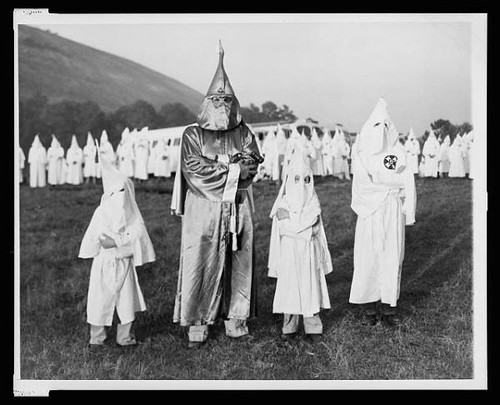
But let's reconsider the bond between the White Citizen's Council and the Ku Klux Klan. Although they both were prominent in the fight against the civil rights movement of the fifties and sixties in the American south and both were fearful of the rise of black power and their lack of economic or political power therein, the constitution of each was distinct. Whereas the latter consisted of working class men, the WCC were the powerful elite: politicians and city elders, mayors and preachers, governors and leading businessmen. The Klan worked exclusively in intimidation and brute violence. The Council was a little more shrewd, however.
However, despite these tangible differences, the two groups worked in perfect symbiosis - each rubbing the back of the other. The WCC was able to say that they don't traffic in violence by comparing themselves to the obvious terrorism tactics of the KKK. Meanwhile, they spurred violence in their rhetoric given in public speeches (which were attended by Klan members). The Council was able to use the Klan as a moral guard (See?At least we're not like them!) while the KKK was able to use the WCC as a moral impetus. The Council sanctioned the violence that the KKK carried out, but then washed their hands of the bloody affairs (with a knowing *wink*), once the shootings or lynchings occurred.
Do you sense a pattern here? It's the pattern of the powerful. D&C and then re-write history.
When they take over property and goods and resources and any other means to self-preservation, they set themselves up as experts and gods. Then they tell those they've dis-empowered from that their real enemies are those people in even worse conditions. Then they watch, disengaged, as those struggling groups rip each other apart.
Of course, if the poor White and Black groups could work together, they'd be unstoppable and they could be secure in having enough food and land to secure what they need. But as long as the elite kept the poor whites and blacks fighting for scraps... well, people are hungry.
In my religious tradition - or at least for the last thirty years - that's meant that a Francis Schaeffer or a Chuck Colson or a Jerry Falwell or a James Dobson will tell the rest of us who or what our "real" enemy is.
And though they'd NEVER {faint} approve of violence against Muslims or homosexuals, they lobby violently against them, doing actual damage of ostracizing, maligning, and humiliating those who are different. Non-Christians and non-straights are scorned and denied basic civil rights that others hold. Constantly held in contemptible suspicion, these crews are perpetually suspended in a secondary citizenship status specifically because conservative Christian leaders aim to maintain their power base of fear. And that's just their direct actions, - the specific lobbying and ignorant preaching against homosexuals, against Muslims and other non-Christians (secular, atheists, Buddhists, etc.), often against the poor, against those whom may threaten communism.
None of these tactics or topics, are advocated by Jesus, of course. But that doesn't keep them from being top priorities for the so-called Moral Majority.And if the leaders say those things are evil from their (bully) pulpits, what can the congregants do but to listen? And then to attack and hurt and bomb the mosques, or mock the little "butch" girl until she hangs herself.
This is the face of bullying. Bullying works most efficiently when it's a scare tactic of the powerful to maintain their own power and keep the rest of us occupied.
And so, (dialectic history lesson approaching!) a couple years ago, when Obama began in office and he was extremely popular, Newt Gingrich, of all people, figured that Republicans can attack Obama and, in so doing, may recover some prominence. He was right, politically speaking. By blocking and obstructing the Democratic Party, the Republican Party actually may have prolonged the recession (though that is debatable), slowed down any growth for many middle class and working-class families, and made Democrats look like spineless cowards. It worked in that sense, but it has done tremendous harm to the typical American family while income inequality has spread incrementally even more so.
The rich are getting richer and the poor are getting poorer. And Newtron Gangly actually helped to make that possible.
So, what is his solution? Fire unionized janitors at schools and hire the students to clean up the schools. Because, he reasoned, inner city students (read: African American and Latino youth and children) are surrounded by inner city adults (read: African American and Latino adults) and therefore, have neither an innate desire to work for pay* nor any role models to teach them how to do an honest day's worth of legal labor. Never mind that this isn't true in the least (we will get to that in a separate blog), but the fact that he was scolded off the planet and IN FACT leads the Republican nomination now does not bode well for our country.
But it's okay, right? Because Gingrich's hands are clean. He's not going to actually go out and personally intimidate young children of working class, Black and Latino kids and refuse to acknowledge their humanity. Right? And his party would NEVER intentionally kick out large swaths of working middle-class African Americans, while simultaneously blaming them for every social evil in the planet - therefore setting the stage for a violent confrontation over non-existent means to survive. Because that would be evil. Right?
So, yeah, N00t is trying to re-write history. And if we don't learn and share the lessons of history - of how the powerful elite claw and maintain their power through our shared sacrifices and in-fighting - then we will continue to lose out.
Ok, the title is a bite of a mislead. I'm not talking about a religious CIA, Glenn Beck's secret caliphate, or men who give each other a high five after mutilating female genitalia. In fact, neither am I making an inter-religious pantheistic call to uniformity.
Rather, I just want to evoke the image of Dr. King's Brotherhood of Man language. For me, being raised in a fundamentalist Christian church, the BoM thought is nothing short of revolutionary - and somewhat heretical. I had normally reserved the title of brother/sister only to fellow Christians. Or, how I would define "Christians", which was an extremely narrow scope and excluded most of the Church. Martin Luther King, Jr. was referencing the fact that we are all connected and that when one is affected, we all are. Jesus called this being neighbors, and he himself extended this intricate connection to everybody - including both the Enemy and the Other. But seeing all the hubballoo that Christias make over the Other/Enemy, I'm not sure the revolutionary message has sunk in.
A recent example of this contradiction between what American Christians profess to believe and what they actually support can be termed the Terror Turkey episode.
This turkey is ready to attack!
When outraged and hysterical blogger Pam Geller mentioned that Butterball brand makes some turkeys halal-friendly, a small but vocal group of concerned anti-Muslim citizens became very, very alarmed. Watching it unfold was like a hysterical, sad, and daunting replay over the Cordoba House once again. Maybe it'd be progress for the American people to recognize just how awful the Islamaphobes are. Maybe it's progress that only a few people and outlets - the ironically-named American Thinker, worst person in the world Bryan Fischer - gave ANY credence to this story. Maybe it's progress that the Boycott Butterball Facebook page only had a few hundred fans, even though it was set-up by the main accuser, Gilly-Geller, herself.
But more likely, the story itself was just too outrageous and stupid to spread beyond the most virulent Muslimaphobes - the people who hate Muslims and Arabs so much that they've lost all sense of grounding in reality. You would think that was true of the story of the Cordoba House a bit over a year ago, though.
In case you' ve forgotten about the story of the Cordoba House initiative or, more likely, you recognize it according to the name that it got popularized by thanks to sensationalistic and garbage media outlets, here is a refresher:
The Cordoba Islamic community in Manhattan has been around for a hundred years. American Muslims, they were seeing that, unlike many other religious and ethnic groups in the city, there were no options for their kids to hang around and learn about their culture and religious background. They wanted to give them a community center, not unlike Christian-based ones in my neighborhood. A place to play sports and receive tutoring and just feel safe from the streets and unreceptive bullies and bigots. Additionally the comunity center would be open for all in order to spur religious/cultural dialog between members of the area. Additionally, the initiative was spurred by a Muslim who worked as a translator and aid for the CIA following the 9/11 attacks. This man was comended by none other than President Bush and even Glenn Beck.
But then the rabid Muslimophobes struck, starting with Gilly. They called the community center a Mosque (a house of worship that is somehow scary largely because it's a house of worship for Muslims. And all Muslims, we are told, hate Americans and most are terrorists. Amirite?? no, of course not) and the Muslimophobes called the center a 9/11 memorial, supposedly built on the land that Muslims conquered - even though it was several blocks from the actual site of the World Trade Center. Which, in Manhattan, constitutes as miles and miles away.*
And the rabid Muslimophobia went viral. Hate became the flavor du jour and buildings were burned and painted with the efficacy of bigotry. Meanwhile, the "good" Christians of the community washed their hands when they didn't blame the Muslims for provoking their own attacks.
The problem was hardly that a sensationalistic 24 hours news channel and its related blow-hards decided to focus on this. It's that any Americans, let alone Christian Americans, listened to them and gave them credence.
I'd like to think that we've evolved past that bigotry. That maybe the lack of approval for Pam's latest round of repressed kinkiness was due to the fact that most Americans don't know what a halal is. And that quite a few who bother to research it would find that it's largely indistinguishable from the kosher process.
But then there's the glowing, inescapable fact that churches in Michigan have tried to excuse themselves from anti-bullying laws in the state. On the grounds, of course, that it's okay to intimidate a non-straight if god says it's okay.
In other words, it is okay to not follow Jesus' primary commands when we can justify it on grounds that completely contradict the commandment of Jesus. It's okay to lie about, intimidate, harass, scare, and publicly humiliate Muslims and transvestites and pre-teen lesbians and Wiccan teens as long as we can pretend that we love them.
Not to put too fine a point on it, but why do Christians - the very people who are supposed to follow the Prince of Peace, have such a violence fetish? Why is it that when we feel offense, it becomes a war?
The Culture Wars.
The War on Christmas.
The War on the Unborn.
The War on the Family (which is actually a war by certain Christiansagainst families that don't match up to their definition of family).
Are we even aware of what actual war actually is?
War is murder. War is ravaging. War is destroying everything good. War is rape. War is burning flesh and starving babies and choking on gasses and surviving shrapnel. War is severed limbs and lost friends.
War is something that I severely do not want my daughter to have to face. It is something that I've personally long conscientiously objected to. It's something that I don't wish on my worst enemies.
So I have to ask: In comparing a perceived (but not real*) slight to our religious sensibilities to war, are we trying to trivialize the horribleness of war - and dehumanize the very people affected by it - or are we fetishizing violence to the point of looking for fights where there is none in the hopes of getting our kinks?
---------------------------------------------
*"Happy Holidays" is an inclusive manner of greeting someone in a pluralistic society during a holy season. Meaning that those that celebrate Christmas are not excluded, but rather others who celebrate another tradition are added and not excluded.
The question is, of course, irrelevant. Christmas started as a pagan ritual that became Christianized. Unlike Easter, there is nothing specifically holy or appropriate about the season or the date. No mythos that connects the birth of the god-man to the beginning of winter, no biblical tradition, no holy connection. Which doesn't keep it from being what one wants it to be, but it is not explicitly a holy season for Christians. Therefore, there is no true reason to argue that "Jesus is the Reason for the Season." Especially since there are other, specifically non-Jesus-y, reasons for the season*.
Earlier this week, a friend and I were discussing my daughter and what she looks forward to - or may look forward to - for the upcoming season. I grumbled something about her expecting Santa (aaargh!) and snow (also, aaarrrgh for us Chicagoans). But then my friends talks brightly and fondly about watching the Christmas classics on TV. And this, oddly enough, flashes my mind with images and emotions related to watching Star Wars (NOT the infamous Holiday Special one) on our black and white telly in the early 80's, pre-VCR. Not to mention Charlie Brown's Christmas classic, or The Grinch, the Christmas Carol with the really freaky Ghost of Christmas to Come in the Joe Black trench coat. Of course, we shan't forget little Ralphie and his Christmas Story.
I cherish and idolize my memories of watching these fantastic stories and their fantastic sets and worlds (early Lucas re-interpreting cheesy sci-fi and Chuck Jones interpreting Charles Schultz and Dr. Seuss, especially. But also Vince Guaraldi, and hilarious word-play like "'Frajily.' It must be Italian."), but especially in the settings where I watched them: with my cousins, my aunts and uncles, my brothers, mom and dad, and grandma. Christmas was for family reunions.
That's what Christmas has meant to me. For my friend, the best part of the season was the fact that her mother relinquished control of her telenovela addiction to allow my friend and her sisters to watch Christmas specials with their only television.
The point being, there is no such thing as the REAL meaning of Christmas. Christmas and the rest of the holidays are as subjective, as meaningless or meaningful as you want them to be.
For me, for now, however, I choose to let the season be more about focusing on what it means that God would submit himself to humanity in the frailest of ways. Not so much Christmas as a supposed holy day, but the notion and contemplation of the birth of Jesus. That, in part, is what this season means. And I'd like to let that influence the rest of me.
-----------------------------------------------------------------
*More on that later. But here's a hint: Credit/Cash/Money/Buy/Spend
There's a lot to hate about the so-called War on Christmas. I hate the trolling and looking for fights where there are none. I hate the misplaced anger. I hate the out-of-whack priorities. I hate the violent-centric, bloodlusty name.
There's so much more and I could do a series on it*. Fortunately our friends at The Christian Left introduced us to a blogger calling him(her?)self Fat Pastor, who addressed many of these issues wonderfully three years ago.
If you want to keep Christ in Christmas, worry about things more important than the signs and decorations at JC Penney. You think Christmas should be about Christ? Then take up your cross and follow Jesus – not into department stores, but into the prisons, the hospitals, among the poor and the outcast. You get angry when someone doesn’t say “Christmas?” Try getting angry over Christ’s children dying of malnutrition or AIDS. Try getting angry over the fact that the Christmas chocolate you love so much was kept cheap on the back of the working poor. Try getting angry over the fact that Christians are keeping people out of churches with their closed minds and closed doors.
You want to keep Christ in Christmas? Try putting Christ in your life first. Then we’ll talk about how to greet each other. And if you want a truly Christian greeting, one that makes no mistake whether or not you follow the Christ child, try, “the peace of Christ be with you.”
Eerste Wereldoorlog, gewonden
Question for today: What do you hate about the "War on Christmas"?
Saturday is being promoted as a day to shop local, independent and small businesses. I've only recently heard about this, and even more recently heard about the fact that American Express, of all the Evil Financial Institutions* is one of the main sponsors for this event.
Since we've been speaking about moving in a local, democratic process for the last three months or so, I like to think that Left Cheek has been responsible for the popularity of this movement....
In either case, where are you shopping tomorrow? I'll be paying Miss Geri's Dance Studio for another month of service (for my daughter, that is) and grabing some java at Cafe Mustache, rather than DD or Starbucks. Outside of that, I'm not sure yet.
*AE charges the highest percentage of all the major credit cards, which would seem to make struggling smal businesses least likely to work with them...
Let's role play a scenario that I see, on average, at least twice a week on the webz.
Jan (Person of color): Did you hear/see that? I find that comment directed at my race to be incredibly insensitive and hurtful.
Jim (Person not of color): Stop being so sensitive. Must you throw out the race card?
It's a weird counter-argument. But it's also horribly inhumane. Without a trace of irony - and most likely without noticing it - by trying to prove how Jim isn't really racist, he actually demonstrates just how racist his frame of reference is.
Let's break it down, shall we?
Jan is hurt by remarks that she is quite aware are directed at her race/family/ethnicity/culture/identity group.
Jan lets others know, that may not know, how hurt she is by the offending statement.
Jim is offended (OFFENDED!) that Jan is offended by such a statement.
Jim does not understand why Jan should be upset as he does not share her cultural or historical background.
Rather than taking Jan seriously as a real, adult human being with actual feelings and emotions and intelligence, he continues to downgrade not just Jan's feelings as being less than legitimate (which leads Jan to feel like less of a person, at least in Jim's eyes), but also Jan's history, culture, family, and humanity.
Jan is not a legitimate person in the eyes of this white person.
Jan is led to believe - and with good reason - that Jim does not trust her accounts of her own experience and reaction simply because Jan is a different race or ethnicity.
This, in effect, is what racism is, what white supremacy is. It is also a sign of sexism. In this regard, Jan is doubly cursed.
A similar scenario can also be played out according to class or sexual identity, for instance). But it's been ridiculous efforts like Rush Limbaugh's "uppity" comments - directed at the First Couple and only at them - and the refusal of specific white Christians to acknowledge that that phrase is used disparagingly toward Black people who are perceived to rise above their station. In fact, judging by the responses I've seen from several paleo-conservative white male Christians, they don't give a rip about the hurt that that phrase causes African Americans.
Add to that, Thanksgiving is once again upon us and we still, in 2011 AD, mock and ridicule the very tribes and nations that were in the Americas first. Those very people that we systematically wiped out through assimilation and murder. And - adding insult to those injuries - we continue to mockingly dress our sports mascots as racist caricatures of "savage" Indian chiefs. A continuation of a history of profiting from the humiliation and exploitation of those we've been oppressing.
When the First Nation tribes and people inform the alumni and students, universities, and professional sports teams that the mascots and mock-ceremonial actions are offensive to the very people that are being caricatured, the white men invariably answer, "No, they aren't. You aren't really offended."
Excuse me. But I have to ask my fellow white males, "WHAT THE FRAPPIN' HELL ARE YOU THINKING?"
Who do we think we are to tell others what they should be offended by when we're offending them, both historically - and because we choose to ignore their histories - currently? Especially after hundreds of years of oppression, genocide, slavery, removal, segregation, and utter marginalization. And now we White people want to act like everything's cool between us and the people we've marginalized and profited from - when it's obvious that we are only continuing the same acts of aggression?
Jesus turned to Peter and said, “Get away from me, Satan! You are a dangerous trap to me. You are seeing things merely from a human point of view, not from God’s.”
Then Jesus said to his disciples, “If any of you wants to be my follower, you must turn from your selfish ways, take up your cross, and follow me.
- Matthew 16 [New Living Translation]
I know it's a bit faddish - or at least that's what I've been told - but I prefer being called a Christ-Follower to being called a Christian. Although there are many reasons to hold onto the typical label*, the term Christian gives off the impression that conversion and purification is something that has happened at a specific moment in time. It is as if I've been Jesus'ed - as if Jesus had happened, and there is nothing else to be done. A moment in time, a simple prayer, some recitation and closed eyes and it's over. The rest is just waiting to happen.
But Jesus called his disciples to follow him. Daily. The book of Philippians instructs us that we are to follow in Jesus' acts of humility. Jesus told his first followers to pick up their crosses of sacrifice and forget the ways that the harsh, cruel, cynical world was teaching them. The world taught them to act in bitterness, told them to love and accumulate power, to bow down before the emperor as if he was a god.
And it only makes sense to, right? After all, the king's seat is the center of power and wealth. And if those are good things, surely those who control them are blessed by the gods, right?
Rather, Christ's followers are to follow him in submission. We see how the God-man acted in his sacrifice - in his actions of becoming a lowly, working-class "slave". In his
We are to follow him by turning our backs on the ways of the world and towards the things of God.
Although many Christians would agree with that assessment, I'm not sure they understand what the ways of the world are. And I'm particularly troubled that they may not understand what the ways of God are - whom God values and treasures. So though their intensity in the struggle may be commendable, the direction of their struggle can be easily misguided. We've gone very far, but in the wrong direction.
Jesus made it clear that his way is the way of the humble, the meek, the lame, the blind, the outcasts, the poor, the shepherds, the prostitutes, the dirty protesters, the aliens, the outsiders, the rejects, the mentally handicapped, women, people who look different than us, who sound different than us, those whose ways are strange to us...
According to Jesus and his early followers:
We cannot worship both wealth and God in our churches - or our politics.
We cannot consume all the world's resources while most of the world starves and follow the same Jesus who reviled gluttony and sided with the poor. That's gluttony. The US must repent, starting with Christians, for our consumptive culture.
We cannot simultaneously hate Arabs and Muslims and claim to love Jesus.
We cannot bear false witness while honoring the ten commandments. Such bold lies as when we allege that Muslims are trying to take over the Western world. Or that Sharia Law is a danger to the US Constitution. Or that Islam is a cult. No religious group that has been around for over a hundred (er, thousand) years and has over a million followers (let alone a billion) can be reasonably called a cult by any reasonable explanation.
We cannot mock homosexuals and yet keep the two commandments (Love God, love neighbors).
We either follow the desires of the world - fame, money, wealth, exclusion, power, gratification - or of Jesus - inclusion, healing, peace, service.
I am not suggesting that I am wonderfully following in these ways. I recognize that I let my anger and rage - often a selfish-influenced anger - get the best of me. I recognize and know my short-comings - or at least a few of them. I feel as if I've only crawled five miles in the general direction of Jesus. But that's not what this is about. This is about the error, the sin, of letting the sins of the prevailing culture - the ways of the world - take precedence over the gospel of freedom and deliverance for all - including the poor, the outsiders, the aliens, the sick, the hungry, the cold, the imprisoned, the lepers...
------------------------------------------------------
*The sense of identification, the family, the history, the traditions, the security, etc. These are not bad in and of themselves and are in many ways a positive benefit of belonging to the universal church. In fact, in general they are good and necessary, and with a bit of soul-searching (apologizing and making up for past and present abuses, for instance) these attributes can once again be a blessing to the world and the name of Jesus. For now, however, we have some demons to exorcise.
Skinny barged into the apartment and found me crouching on the sofa while my one year old was busy tearing down - and tearing up - any books in her reach. Skinny didn’t live with us anymore - but he still had keys - and he still came in whenever he felt it appropriate. He still does, actually. And that fact, and he, are a God-send.
“Yeah, I know how you feel,” he shared in his slow, low, slightly-Spanish accent.
That meant something profound and significant.
At a time when I felt I couldn’t find anybody who understood my depression - not even myself - Skinny was there. He knew of the ravaging effects of depression. He spent months in solitary confinement, and was still feeling the effects of that. I couldn’t hide who I was or what I was going through with Skinny.
During the swank of the summer, Kiki swung by as a respite from the swamp-like heat-wave invading her non-AC apartment. I asked her to spend the night so that she could finally get some sleep. But after she accepted (yeah, I really had to twist her arms to do that), I wondered where I would sleep if my wife and I had a fight that night. There are times when I grab a blanket and lay on the couch more often than I care to admit.
It’s easy - when neither of us are at a place where we can communicate fully and well - for me to move my frustrations to the couch. Lot less messier than yelling or letting my frustrations get the best of me, and maybe a spot in the wall as well.
In my depression, I just want to be left alone.
But living in community does not afford me that option. It doesn’t allow me to hide. To cover my shame. Or desperation. To be secretive. Or to disappear all together.
I bring up both Skinny and Kiki because, both being chronically depressed, they have both benefited and assisted our community.
And because, in times like now, I am deeply indebted to them for their support of me and my family.
The blog was inspired by a post from current presidential candidate Herman Cain where he blathers on about things he doesn't seem to understand:
For over 2,000 years the world has tried hard to erase the memory of the perfect conservative, and His principles of compassion, caring and common sense.
Of course, the brilliance is that Jesus didn't use what we would refer to as "Common Sense." Certainly not what politicians and pundits mean when they say "Common Sense." In fact, it's quite the opposite from how the world operates and thinks. We have a limited imagination, and we are influenced by the Powers That Be to think that power comes only through violence and coercion. That hope ends when the figurehead is murdered (or when the centralizing area - say Zacutti Park - is shut down). That turning the other cheek is weak. That miracles don't happen and faith and hope are silly - or that we should only have faith and hope in future, otherworldly events without corresponding and revolutionary actions in the here and now.